
Thomas Midgley
American mechanical and chemical engineer who developed tetraethyl lead and some of the first chlorofluorocarbons (CFCs) · 1889–1944
- Born
- May 18, 1889
- Died
- November 2, 1944
- Country
- United States
- Section
- Chemistry
Biography
Thomas Midgley Jr. (Beaver Falls, Pennsylvania, 1889 - Worthington, Ohio, 1944) was an American mechanical and chemical engineer whose inventions shaped the air of the twentieth century. He is remembered for two products: tetraethyl lead, an additive that stopped engines from knocking when mixed into petrol, and the first chlorofluorocarbons (CFCs), sold under the name Freon. Both were hailed as technical triumphs in their day, and both were later restricted because of their damage to human health and the environment.
Midgley came from a family of tinkerers. His father worked on automobile tyres, and his maternal grandfather had patented a saw with inserted teeth. He grew up in Columbus, Ohio, and graduated in mechanical engineering from Cornell University in 1911. He liked finding practical uses for substances that were already known. As a schoolboy he chewed slippery elm bark and rubbed it on baseballs to make them curve more, a trick that professional pitchers later copied.
In 1916 he joined General Motors and worked at the Dayton Research Laboratories under Charles Kettering. The engineers wanted to stop knocking, the early ignition of fuel in the cylinder that wasted power and damaged engines. In December 1921 Midgley found that adding tetraethyl lead to petrol prevented it. The company branded the additive 'Ethyl' and kept the word lead out of its reports and advertising. Together with oil firms and carmakers, it promoted the additive as a cheap alternative to ethanol, which offered less profit.
The discovery brought him the American Chemical Society's Nichols Medal in 1923, the first of several honours. The costs, however, appeared quickly. Workers at the Dayton pilot plant, at DuPont's factory in Deepwater, New Jersey, and at the Bayway plant run by Standard Oil of New Jersey suffered poisoning, and several died. Midgley was himself poisoned and took a long rest in 1923 to recover. Even so, in October 1924 he staged a press conference in which he poured tetraethyl lead over his hands and breathed its vapour for a full minute, claiming he could do so every day without harm. Within days, New Jersey authorities ordered the Bayway plant closed. The demonstration is now seen as misleading.
He then turned to refrigerants. In the late 1920s, cooling systems used ammonia, chloromethane and sulphur dioxide, which worked well but were toxic, flammable or explosive. Frigidaire, a General Motors division, wanted a safer option. With chemist Albert Leon Henne, Midgley focused on alkyl halides, compounds that evaporate easily, a requirement for a coolant, and that barely react with other substances. They added fluorine to these hydrocarbons, trusting that the very stable carbon-fluorine bond would stop the release of hydrogen fluoride, a toxic gas. The result was dichlorodifluoromethane, the first CFC, which they named Freon. The Society of Chemical Industry gave him the Perkin Medal in 1937 for this work.
CFCs soon replaced older refrigerants and spread to aerosol sprays and asthma inhalers. Their effect on the ozone layer was unknown at the time. In 1940, aged 51, Midgley contracted polio and lost the use of his legs. He designed a system of ropes and pulleys to lift himself out of bed. On 2 November 1944 he was found dead at his home in Worthington, Ohio, strangled by the apparatus he had built. The coroner ruled it a suicide, although the accident version is still widely repeated.
His legacy is uncomfortable. The historian J. R. McNeill wrote that he had more impact on the atmosphere than any other organism in the history of the Earth. The Montreal Protocol of 1987 began limiting CFCs, and leaded petrol was gradually withdrawn from the 1970s onwards.
Main contributions
- 1921Tetraethyl lead as an anti-knock additive for petrol: a compound that stopped the knocking of internal combustion engines.
- Chlorofluorocarbons (CFCs): a family of gases, such as dichlorodifluoromethane or Freon, used in refrigeration, aerosols and inhalers, developed in the late 1920s.
- More than a hundred patents over the course of his career, including those for his additive and refrigerant work.
Trivia and anecdotes
Curveballs from bark
As a teenager he rubbed chewed slippery elm bark on baseballs so that they would curve more sharply.
A one-man disaster
Writing for New Scientist, Fred Pearce described him as a one-man environmental disaster.
An instinct for the regrettable
Bill Bryson remarked that Midgley had an instinct for the regrettable that was almost uncanny.
Their contemporaries
While Thomas Midgley was alive (1889–1944)…
Alive at the same time
Discovered or invented in those years
- 1897ElectronA negatively charged subatomic particle found in every atom, and key to electricity and chemical bonding.
- 1903AirplaneA fixed-wing aircraft, heavier than air, powered by engines or rockets, that stays aloft because its wings generate lift.
- 1916Black holeA region of space where gravity is so strong that nothing, not even light, can escape once it crosses a certain boundary.
- 1925TelevisionA system that sends moving pictures and sound over distance and shows them on a receiver, the television set.
- 1925Quantum mechanicsPhysical theory describing how matter and light behave at atomic and subatomic scales, where energy is exchanged in minimal packets and results are expressed as probabilities.
- 1931Big BangA cosmological model describing how the universe expanded from an early state of extreme density and temperature, about 13.8 billion years ago.
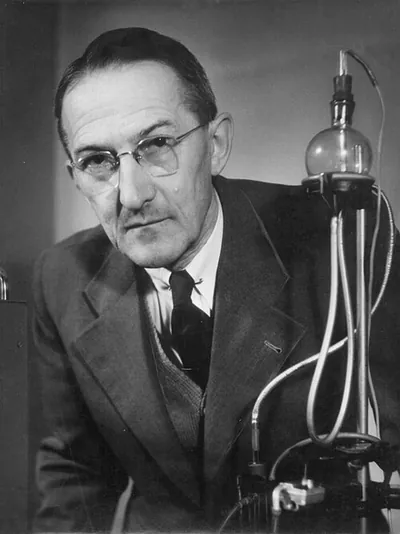 Jaroslav Heyrovský1890–1967 · Chemistry
 Harold Urey1893–1981 · Chemistry
 Peter Debye1884–1966 · Chemistry
 Wallace Carothers1896–1937 · Chemistry
 Cyril Norman Hinshelwood1897–1967 · Chemistry
 Otto Hahn1879–1968 · Chemistry
