
Tracy Hall
American physical chemist who made the first reproducible synthetic diamond · 1919–2008
- Born
- October 20, 1919
- Died
- July 25, 2008
- Country
- United States
- Section
- Chemistry
Biography
Howard Tracy Hall (born in Ogden, Utah, on October 20, 1919; died in Provo, Utah, on July 25, 2008) was an American physical chemist who, in 1954, produced synthetic diamonds in a reproducible and verifiable way, using a high-pressure press of his own design. His work opened the way to today's industrial diamond industry, which supplies cutting and drilling tools, at a time when high-pressure chemistry was advancing quickly.
Hall grew up on a farm in Marriott, Utah, in a family of Mormon pioneers. He reportedly told his classmates in fourth grade that he intended to work for General Electric, a goal he later achieved. He studied for two years at Weber College, then earned his bachelor's degree at the University of Utah in 1942 and his master's the following year. After two years as a naval officer in the U.S. Navy, he returned to the same university in 1946 as the first graduate student of Henry Eyring, a highly influential chemist, and earned his PhD in physical chemistry in 1948.
Two months later he joined the General Electric Research Laboratory in Schenectady, New York, on a team called Project Superpressure and led by engineer Anthony Nerad. The aim was to make synthetic diamond, that is, to recreate in a laboratory the pressure and heat that form diamond deep inside the Earth. For almost four years, the group of about half a dozen researchers went through failed experiments, growing impatience from management and rivalries among colleagues.
Hall's breakthrough, in his own account, came from insisting on his own approach. He redesigned the press with a doughnut-shaped ring around the sample chamber and two curved, tapered pistons that squeezed it. He quietly machined a first hardened steel version, and later management approved a tougher and far more expensive version in tungsten carbide. His experiments, however, were moved to an old, leaky 400-ton press instead of the new thousand-ton machine his colleagues used. Hall himself described being pushed aside in this way.
On December 16, 1954, he made synthetic diamonds. He used iron sulfide and powdered carbon as the starting material, and tantalum disks that carried electric current to heat the cell. The run reached about 100,000 atmospheres and 1600 degrees Celsius and lasted roughly 38 minutes. When the sample was opened, octahedral diamond crystals were found on the tantalum disks, which apparently acted as a catalyst, a substance that speeds up a reaction without being used up. As with many important inventions, the exact circumstances of the synthesis have been debated by those involved.
In 1955 he left General Electric to become a full professor of chemistry and research director at Brigham Young University. There he invented the tetrahedral press in 1957 and helped found companies making industrial diamonds and drill bits, including MegaDiamond and Novatek. In 1976 he was ordained a minister of The Church of Jesus Christ of Latter-day Saints, a role he held for five years, and later served a church mission in southern Africa with his wife, Ida-Rose Langford, whom he had married in 1941. He died in Provo at 88, leaving seven children, 35 grandchildren and 53 great-grandchildren.
His legacy is twofold: synthetic diamond moved from a laboratory dream to an industrial material, and his high-pressure apparatus helped open a new era of research under extreme conditions. He received many honours, including the American Chemical Society's award for creative invention in 1972 and the James C. McGroddy Prize from the American Physical Society in 1977.
Main contributions
- 1954First reproducible synthetic diamonds, made from carbon and iron sulfide in a high-pressure press.
- 1957Tetrahedral press, a high-pressure apparatus with four anvils that squeeze the sample.
- 1960Patent for the method of making diamonds, filed with Herbert Strong and Robert Wentorf.
- 1964Patent for the high-pressure press, a design that influenced industrial diamond production.
Trivia and anecdotes
A savings bond
According to his own account, General Electric rewarded him with a 25-dollar savings bond for an invention that brought the company a fortune.
A childhood announcement
It is said that, while still in fourth grade, he announced he would work for General Electric, which he eventually did.
Their contemporaries
While Tracy Hall was alive (1919–2008)…
Alive at the same time
Discovered or invented in those years
- 1925TelevisionA system that sends moving pictures and sound over distance and shows them on a receiver, the television set.
- 1925Quantum mechanicsPhysical theory describing how matter and light behave at atomic and subatomic scales, where energy is exchanged in minimal packets and results are expressed as probabilities.
- 1931Big BangA cosmological model describing how the universe expanded from an early state of extreme density and temperature, about 13.8 billion years ago.
- 1945ComputerA programmable machine that takes in data, processes it by following stored instructions, and produces results, able to switch tasks simply by running different software.
- 1969InternetA global network of interconnected computer networks that communicate using the TCP/IP protocol suite.
- 1989World Wide WebA system of linked documents and resources, connected by hyperlinks and accessed over the Internet with web browsers.
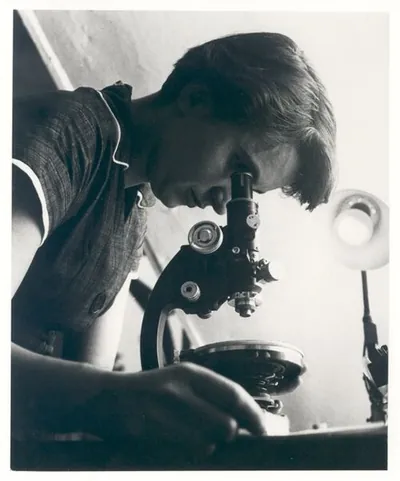 Rosalind Franklin1920–1958 · Chemistry
 Derek Barton1918–1998 · Chemistry
 Robert Burns Woodward1917–1979 · Chemistry
 Ilya Prigogine1917–2003 · Chemistry
 John Pople1925–2004 · Chemistry
