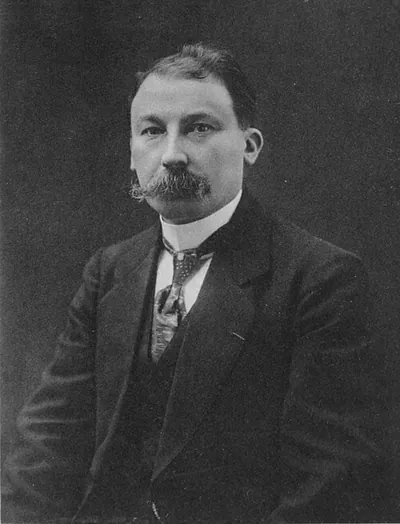
Victor Grignard
French chemist, creator of Grignard reagents and 1912 Nobel laureate in Chemistry · 1871–1935
- Born
- May 6, 1871
- Died
- December 13, 1935
- Country
- France
- Section
- Chemistry
- Awards
- Nobel Prize in Chemistry
Biography
François Auguste Victor Grignard (Cherbourg-Octeville, 1871 – Lyon, 1935) was a French chemist whose name is attached to one of the most useful methods for building organic molecules. He worked at the turn of the twentieth century, when France was investing heavily in university and industrial chemistry, and in 1912 he shared the Nobel Prize in Chemistry with Paul Sabatier. His reagents remain in everyday use in laboratories and factories around the world.
The sources disagree about his father's trade: one describes him as a worker in the Cherbourg shipyards, another as a sailmaker. Grignard showed a strong talent for mathematics from an early age. After trying to specialise in that subject and failing his entrance examinations, he did his compulsory military service in 1892. On his return to the University of Lyon he earned a degree in mathematical sciences in 1894.
That same year he switched to chemistry under Philippe Barbier and Louis Bouveault. He first worked on stereochemistry, the study of how atoms are arranged in space within a molecule, and on a class of compounds called enynes, but the subject did not hold his interest. Barbier suggested a new direction for his doctoral research: a Saytzeff reaction that had failed with zinc had worked, though weakly, when magnesium replaced the zinc. The aim was to make alcohols from alkyl halides, aldehydes, ketones and alkenes.
Grignard reasoned that the aldehyde or ketone was blocking the magnesium from reacting with the alkyl halide, which would explain the poor yields. To test this, he changed the order of mixing: he first combined the halide with magnesium filings in dry ether, and only then added the aldehyde or ketone. The yield rose sharply. A few years later he managed to isolate the intermediate, heating magnesium turnings with isobutyl iodide and adding dry ethyl ether. This organomagnesium compound, written R-Mg-X, is what chemists now call a Grignard reagent. According to the sources, the method dates to 1900, and his thesis appeared in 1901.
The reaction runs in two stages. First, an organic halide combines with metallic magnesium to form the reagent. Then a ketone or aldehyde is added, and its carbon atom, which carries a slight positive charge, attracts the carbon bonded to magnesium. Treating the mixture with aqueous acid then yields an alcohol. By joining two carbon fragments, the method allows chemists to assemble complex molecular frameworks, a task central to organic chemistry.
He taught chemistry at Lyon until 1909. He then moved to Nancy, where he became a full professor in 1910, and in 1919 he returned to Lyon, where he stayed until his death. Accounts differ on the exact dates of his Nancy years, so they should be treated with some caution. In 1926 he was elected a non-resident member of the French Academy of Sciences.
When the First World War began he was called back into the army, still as a corporal, and posted to guard railway lines. One anecdote holds that a superior ordered him to remove the Legion of Honour medal he was wearing, and that he did not do so at once. The General Staff concluded he would be more useful in research than on sentry duty and assigned him to the explosives division. When making TNT became unsustainable, his work turned to antidotes and new chemical weapons. With Georges Urbain at the Sorbonne he studied the production of phosgene and the detection of mustard gas. In 1918 he found that sodium iodide could serve as a field test: it converts mustard gas into a compound that crystallises more readily, and the test could detect as little as 0.01 grams per cubic metre of air. His German counterpart in this work was another Nobel-winning chemist, Fritz Haber.
In 1912 he received half of the Nobel Prize for his studies of alcohols made through his reaction. The other half went to Sabatier for a method of hydrogenating organic compounds using metals as catalysts. That year he also received the Lavoisier Medal from the French Chemical Society and was named a Chevalier of the Legion of Honour, rising to Commander in 1933.
He died in Lyon on 13 December 1935, aged 64. By then roughly 6,000 papers had reported applications of his reaction. Under his direction the multi-volume Traité de chimie organique was published between 1935 and 1954, running to 23 volumes. Today his name survives in the Grignard reaction and reagents, in an asteroid (10305 Grignard) and in a lunar crater.
Main contributions
- 1900Grignard reaction: a method using magnesium to join carbon atoms, turning aldehydes and ketones into alcohols.
- 1901Doctoral thesis on mixed organomagnesium compounds and their use in making acids, alcohols and hydrocarbons.
- 1912Nobel Prize in Chemistry, shared with Paul Sabatier, for his work on alcohols made through his reaction.
- 1918Field test using sodium iodide to detect mustard gas in the air.
- 1935Traité de chimie organique, a work he directed, published in 23 volumes up to 1954.
Teachers and students
Trivia and anecdotes
A defiant medal
According to one anecdote, while on sentry duty in the First World War he did not immediately remove his Legion of Honour medal, a detail that helped lead to his transfer to research.
A father with two trades
The sources do not agree on his father's work: some say he worked in the Cherbourg shipyards, others that he was a sailmaker.
Named in the sky
An asteroid, 10305 Grignard, and a lunar crater bear his name in honour of his work.
Their contemporaries
While Victor Grignard was alive (1871–1935)…
Alive at the same time
Discovered or invented in those years
- 1876TelephoneA device that carries the human voice over distance by turning sound into electrical signals and back into sound at the other end of the line.
- 1884CarA road vehicle with four wheels and its own engine, mainly built to carry people.
- 1903AirplaneA fixed-wing aircraft, heavier than air, powered by engines or rockets, that stays aloft because its wings generate lift.
- 1925TelevisionA system that sends moving pictures and sound over distance and shows them on a receiver, the television set.
- 1925Quantum mechanicsPhysical theory describing how matter and light behave at atomic and subatomic scales, where energy is exchanged in minimal packets and results are expressed as probabilities.
- 1931Big BangA cosmological model describing how the universe expanded from an early state of extreme density and temperature, about 13.8 billion years ago.
 Fritz Haber1868–1934 · Chemistry
 Marie Curie1867–1934 · Chemistry
 Alfred Werner1866–1919 · Chemistry
 Walther Hermann Nernst1864–1941 · Chemistry
 Otto Hahn1879–1968 · Chemistry
 Johannes Nicolaus Brønsted1879–1947 · Chemistry
