Vladimir Engelgardt
Soviet biochemist, a pioneer of molecular biology in the Soviet Union · 1894–1984
- Born
- December 3, 1894
- Died
- July 10, 1984
- Country
- Soviet Union, Russian Empire
- Section
- Chemistry
- Awards
- Abel Prize
Biography
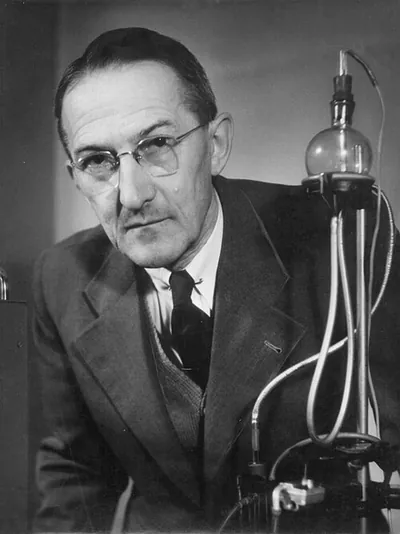
Vladimir Alexandrovich Engelhardt (also spelled Vladimir Engelgardt) was a Soviet biochemist who lived from 1894 to 1984. He worked in the first half of the twentieth century, when biology was beginning to be explained in terms of molecules, and he is regarded as one of the founders of molecular biology in the Soviet Union.
He was born in Moscow on 3 December 1894. The sources available give little detail about his childhood and academic training, so the specific stages of his early life should not be taken as certain. What is documented is that he turned to biochemistry, the branch that studies the chemical reactions taking place in living things, and became one of the best-known scientists in his country.
His career was consolidated when he joined the Soviet Academy of Medical Sciences in 1944 and, shortly afterwards, the Soviet Academy of Sciences in 1953. These honours reflect his weight in both medical research and basic science in the USSR. One of his central topics was the study of muscle tissue, a line of work that earned him the Stalin Prize in 1943.
The most significant step in his institutional career was founding the Institute of Molecular Biology of the Russian Academy of Sciences, where he served as its first director. The institute was later renamed the Engelhardt Institute of Molecular Biology in his honour. From that post he promoted research in a field that then had little tradition in the country.
His official recognition was wide. In 1969 he was named Hero of Socialist Labour, and over his lifetime he accumulated five Orders of Lenin, the Order of the Patriotic War, 2nd class, and the Order of the Red Banner of Labour. In 1968 he received the Lomonosov Gold Medal, and in 1979 the USSR State Prize.
Engelhardt died in Moscow on 10 July 1984. His legacy survives mainly through the institute he founded, which bears his name, and through his role in establishing molecular biology as a discipline in the USSR.
Main contributions
- 1943Stalin Prize for his studies of muscle tissue, a line of research to which he devoted particular attention.
- 1944Elected academician of the Soviet Academy of Medical Sciences.
- 1953Elected academician of the Soviet Academy of Sciences.
- 1968Lomonosov Gold Medal, one of his most notable scientific honours.
Teachers and students
Trivia and anecdotes
An institute named after him
The Institute of Molecular Biology he founded was later renamed the Engelhardt Institute of Molecular Biology in his honour.
Their contemporaries
While Vladimir Engelgardt was alive (1894–1984)…
Alive at the same time
Discovered or invented in those years
- 1903AirplaneA fixed-wing aircraft, heavier than air, powered by engines or rockets, that stays aloft because its wings generate lift.
- 1925TelevisionA system that sends moving pictures and sound over distance and shows them on a receiver, the television set.
- 1925Quantum mechanicsPhysical theory describing how matter and light behave at atomic and subatomic scales, where energy is exchanged in minimal packets and results are expressed as probabilities.
- 1931Big BangA cosmological model describing how the universe expanded from an early state of extreme density and temperature, about 13.8 billion years ago.
- 1945ComputerA programmable machine that takes in data, processes it by following stored instructions, and produces results, able to switch tasks simply by running different software.
- 1969InternetA global network of interconnected computer networks that communicate using the TCP/IP protocol suite.
 Harold Urey1893–1981 · Chemistry
 Wallace Carothers1896–1937 · Chemistry
 Cyril Norman Hinshelwood1897–1967 · Chemistry
 Jaroslav Heyrovský1890–1967 · Chemistry
 Linus Pauling1901–1994 · Chemistry