
Walter Houser Brattain
American physicist, co-inventor of the point-contact transistor and 1956 Nobel Prize in Physics laureate · 1902–1987
- Born
- February 10, 1902
- Died
- October 13, 1987
- Country
- United States
- Section
- Physics
- Awards
- Nobel Prize in Physics
Biography
Walter Houser Brattain (Amoy, China, 1902 - Seattle, 1987) was an American physicist who, together with John Bardeen and William Shockley, built the first working transistor. He worked at a time when electronics depended on bulky, costly and unreliable vacuum tubes, and his invention paved the way for modern electronic devices. For this achievement he shared the 1956 Nobel Prize in Physics.
Brattain was born on February 10, 1902, in Amoy, now Xiamen, in the Chinese province of Fujian, to American parents. His father taught at the Ting-Wen Institute, a private school for Chinese boys, and his mother, Ottilie Houser, was a gifted mathematician. Both had graduated from Whitman College. The family returned to the United States in 1903, lived for several years in Spokane, Washington, and settled on a cattle ranch near Tonasket in 1911. Brattain finished school in several Washington institutions and then enrolled at Whitman College, where he graduated in 1924 with a double major in physics and mathematics. Some of his classmates later had distinguished careers of their own, and the group became known as the four horsemen of physics.
He continued his studies at the University of Oregon, where he earned a master's degree in 1926, and at the University of Minnesota, where he completed his doctorate in 1929. At Minnesota he studied quantum mechanics, the theory that describes how particles such as electrons behave, under John Hasbrouck Van Vleck. From 1928 to 1929 he worked for the National Bureau of Standards in Washington, where he helped develop frequency standards based on crystals that vibrate very steadily when an electric current is applied.
In August 1929 he joined the Bell Telephone Laboratories as a research physicist. There he studied copper oxide rectifiers, devices that let electric current pass in only one direction, and how heat affects the movement of electric charges. Some of his experiments on electrons leaving heated metals supported a theory by Arnold Sommerfeld. His studies of semiconductors such as cuprous oxide and silicon led him to discover the photo-effect at the free surface of a semiconductor, one of the contributions the Nobel Committee considered most important.
Bell needed a replacement for the vacuum tubes that controlled and amplified current in telephone equipment. As early as the 1930s, Brattain worked with William Shockley on a semiconductor amplifier made with copper oxide, an early and unsuccessful attempt at a field-effect transistor. During the Second World War, both men separately researched the magnetic detection of submarines. Brattain's group built magnetometers sensitive enough to pick up the disturbances submarines cause in the Earth's magnetic field, and in 1944 he patented the design of a magnetometer head.
In 1945 Bell set up a group devoted to solid-state physics, the branch that studies how solid materials behave at the atomic level. Shockley and Stanley O. Morgan led it, and John Bardeen soon joined; he was a close friend of Brattain's brother. Bardeen was a quantum theorist, Brattain a skilled experimenter with materials, and Shockley the team leader. According to the theories of the time, Shockley's field-effect transistor should have worked, but it did not. Between November and December 1947, Brattain and Bardeen ran a series of experiments to find out why. Bardeen suggested that charge carriers were being trapped by local variations in the surface of the material.
The breakthrough came from an improvised setup. They achieved a small amount of amplification by pressing a gold point onto silicon surrounded by distilled water, and germanium improved the result, though only for low-frequency currents. On December 16, Brattain placed two gold foil contacts close together on a germanium surface. One acted as a grid and the other as a plate, and amplification required a positive bias on the grid. Bardeen later explained that the contacts introduced holes, regions of positive charge, into the germanium, and that the names emitter and collector were chosen to describe this effect. On December 23, 1947, the three men demonstrated the first working transistor to their colleagues. It is now the basic building block of modern electronics, since it amplifies weak electrical signals and helps process digital information.
At first Bell Labs kept the work strictly secret, and the patents for the point-contact transistor were registered in the names of Bardeen and Brattain. On June 30, 1948, the company announced the discovery at a press conference and adopted an open policy of sharing knowledge with universities and firms, which kept the work from being classified as a military secret. Shockley, however, insisted that he deserved all the credit, excluded Bardeen and Brattain from new research areas, and patented the junction transistor on his own. Brattain moved to another group within Bell, where he continued studying the surface properties of solids. Bardeen left the company in 1951 for the University of Illinois, where he later won a second Nobel Prize for his theory of superconductivity. Shockley left Bell in 1953 and founded his own semiconductor laboratory.
In 1956 King Gustaf VI Adolf of Sweden presented the Nobel Prize in Physics to the three men for their research on semiconductors and their discovery of the transistor effect. Bardeen and Brattain were recognized for the point-contact transistor, and Shockley for the junction transistor. Brattain is credited with saying that he was satisfied to have done something worthwhile in life, but that much of his good fortune came from being in the right place at the right time, with the right people to work with.
Apart from transistors, Brattain collaborated with P. J. Boddy and P. N. Sawyer on electrochemical processes in living matter, and he became interested in blood clotting after his son needed heart surgery. He taught as a visiting lecturer at Harvard in 1952 and at Whitman College from 1962. He retired from Bell in 1967, kept teaching at Whitman until 1976, and his name remains attached to merit scholarships at that college.
Brattain married twice. His first wife, the chemist Keren Gilmore, died in 1957, and the following year he married Emma Jane Miller, a mother of three. He died of Alzheimer's disease on October 13, 1987, in Seattle, at the age of 85, and is buried in Pomeroy, Washington.
His legacy is the transistor, a small component that replaced vacuum tubes and made possible portable radios, hearing aids and, later, integrated circuits. Brattain was above all a practical experimenter with a fine intuition for semiconductors, and his hands-on work made the invention possible.
Main contributions
- 1929Studies of copper oxide rectifiers, devices that let current flow in only one direction.
- 1944Patent for a magnetometer head able to detect submarines through the disturbances they cause in Earth's magnetic field.
- 1947First working transistor, a point-contact device built from two gold contacts on germanium to amplify electrical signals.
- 1948Public announcement of the transistor and adoption of an open policy for sharing knowledge about the technology.
- 1956Nobel Prize in Physics, shared with Bardeen and Shockley, for research on semiconductors and the transistor effect.
Teachers and students
Trivia and anecdotes
The four horsemen of physics
Some of his Whitman College classmates also went on to distinguished careers, and the group became known as the four horsemen of physics.
An intuitive hand with semiconductors
Bardeen described Brattain as someone with an intuitive feel for what could be done with semiconductors, a talent as important as Bardeen's own theoretical brilliance.
Right place, right time
Brattain is credited with saying, on hearing of the award, that much of his fortune came from being in the right place at the right time with the right people.
Their contemporaries
While Walter Houser Brattain was alive (1902–1987)…
Alive at the same time
Discovered or invented in those years
- 1903AirplaneA fixed-wing aircraft, heavier than air, powered by engines or rockets, that stays aloft because its wings generate lift.
- 1925TelevisionA system that sends moving pictures and sound over distance and shows them on a receiver, the television set.
- 1925Quantum mechanicsPhysical theory describing how matter and light behave at atomic and subatomic scales, where energy is exchanged in minimal packets and results are expressed as probabilities.
- 1931Big BangA cosmological model describing how the universe expanded from an early state of extreme density and temperature, about 13.8 billion years ago.
- 1945ComputerA programmable machine that takes in data, processes it by following stored instructions, and produces results, able to switch tasks simply by running different software.
- 1969InternetA global network of interconnected computer networks that communicate using the TCP/IP protocol suite.
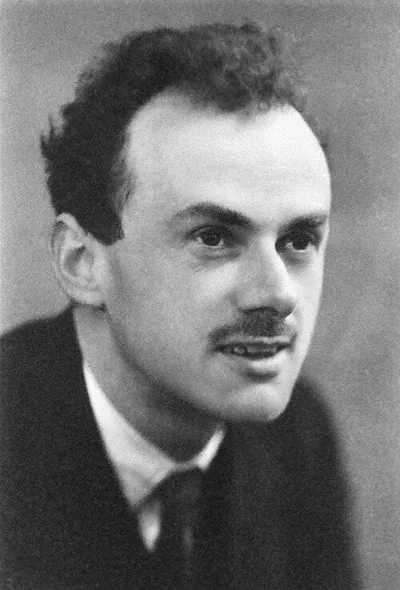 Paul Dirac1902–1984 · Physics
 Eugene Paul Wigner1902–1995 · Physics
 Enrico Fermi1901–1954 · Physics
 Werner Heisenberg1901–1976 · Physics
 Ernest Lawrence1901–1958 · Physics
 J. Robert Oppenheimer1904–1967 · Physics
