
William Kennedy Dickson
Scottish-American engineer and film director, regarded as one of the fathers of cinema · 1860–1935
- Born
- August 3, 1860
- Died
- September 28, 1935
- Country
- United States, France, United Kingdom
- Section
- Technology and communications
Biography
William Kennedy Laurie Dickson (1860-1935) was a Scottish-American engineer and film director who is regarded as one of the fathers of cinema. He worked in the last decades of the nineteenth century, when moving pictures were still experimental, and his importance lies in building some of the first cameras and projection devices that made the film show possible in the form we know it.
Dickson was born on 3 August 1860 in Le Minihic-sur-Rance, in Brittany, France, but he grew up in England. His father, James Waite Dickson, was a Scottish artist, astronomer and linguist, and his mother, Elizabeth Kennedy-Laurie, was born in Virginia. His father claimed descent from the painter William Hogarth, a link that cannot be confirmed. As a young man Dickson became an amateur photographer and followed the work of other pioneers who were trying to capture moving images.
When he reached adulthood he decided to seek his fortune in the United States. In 1879 he wrote to Thomas Alva Edison asking for work, but the reply was negative. That same year he moved with his mother and two sisters to Virginia. Edison finally hired him in 1883, and he joined the laboratory at Menlo Park, New Jersey, where he became the company's official photographer.
Edison gave him a task: to build a device that would do for the eye what the phonograph does for the ear. The first attempts involved recording micro-photographs on a cylinder, a method that proved impractical. In late 1889, after encountering the work of the physiologist Étienne-Jules Marey, Edison changed direction and ordered the team to work with rolls of flexible film. Dickson worked with the Eastman company to obtain a suitable celluloid film. He first tried a 19-millimetre format before settling on 35-millimetre film, with a picture ratio of 1.33:1, which remains a standard in cinema today.
To record movement, the camera took a long strip of consecutive frames. When the strip was played back, the viewer lit it with brief flashes through a rotating slit, which fooled the eye into seeing continuous motion. The most delicate technical problem was advancing the film from one frame to the next without long pauses and without tearing it. Dickson solved this with an escapement mechanism that held the strip still long enough to expose each image and then pulled it on in a fraction of a second. This system laid the groundwork for the stop-and-go film movement that cameras used for much of the twentieth century. Edison's patent application of 1891 gave the device its name, the kinetoscope, which was unveiled to the public in 1893.
The kinetoscope was a peep-show machine: a viewer looked through a window and saw a looped film. By the mid-1890s parlours containing these machines had become popular. Dickson turned his attention to projection so that films could be shown to large groups at once. In late 1894 or early 1895 he informally advised the Latham brothers, who ran one of the leading kinetoscope businesses, and their father, Woodville Latham. According to some accounts, he and the former Edison employee Eugene Lauste helped devise the so-called Latham loop, which allowed much longer strips of film. The idea had already appeared in 1890 in descriptions of William Friese-Greene's camera, however.
In 1895 Dickson left Edison's company. After the split he helped found the American Mutoscope and Biograph Company, which made its own films and became one of the great studios of its era. Its Mutoscope machine showed pictures from a rotating drum of photographs, similar to a flip-book, and was often placed at seaside resorts. Dickson returned to London in 1897 to run the British side of the company, and for several years he travelled and made films.
His association with Biograph ended in unclear circumstances in 1911. He then left the film industry and turned to electrical engineering. He spent his last years quietly at his home in Twickenham, England, where he died on 28 September 1935, aged 75. For a long time his contribution went largely unrecognised. Historians Gordon Hendricks and Paul Spehr documented his work in detail and showed how central he was to many key projects. His legacy lies in the 35-millimetre format, the intermittent movement mechanism, and the 1894 sound experiment in which a man, probably Dickson himself, played the violin into a megaphone linked to a phonograph. He is now recognised as a key figure in the invention of cinema.
Main contributions
- 1890A camera and viewer that used long strips of film to capture motion frame by frame.
- 1891Edison's patent for the device later called the kinetoscope, a individual viewer showing looped films.
- 1892The 35-millimetre film format with a 1.33:1 ratio, still the standard in cinema.
- 1893An escapement mechanism for intermittent film movement, the basis of filming for much of the twentieth century.
- 1894The earliest known sound film experiment, the Kinetophone, in which a violin was played into a megaphone.
- Co-founding of the American Mutoscope and Biograph Company and its Mutoscope viewer.
Trivia and anecdotes
A papal blessing
Dickson is said to have been the first person to film the Pope, and his Biograph camera was reportedly blessed by Pope Leo XIII.
A cheeky nickname
In Britain the Mutoscope machines became known as What the butler saw machines, after one of the earliest and most famous risqué reels.
A violin into a megaphone
In the 1894 sound film a violinist plays The Song of the Cabin Boy; the player is probably Dickson, though this is not certain.
Related discoveries and inventions
- 1889Movie cameraA camera that records rapid successive photographs, on film or on a sensor, so they can be played back as a moving image.
Their contemporaries
While William Kennedy Dickson was alive (1860–1935)…
Alive at the same time
Discovered or invented in those years
- 1869Periodic tableAn arrangement of the chemical elements into rows (periods) and columns (groups), ordered by atomic number, that reveals recurring chemical behaviour and lets scientists predict properties.
- 1869Deoxyribonucleic acidA double-stranded molecule that carries the genetic instructions of nearly all living things and many viruses.
- 1876TelephoneA device that carries the human voice over distance by turning sound into electrical signals and back into sound at the other end of the line.
- 1884CarA road vehicle with four wheels and its own engine, mainly built to carry people.
- 1903AirplaneA fixed-wing aircraft, heavier than air, powered by engines or rockets, that stays aloft because its wings generate lift.
- 1925TelevisionA system that sends moving pictures and sound over distance and shows them on a receiver, the television set.
 Aleksandr Popov1859–1906 · Technology and communications
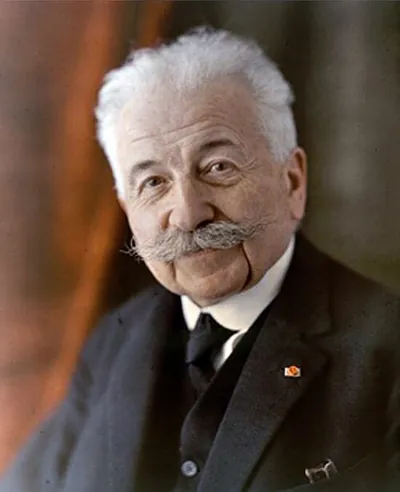 Auguste Lumière1862–1954 · Technology and communications
 Louis Lumière1864–1948 · Technology and communications
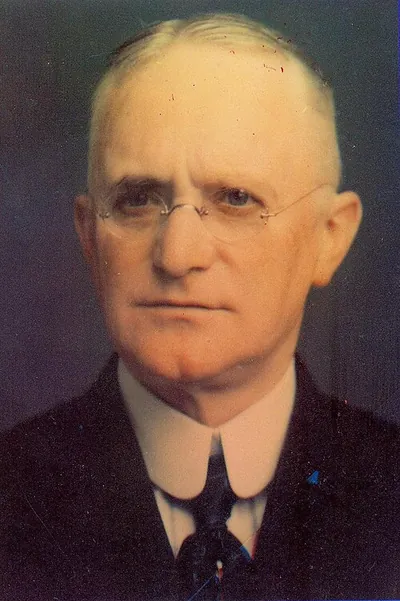 George Eastman1854–1932 · Technology and communications
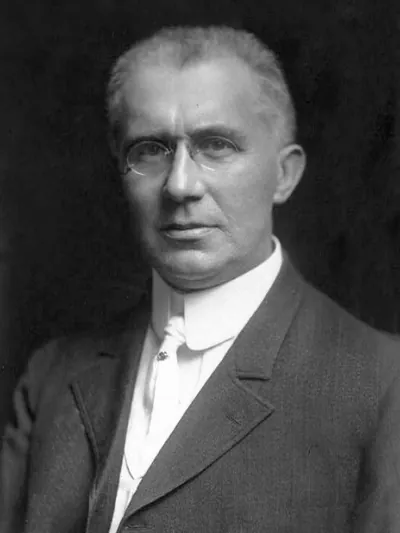 Emile Berliner1851–1929 · Technology and communications
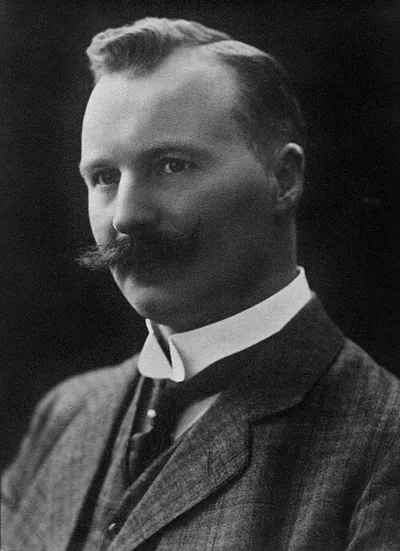 Nils Gustaf Dalén1869–1937 · Technology and communications
