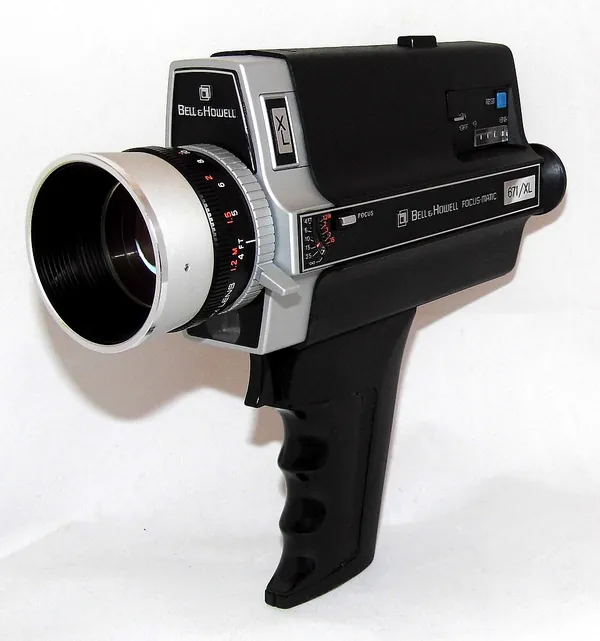
Movie camera
A camera that records rapid successive photographs, on film or on a sensor, so they can be played back as a moving image.
- Year
- 1889
- People involved
- Thomas Edison, William Kennedy Dickson
- Section
- Technology and communications
History
A movie camera is a photographic camera that takes many pictures in quick succession, so that when they are projected on a screen, objects appear to move. It matters because it made possible the motion picture as we know it. Its roots lie in optics and projection. In 1645 Athanasius Kircher described, in his Ars Magna Lucis et Umbrae, how images could be projected onto a wall in a darkened room, and magic lantern shows had long displayed pictures on screens. What was missing was a way to record real movement.
The eye and brain merge a series of still images into the perception of motion. For a long time this was explained by persistence of vision, the brief afterimage left on the retina; today it is attributed mainly to the phi phenomenon and beta movement, studied in the twentieth century. Photographers such as Eadweard Muybridge and Étienne-Jules Marey sought ways to capture such sequences. In 1878 Muybridge used a battery of twelve cameras along a racetrack in Palo Alto to photograph the racehorse Sallie Gardner at a gallop. In 1882 Marey built a chronophotographic gun that could record twelve images per second.
In 1889 William Friese-Greene patented a camera able to take up to ten photographs a second, and in 1890 he showed a model that used perforated celluloid film. That same year he sent details of his invention to Thomas Edison, who had already invented the phonograph and wanted a device that did for the eye what the phonograph did for the ear. With help from Muybridge, Edison coined the terms kinetograph for the camera and kinetoscope for the viewer. In 1891 William Kennedy Laurie Dickson, an employee of Edison, designed the Kinetograph camera. An escapement disc stopped the film long enough to expose each frame and then advanced it in about 1/460 of a second. It was the first practical system of stop-and-go film movement, and it became the foundation of cinematography for the following century.
The Lumière brothers in Lyon built on these ideas. In 1893 Georges Demenÿ proposed a film transport mechanism similar to that of a sewing machine, and Charles Moisson, chief mechanic at the Lumière factory, helped design and build the combined camera and projector they called the Cinematograph. Its film capacity was short, roughly 17 to 18 metres, because the aim was to produce brief sequences. The celluloid came from a New York company. The public screening in Paris in December 1895 is often cited as the birth of commercial cinema, though the choice of that date is a convention.
By the mid-1890s movie cameras had become a practical reality and were manufactured by several firms. Between 1909 and 1911 the Polish inventor Kazimierz Prószyński built the Aeroscope in England, the first successful hand-held film camera, which did not need a crank turned to advance the film, so the operator could use both hands. The Bell & Howell Standard of 1911-12 was the first all-metal cine camera. From about 1929 Mitchell cameras were widely used for newsreels and Hollywood films. During the Second World War, field cameramen working for Germany used the Arriflex 35, whose mirrored shutter allowed the operator to see exactly what was being filmed, a feature now common in cameras.
Inside the camera, the lens carries light to the film, the shutter lets light in only while the film is still, and claws pull each frame into the exposure window. Because the film is under strain when it moves in jerks, loops are formed on either side of the window so that it does not break. The professional standard of 24 frames per second was chosen to balance smooth motion against cost.
Electronic imaging has its own history. John Logie Baird experimented with transmitting images in the early twentieth century, and in 1975 Steven Sasson, working at Eastman Kodak, built the first fully digital still camera, which used a CCD sensor. Today digital cameras, with CCD or CMOS sensors replacing film, have dominated the motion picture industry since the 2010s, although celluloid is still used. The basic principle, recording a sequence of images so that it can be replayed, has remained the same for more than a century.
Timeline
- 1645Athanasius Kircher describes projecting images onto a wall in his work.
- 1878Eadweard Muybridge photographs the horse Sallie Gardner with a battery of cameras.
- 1882Étienne-Jules Marey presents a chronophotographic gun shooting twelve images per second.
- 1889William Friese-Greene patents a camera able to take up to ten photographs per second.
- 1891William Kennedy Laurie Dickson designs the Kinetograph for Edison.
- 1895The Lumière brothers present their Cinematograph at a public screening in Paris.
- 1911Bell & Howell produces the Standard, the first all-metal cine camera.
- 1975Steven Sasson builds at Kodak the first fully digital still camera, with a CCD sensor.
Trivia and anecdotes
A camera held in both hands
The Aeroscope by Prószyński needed no crank, which made it useful in difficult conditions, including filming from the air.
The mirror that showed the scene
In 1937 Erich Kästner designed a mirrored shutter that let the operator look through the lens and avoid parallax between what was seen and what was recorded.
 Thomas Edison1847–1931 · Technology and communications
 William Kennedy Dickson1860–1935 · Technology and communications
