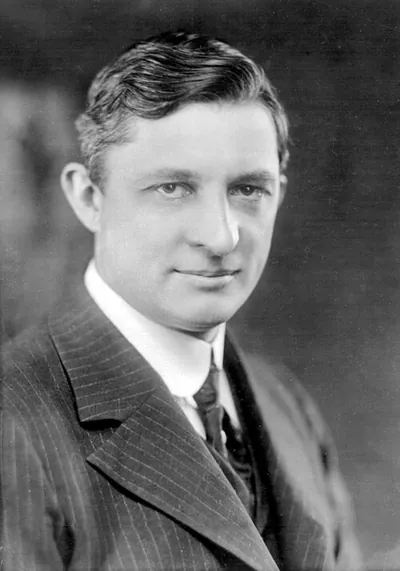
Willis Carrier
American engineer and inventor who developed modern air conditioning · 1876–1950
- Born
- November 26, 1876
- Died
- October 7, 1950
- Country
- United States
- Section
- Technology and communications
Biography
Willis Haviland Carrier (born 1876 in Angola, New York; died 1950 in New York) was an American engineer and inventor credited with creating modern air conditioning. His work reshaped twentieth-century life: it made it possible to live, work and travel through hot summers in places that had previously been almost unbearable, and it helped fuel the economic growth of the American Southwest and other hot regions of the world.
Carrier was born on 26 November 1876 in Angola, a town on the shore of Lake Erie in New York State. From his mother he inherited a habit of tinkering with clocks, sewing machines and other household gadgets, a curiosity that never left him. He loved mathematics and studied it whenever he could, while spending much of his free time designing devices of his own. He won a scholarship to Cornell University and graduated in electrical engineering in 1901.
After university he joined the Buffalo Forge Company, a maker of heaters, fans and air extraction equipment. In its heating engineering department he designed systems for drying lumber and coffee. He soon devised a better way to measure how much heat a system could deliver, and was made head of the company's experimental engineering department.
His breakthrough came in 1902. The Sackett-Wilhelms lithographic printing firm in Brooklyn struggled with colour printing: heat and moisture made the paper swell and shrink between the successive ink passes, so the images came out blurred. Carrier proposed a system that could control both temperature and humidity at once. This installation is widely regarded as the birth of modern air conditioning, although the details of those early designs are known mainly from his own records. Humidity is the amount of water vapour in the air, and controlling it was the heart of the idea. In 1906 he was granted a patent for an apparatus for treating air, usually described as the first spray-type air conditioner. It heated or cooled the water it sprayed into the air, so the air could be humidified or dehumidified as needed.
He refined the design over the following years. He found that keeping the gap between air temperature and dew point constant kept relative humidity almost steady, a relationship engineers later called the law of constant dew-point depression. He used it as the basis for an automatic control system. In 1911 he presented Rational Psychrometric Formulae to the American Society of Mechanical Engineers, a work linking relative humidity, absolute humidity and dew-point temperature so that systems could be designed with precision. It became known as the Magna Carta of psychrometrics.
When the First World War began, Buffalo Forge chose to stop making air conditioning. Carrier and six colleagues pooled their savings, about 32,600 dollars, and founded Carrier Engineering Corporation in 1915. Early customers included Madison Square Garden and the United States Senate and House of Representatives. A domestic unit had already been installed in a house in Minneapolis in 1914, an early step into home use. The firm struggled during the crash of 1929, and in 1930 it merged with other companies to form Carrier Corporation, with Carrier as chairman of the board. In 1937 he moved the headquarters to Syracuse, where the firm became one of the largest employers in central New York.
His personal life also shaped his story. He married three times: first to Edith Claire Seymour, whom he had met at Cornell and who died in 1912; then to Jennie Tifft Martin, with whom he adopted two children; and finally to Elizabeth Marsh Wise in 1941. He was a Presbyterian and died in New York on 7 October 1950.
His legacy is considerable. The company he founded remains a world leader in heating, cooling and refrigeration, and air conditioning changed American life by allowing factories to keep up production through the summer and by encouraging migration toward the warmer south and west. Today it is a standard feature of homes, offices and factories around the world.
Main contributions
- 1902Temperature and humidity control system for the Sackett-Wilhelms printing firm, regarded as the origin of modern air conditioning.
- 1906Patent for an apparatus for treating air, a spray-type unit that humidified or dehumidified by spraying heated or cooled water.
- 1911Rational Psychrometric Formulae, a work linking relative humidity, absolute humidity and dew point so air conditioners could be designed precisely.
- 1914First domestic air conditioning installation, in a house in Minneapolis.
- 1915Founding of Carrier Engineering Corporation with the savings of seven engineers.
- 1930Creation of Carrier Corporation after several firms merged, and opening of affiliates in Asia.
Trivia and anecdotes
A paper problem
The invention began with an industrial headache: paper swelled with humidity and the colour inks no longer lined up.
An old 'Magna Carta'
His 1911 paper earned the nickname Magna Carta of psychrometrics, a playful nod to the English founding charter.
Their contemporaries
While Willis Carrier was alive (1876–1950)…
Alive at the same time
Discovered or invented in those years
- 1876TelephoneA device that carries the human voice over distance by turning sound into electrical signals and back into sound at the other end of the line.
- 1884CarA road vehicle with four wheels and its own engine, mainly built to carry people.
- 1903AirplaneA fixed-wing aircraft, heavier than air, powered by engines or rockets, that stays aloft because its wings generate lift.
- 1925TelevisionA system that sends moving pictures and sound over distance and shows them on a receiver, the television set.
- 1931Big BangA cosmological model describing how the universe expanded from an early state of extreme density and temperature, about 13.8 billion years ago.
- 1945ComputerA programmable machine that takes in data, processes it by following stored instructions, and produces results, able to switch tasks simply by running different software.
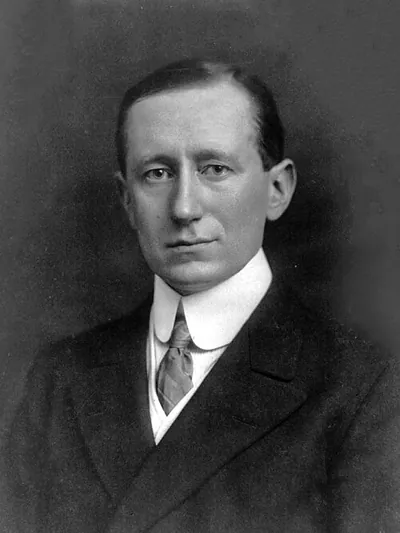 Guglielmo Marconi1874–1937 · Technology and communications
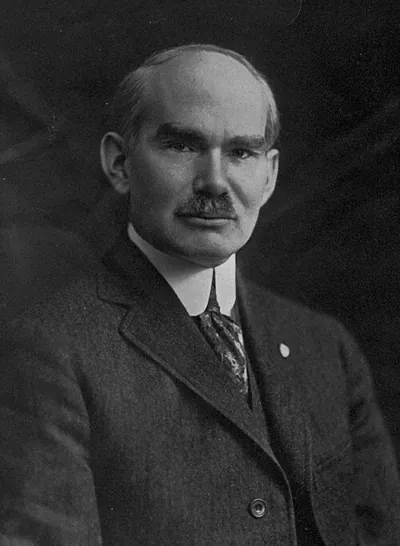 Lee de Forest1873–1961 · Technology and communications
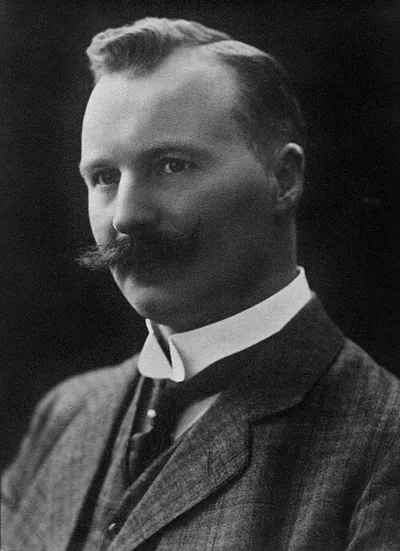 Nils Gustaf Dalén1869–1937 · Technology and communications
 John Logie Baird1888–1946 · Technology and communications
 Vladimir K. Zworykin1888–1982 · Technology and communications
 Louis Lumière1864–1948 · Technology and communications
