
Yellapragada Subbarow
Indian-American biochemist who discovered the role of ATP in cellular energy and helped develop methotrexate for cancer treatment · 1895–1948
- Born
- January 12, 1895
- Died
- August 8, 1948
- Country
- India, British Raj
- Section
- Chemistry
Biography
Yellapragada Subbarao (1895-1948) was an Indian-born scientist who spent most of his career in the United States. His work on cellular energy and on drugs against cancer and filariasis makes him an important figure in twentieth-century biochemistry and pharmacology, although for decades his name remained little known outside research laboratories.
He was born on 12 January 1895 into a poor family of the priestly caste, in the Godavari district of what is now Andhra Pradesh. His ancestors had worked as revenue accountants for successive rulers, but the family's fortunes declined after the death of his grandfather left his income insufficient for a large joint household. He studied at Madras Medical College, where his involvement in the Indian independence movement led to his receiving the Licentiate of Medicine and Surgery rather than the full medical degree, which offered fewer professional opportunities. According to the sources, two of his brothers died of tropical sprue, a chronic intestinal illness, within eight days of each other, an experience that may have shaped his later interest in tropical disease.
After qualifying he taught anatomy and physiology at Madras Ayurvedic College and eventually became its vice principal. There he turned to traditional Indian medicine. One episode often recounted is a severe bout of diarrhoea that did not respond to conventional treatment but recovered under Ayurvedic care, an experience that strengthened his belief that the two systems could be combined. During these years he wrote a 427-page manuscript on vegetable drugs of northern India. A chance meeting with the American physician John Fox Kendrick encouraged him to train at the Harvard School of Tropical Medicine. Lacking a scholarship, he supported himself through part-time work.
At Harvard he earned his diploma and stayed on as a junior faculty member. With Cyrus Fiske he developed a method for measuring phosphorus in body tissues and fluids, known as the Fiske-Subbarow method. He then studied phosphocreatine and adenosine triphosphate (ATP), a molecule that stores the energy cells use to contract and carry out work. This research earned him a place in biochemistry textbooks of the 1930s. He completed his doctorate in 1930 but failed to secure a permanent post at Harvard.
He moved to the Lederle Laboratories, then part of American Cyanamid and now a division of Wyeth. There he devised a way to synthesise folic acid, vitamin B9, building on Lucy Wills's findings on its role against anaemia. Working with the physician Sidney Farber, he developed methotrexate, one of the first chemotherapy drugs for cancer, which remains in use and is also prescribed for rheumatoid arthritis. He also laid the groundwork for diethylcarbamazine, an anti-parasitic drug that the World Health Organization later recommended for filariasis.
Under his supervision, Benjamin Duggar discovered chlortetracycline in 1945, the first tetracycline antibiotic. Duggar isolated it from an actinomycete grown from a soil sample collected at the University of Missouri. Subbarao rarely sought public attention: he did not patent his discoveries, gave few lectures and granted no interviews, which delayed his recognition. His relationship with Cyrus Fiske was strained. His colleague George Hitchings, who shared the Nobel Prize in Medicine, said some nucleotides Subbarao had isolated had to be rediscovered years later because Fiske kept parts of his work from being published. The charge of jealousy comes from Hitchings, a contemporary, and should be read as his testimony.
Subbarao died of cardiac arrest in New York on 8 August 1948. His legacy lives on in methotrexate, in the understanding of ATP's role in biology and in the fight against filariasis. A fungal genus, Subbaromyces, and a species of jumping spider were named in his honour, and a street in his hometown of Bhimavaram bears his name.
Main contributions
- 1925Fiske-Subbarow method: a technique for measuring phosphorus in body tissues and fluids, developed with Cyrus Fiske.
- 1945Chlortetracycline: the first tetracycline antibiotic, discovered by Benjamin Duggar under Subbarao's direction.
- Role of ATP and phosphocreatine in muscle activity: showed that these molecules store and release the energy muscles use.
- Synthesis of folic acid (vitamin B9): a laboratory method for producing this vitamin, important against anaemia.
- Methotrexate: an anticancer drug developed with Sidney Farber, still used in chemotherapy.
- Diethylcarbamazine: an antiparasitic drug recommended by the WHO against filariasis, whose basis he helped establish at Lederle.
Trivia and anecdotes
Brothers and sprue
According to the sources, two of his brothers died of tropical sprue within days of each other, an event that may have shaped his interest in tropical diseases.
A reported theft
It is said that the antibiotic attracted so much interest that someone tried to steal it from a Boston warehouse. This is an unconfirmed story that the sources present with some irony.
A quiet tribute
A 1950 article in Argosy credited his work with helping many people live longer and healthier lives, although the public barely knew his name.
Their contemporaries
While Yellapragada Subbarow was alive (1895–1948)…
Alive at the same time
Discovered or invented in those years
- 1897ElectronA negatively charged subatomic particle found in every atom, and key to electricity and chemical bonding.
- 1903AirplaneA fixed-wing aircraft, heavier than air, powered by engines or rockets, that stays aloft because its wings generate lift.
- 1925TelevisionA system that sends moving pictures and sound over distance and shows them on a receiver, the television set.
- 1925Quantum mechanicsPhysical theory describing how matter and light behave at atomic and subatomic scales, where energy is exchanged in minimal packets and results are expressed as probabilities.
- 1931Big BangA cosmological model describing how the universe expanded from an early state of extreme density and temperature, about 13.8 billion years ago.
- 1945ComputerA programmable machine that takes in data, processes it by following stored instructions, and produces results, able to switch tasks simply by running different software.
 Wallace Carothers1896–1937 · Chemistry
 Harold Urey1893–1981 · Chemistry
 Cyril Norman Hinshelwood1897–1967 · Chemistry
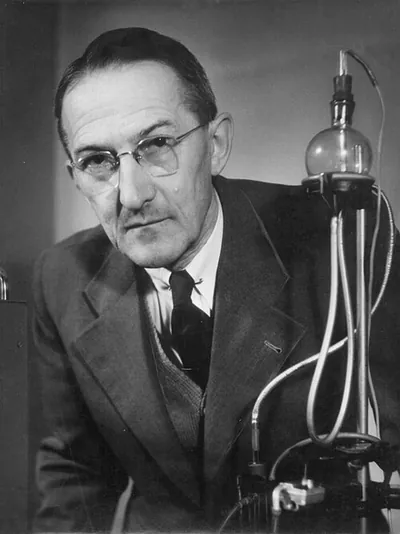 Jaroslav Heyrovský1890–1967 · Chemistry
 Linus Pauling1901–1994 · Chemistry
