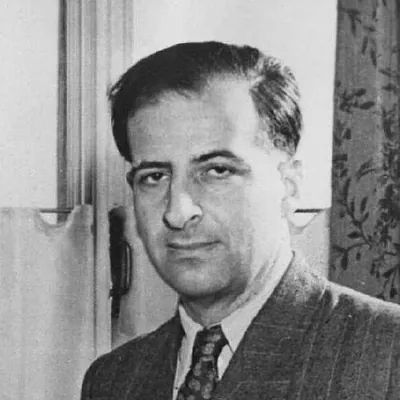
Bruno Pontecorvo
Italian nuclear physicist, collaborator of Enrico Fermi and pioneer in neutrino research · 1913–1993
- Born
- August 22, 1913
- Died
- September 24, 1993
- Country
- Italy, United Kingdom, Soviet Union
- Section
- Physics
Biography
Bruno Pontecorvo (born 22 August 1913, Marina di Pisa; died 24 September 1993) was an Italian nuclear physicist who worked with Enrico Fermi in the 1930s and became a leading figure in neutrino research. Neutrinos are nearly massless particles with no electric charge that pass through ordinary matter almost unnoticed. His career unfolded across fascism, the Second World War and the Cold War, and those upheavals shaped both his scientific path and his personal choices.
He was born in Marina di Pisa, the fourth of eight children in a prosperous Italian family. His father, Massimo, owned three textile factories and was Jewish but did not practise; his mother, Maria, was a Waldensian Protestant. Pontecorvo began studying engineering at the University of Pisa, but in 1931 he switched to physics on the advice of his brother Guido, a future geneticist, and enrolled at the University of Rome. There Fermi had gathered a group of young scientists known as the Via Panisperna boys, after the street where the institute stood. At eighteen he entered the third year of physics directly, and as the youngest member of the group he earned the nickname Cucciolo, meaning little puppy.
In 1934 he took part in Fermi's experiments with slow neutrons. A neutron is a particle inside the atomic nucleus with no electric charge, so it can approach nuclei without being pushed away. The team found that hydrogen slowed neutrons more effectively than heavy elements, and that slower neutrons were absorbed more readily. This work paved the way to the discovery of nuclear fission. His name appeared on an Italian patent granted in 1935 in the name of the whole group.
In 1936 he moved to Paris to work with Irène and Frédéric Joliot-Curie, on a one-year scholarship to study neutron collisions with protons and isomers, which are nuclei with the same composition that remain in different energy states. In Paris, his cousin Emilio Sereni drew him towards communism, and he remained loyal to it for life. There he also met Marianne Nordblom, and their son Gil was born in 1938. That year, Italy's Fascist racial laws made a return home impossible, and his family scattered across Britain, France and the United States. In the Joliot-Curie laboratory he discovered what Frédéric called nuclear phosphorescence, the emission of X-rays when excited nuclei fall back to their lowest energy state.
When the German army closed in on Paris in 1940, he fled by bicycle with his brother Gillo, his cousin Emilio Sereni and Salvador Luria. After ten days they reached Toulouse, and he later travelled through Lisbon to New York. Britain had turned him away as an undesirable, but Segrè recommended him for a post in Tulsa, Oklahoma, where he applied nuclear physics to the search for oil and minerals. In 1943 he joined the British Tube Alloys team in Montreal, part of the Manhattan Project, and later worked at the Chalk River laboratories, where he helped design the ZEEP reactor, which reached criticality in 1945. A reactor is critical when its chain reaction sustains itself.
He moved to Harwell in Britain in 1949 and defected to the Soviet Union in 1950, joining the Joint Institute for Nuclear Research at Dubna. There he concentrated on neutrinos. He proposed using chlorine to detect them and, in 1959, argued that the electron neutrino and the muon neutrino were distinct particles. The Homestake experiment had detected only a third to a half of the solar neutrinos predicted, and to explain this he proposed neutrino oscillation, in which one kind of neutrino changes into another. The Super-Kamiokande experiment confirmed this in 1998. In 1958 he also predicted that supernovae would release intense bursts of neutrinos, which was observed in 1987 in SN 1987A.
Pontecorvo died in 1993. The Pontecorvo Prize, established in his memory in 1995, has since honoured work in high-energy physics. His legacy lies in linking the nuclear physics of the 1930s with the neutrino astrophysics that now studies stars through these particles.
Main contributions
- 1934Took part in Fermi's slow-neutron experiments, which paved the way to the discovery of nuclear fission.
- 1945Helped design the ZEEP reactor at Chalk River, the first reactor outside the United States, which reached criticality.
- 1958Predicted that supernovae would release intense bursts of neutrinos.
- 1959Argued that the electron neutrino and the muon neutrino are distinct particles.
- 1987Neutrinos from supernova SN 1987A were detected, confirming his prediction.
- 1998The Super-Kamiokande experiment confirmed the existence of neutrino oscillations.
- Proposed neutrino oscillation, in which one type of neutrino changes into another; the exact year of the proposal is not given in the sources.
Teachers and students
Studied under:
Taught:
Trivia and anecdotes
Cucciolo
As the youngest member of the Via Panisperna group, he was nicknamed Cucciolo, meaning little puppy.
Praise from Fermi
Fermi described him as one of the brightest men he had worked with during his scientific career.
A British rejection
Britain, which offered refuge to other French nuclear scientists, turned him down as undesirable.
Their contemporaries
While Bruno Pontecorvo was alive (1913–1993)…
Alive at the same time
Discovered or invented in those years
- 1916Black holeA region of space where gravity is so strong that nothing, not even light, can escape once it crosses a certain boundary.
- 1925TelevisionA system that sends moving pictures and sound over distance and shows them on a receiver, the television set.
- 1925Quantum mechanicsPhysical theory describing how matter and light behave at atomic and subatomic scales, where energy is exchanged in minimal packets and results are expressed as probabilities.
- 1931Big BangA cosmological model describing how the universe expanded from an early state of extreme density and temperature, about 13.8 billion years ago.
- 1945ComputerA programmable machine that takes in data, processes it by following stored instructions, and produces results, able to switch tasks simply by running different software.
- 1969InternetA global network of interconnected computer networks that communicate using the TCP/IP protocol suite.
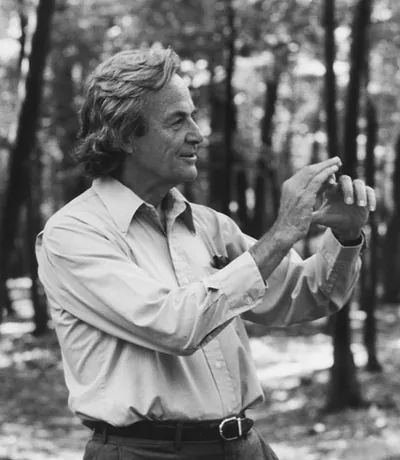 Richard Feynman1918–1988 · Physics
 Lev Landau1908–1968 · Physics
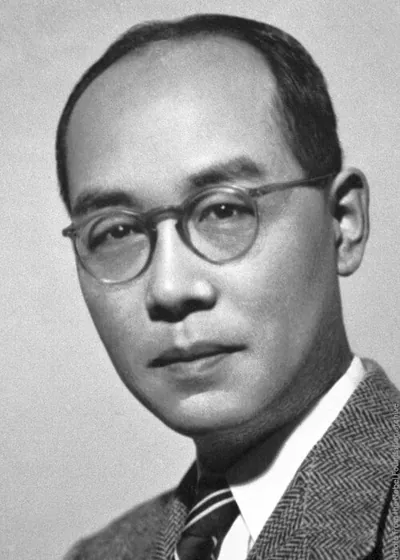 Hideki Yukawa1907–1981 · Physics
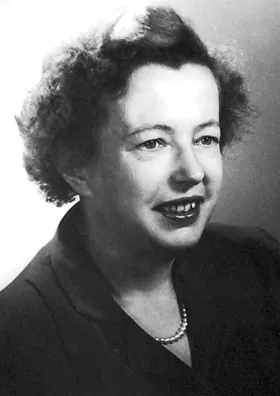 Maria Göppert Mayer1906–1972 · Physics
 Hans Bethe1906–2005 · Physics
 J. Robert Oppenheimer1904–1967 · Physics
