
C. B. van Niel
Dutch-American microbiologist and botanist who introduced general microbiology to the United States and clarified the chemistry of photosynthesis · 1897–1985
- Born
- November 4, 1897
- Died
- March 10, 1985
- Country
- United States, Kingdom of the Netherlands
- Section
- Biology
Biography
Cornelis Bernardus van Niel, known as Kees van Niel, was a Dutch-born microbiologist and botanist who spent most of his career in the United States. Born in Haarlem in 1897 and dying in Carmel, California, in 1985, he worked during the first half of the twentieth century, when microbiology was becoming a discipline in its own right. He is remembered for two things: bringing general microbiology to the United States, and explaining how photosynthesis, the process by which plants turn light into chemical energy, actually works at the level of its chemistry.
Van Niel trained as a chemical engineer at Delft University of Technology, graduating in 1923. He soon became an assistant to Albert Jan Kluyver, who had launched comparative biochemistry, the study of how different microorganisms obtain and transform substances in different ways. In 1925 he married Christina van Hemert, who had also trained in chemical engineering at Delft. In 1928 he completed his doctoral dissertation on propionic acid bacteria and then left for the United States to continue his research at the Hopkins Marine Station of Stanford University.
There he studied purple and green sulphur bacteria, microbes that carry out photosynthesis without producing oxygen. In 1931 he showed that photosynthesis is a light-dependent redox reaction, meaning one in which electrons move from one substance to another: hydrogen from an oxidizable compound is used to reduce carbon dioxide into cell material. From this he reasoned that in green plants the hydrogen donor is water, which is oxidized and releases oxygen. Robert Hill later confirmed this experimentally. The idea overturned the older assumption that the oxygen came from carbon dioxide, and it became a milestone in understanding the chemistry of the process.
Van Niel also played a key part in bacterial classification. In 1962, working with Roger Y. Stanier, he defined prokaryotes as cells whose genetic material is not enclosed in a nuclear membrane, a definition that remains in use. Shortly after arriving at Hopkins he had designed a course in general microbiology that became highly influential. From 1938 to 1962 it drew students from around the world, among them Esther Lederberg, Allan Campbell and Arthur Kornberg, who later won the Nobel Prize for work on DNA synthesis.
His legacy lies in the generations of microbiologists he trained and in the conceptual foundation he gave to research on photosynthesis. He received the United States National Medal of Science in 1963, the first awarded to a biologist, and the Leeuwenhoek Medal in 1970. He was elected to the United States National Academy of Sciences in 1945 and to the American Philosophical Society in 1948.
Main contributions
- 1928Doctoral dissertation on propionic acid bacteria, defended at Delft.
- 1931Demonstration that photosynthesis is a light-dependent redox reaction in which hydrogen from an oxidizable compound reduces carbon dioxide to cell material.
- 1931Proposal that water is the hydrogen donor in green plant photosynthesis, being oxidized and releasing oxygen.
- 1956Co-authored with Albert Jan Kluyver The Microbe's Contribution to Biology, a work on the role of microorganisms in biology.
- 1962With Roger Y. Stanier, definition of prokaryotes as cells whose genetic material is not enclosed by a nuclear membrane.
Teachers and students
Studied under:
Taught:
Trivia and anecdotes
First biologist honoured
He was the first biologist to receive the United States National Medal of Science, in 1963, for his work on comparative biochemistry and photosynthesis.
A course with famous students
The general microbiology course he created at Hopkins drew students from around the world for over two decades, including future Nobel laureates.
Their contemporaries
While C. B. van Niel was alive (1897–1985)…
Alive at the same time
Discovered or invented in those years
- 1903AirplaneA fixed-wing aircraft, heavier than air, powered by engines or rockets, that stays aloft because its wings generate lift.
- 1925TelevisionA system that sends moving pictures and sound over distance and shows them on a receiver, the television set.
- 1925Quantum mechanicsPhysical theory describing how matter and light behave at atomic and subatomic scales, where energy is exchanged in minimal packets and results are expressed as probabilities.
- 1931Big BangA cosmological model describing how the universe expanded from an early state of extreme density and temperature, about 13.8 billion years ago.
- 1945ComputerA programmable machine that takes in data, processes it by following stored instructions, and produces results, able to switch tasks simply by running different software.
- 1969InternetA global network of interconnected computer networks that communicate using the TCP/IP protocol suite.
 Gerty Cori1896–1957 · Biology
 Hans Krebs1900–1981 · Biology
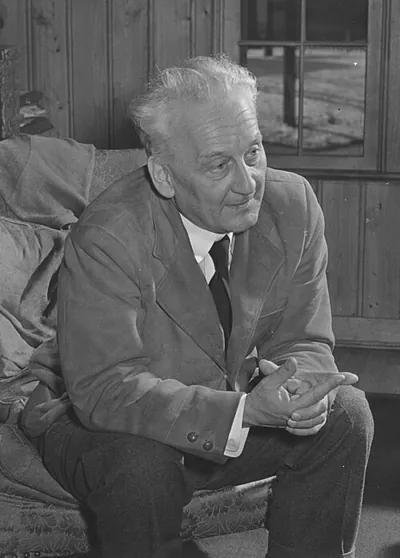 Albert Szent-Györgyi1893–1986 · Biology
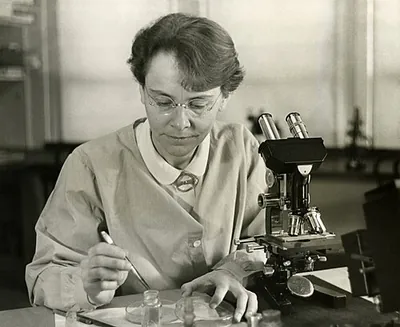 Barbara McClintock1902–1992 · Biology
 J.B.S. Haldane1892–1964 · Biology
 Konrad Lorenz1903–1989 · Biology
