
Albert Kluyver
Dutch microbiologist, mycologist and biochemist, regarded as a father of comparative microbiology · 1888–1956
- Born
- June 3, 1888
- Died
- May 14, 1956
- Country
- Kingdom of the Netherlands
- Section
- Biology
Biography
Albert Jan Kluyver (Breda, 1888 - 1956) was a Dutch microbiologist, mycologist and biochemist who spent his career working out what microorganisms do with chemical substances. His name is tied to the Delft school of microbiology and to the idea that, at their most basic level, very different living things run on the same chemistry. He is remembered as one of the fathers of comparative microbiology, the field that studies microbes in relation to other forms of life.
The sources I have say little about his early years. We know he was born in Breda on 3 June 1888 and that his training led him toward microbiology, the study of organisms too small to see with the naked eye, such as bacteria, yeasts and microscopic fungi. The texts do not record the names of his teachers or the details of his first academic steps, so I will not offer them here, since I cannot confirm them.
His work was based in Delft, where he succeeded Martinus Beijerinck, another leading figure in Dutch microbiology. There, a research tradition had grown up that treated microbes as active chemical systems able to transform the substances around them. Kluyver inherited that approach and pushed it further, asking whether the reactions he saw in bacteria had counterparts in animals and plants.
His most influential work appeared in 1926, when he and Hendrick Jean Louis Donker published the paper "Die Einheit in der Biochemie" ("Unity in Biochemistry"). Biochemistry is the study of the chemical reactions that take place inside living things. The central claim was that, at that level, all organisms share a common chemical foundation. To sum up the idea, Kluyver used a phrase that became famous: "From elephant to butyric acid bacterium, it is all the same." Butyric acid is a compound produced by certain bacteria, and the line was meant to stress the uniformity of basic processes rather than to be taken literally.
From this view grew comparative biochemistry, which Kluyver saw as the chemical counterpart of comparative anatomy, the discipline that sets the body structures of different animals side by side. Bacteria offered a simple model for studying processes that could then be extended to more complex organisms. His best-known student, C. B. van Niel, observed that by the middle of the twentieth century his work on biochemical unity was hardly being cited, even though the idea had taken hold in scientific thinking.
The aphorism also took on a life of its own. In 1961, François Jacob and Jacques Monod paraphrased it, without naming Kluyver, to justify the universality of the genetic code, the set of rules that turns hereditary information into proteins. The loss of authorship contrasts with how strongly the idea spread.
His career was deeply affected by the Second World War and the Nazi occupation of the Netherlands. The sources mention this context but do not detail how it shaped his specific work, and it would be wrong to assume more than the texts state.
In 1926 he became a member of the Royal Netherlands Academy of Arts and Sciences. In 1953 he received the Copley Medal, one of the oldest scientific awards in Britain. His books include Chemical Activities of Micro-Organisms (1931) and, together with van Niel, The Microbe's Contribution to Biology (1956). He died on 14 May 1956.
His legacy lives on in the names of several organisms. In 1956, the botanist Johannes P. Van der Walt published the yeast genus Kluyveromyces in his honour, and in 1981 the bacterial genus Kluyvera was named after him. The Royal Netherlands Society for Microbiology created an award in his name for microbiologists who make an exceptional contribution to the field.
Main contributions
- 1926Biochemical unity: the idea that organisms share a common chemical foundation, set out in "Die Einheit in der Biochemie".
- 1931Book Chemical Activities of Micro-Organisms, on the chemical activities carried out by microorganisms.
- 1956The Microbe's Contribution to Biology, written with C. B. van Niel on what microbes contribute to biology.
- Comparative biochemistry: the study of chemical processes in bacteria extended to higher organisms, conceived as the chemical equivalent of comparative anatomy.
Teachers and students
Trivia and anecdotes
A famous aphorism
Kluyver summed up his idea with the line "From elephant to butyric acid bacterium, it is all the same."
A phrase without its author
In 1961, Jacob and Monod paraphrased the line without naming Kluyver, so it became known largely through others.
Living things named after him
The yeast genus Kluyveromyces (1956) and the bacterial genus Kluyvera (1981) bear his name in his honour.
Their contemporaries
While Albert Kluyver was alive (1888–1956)…
Alive at the same time
Discovered or invented in those years
- 1897ElectronA negatively charged subatomic particle found in every atom, and key to electricity and chemical bonding.
- 1903AirplaneA fixed-wing aircraft, heavier than air, powered by engines or rockets, that stays aloft because its wings generate lift.
- 1925TelevisionA system that sends moving pictures and sound over distance and shows them on a receiver, the television set.
- 1925Quantum mechanicsPhysical theory describing how matter and light behave at atomic and subatomic scales, where energy is exchanged in minimal packets and results are expressed as probabilities.
- 1931Big BangA cosmological model describing how the universe expanded from an early state of extreme density and temperature, about 13.8 billion years ago.
- 1945ComputerA programmable machine that takes in data, processes it by following stored instructions, and produces results, able to switch tasks simply by running different software.
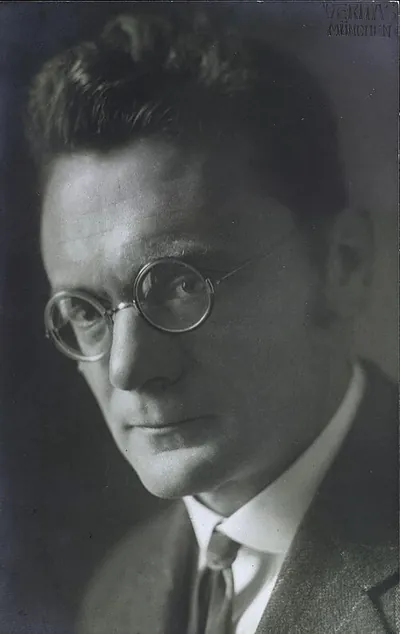 Karl von Frisch1886–1982 · Biology
 Hermann Joseph Muller1890–1967 · Biology
 J.B.S. Haldane1892–1964 · Biology
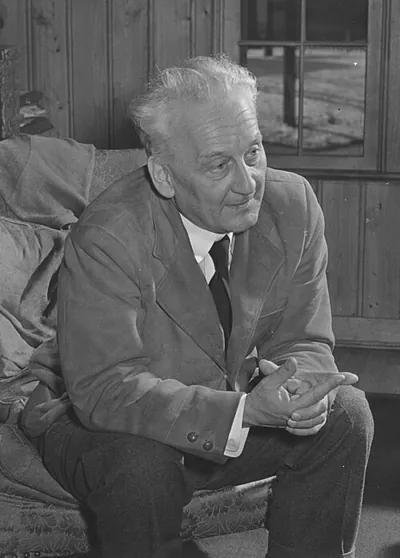 Albert Szent-Györgyi1893–1986 · Biology
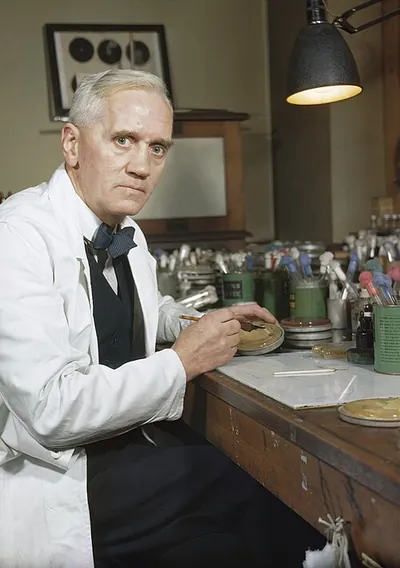 Alexander Fleming1881–1955 · Biology
 Gerty Cori1896–1957 · Biology
