
Charles Goodyear
American inventor who discovered the vulcanization of rubber · 1800–1860
- Born
- December 29, 1800
- Died
- July 1, 1860
- Country
- United States
- Section
- Engineering and construction
Biography
Charles Goodyear (1800-1860) was an American inventor who discovered vulcanization, the process that turns soft, sticky rubber into a material that is elastic, strong and stable. He lived in the first half of the nineteenth century, when natural rubber was just beginning to find industrial uses, and his discovery underlies many of the rubber products we use today, from tyres to footwear.
Born on 29 December 1800 in New Haven, Connecticut, he was the eldest of six children in a family whose roots went back to the colony founded in 1638 by an ancestor. As a young man he went to Philadelphia to learn the hardware trade. Around the age of twenty-five he returned to Connecticut and entered a partnership with his father, whose business made buttons and farm implements. In 1824 he married Clarissa Beecher, whom he had met at his congregational church. Two years later the couple settled in Philadelphia, where he opened a hardware store that prospered for a time. Between 1829 and 1830 his health broke down and several ventures failed, and the firm eventually collapsed.
Goodyear had no formal scientific training. He was self-taught and learned largely by trial and error. Around 1831 and 1832 he became interested in natural rubber, then called gum elastic, after seeing goods made by the Roxbury Rubber Company of Boston. Noticing that the inflation tubes in life preservers worked poorly, he made better ones and showed them to the company's manager, who admitted that much of its output was being returned because the gum rotted. That moment set Goodyear on a quest that would occupy most of his life.
His first attempts involved mixing the rubber with substances such as magnesia to reduce its stickiness. The results looked promising at first, but the material softened again when exposed to acids or heat. Money problems were constant. He was jailed for debt and sold his furniture, and in New York his family endured such hardship that, by a well-known account, they caught frogs and dug up half-frozen potatoes to eat. Two of his sons died while still small. His wife and children nevertheless stood by him. He also worked with nitric acid, which gave rubber a tougher surface, but exposure to such chemicals, along with lead oxide, badly damaged his health.
After the financial panic of 1837 wiped out a business partner, he moved to Boston, where he received help from J. Haskins of the Roxbury company and from a man named Chaffee, who lent him money and suggested that the solvent used in mixing might be causing many of the faults. Goodyear then began blending the rubber mechanically, in a large machine, without solvents. The goods looked better, but they still failed in cold, heat and acid.
The decisive breakthrough came in 1839 at the Eagle India Rubber Company in Woburn, Massachusetts. There he found that heating rubber mixed with sulphur over a hot stove made it rigid and stable. He named the process vulcanization after the heat involved, and he patented it that same year. In 1844 he received US patent 3633 once the method had been refined. His brother Henry introduced mechanical mixing in place of solvents, and by 1842 Goodyear had moved his main operations to Springfield.
Patents brought lawsuits. From 1844 onward rivals accused him of stealing their ideas, and he won many of these cases; by 1851 he had hired the lawyer and orator Daniel Webster. In 1852 he travelled to Europe and met Thomas Hancock, who claimed to have invented vulcanization independently. Goodyear sold licences abroad, including to Hiram Hutchinson, who founded a company in France in 1853.
His legacy is twofold. Vulcanized rubber became the base for dental dentures, known as vulcanite, until acrylic resins replaced it in 1937. And the Goodyear Tire and Rubber Company bears his name, though he did not found it; the firm was established in 1898, thirty-eight years after his death.
Main contributions
- 1839Vulcanization of rubber: a process that heats rubber mixed with sulphur, making it rigid, elastic and stable.
- 1844US patent 3633: records the vulcanization method once it had been refined.
- Vulcanite dental dentures: hard rubber plates used in dentistry until acrylic resins replaced them in 1937.
- Rubber footwear and tyres: industrial products that made vulcanized rubber a mass-market material.
Trivia and anecdotes
A legend about Seiberling
It is often said that Goodyear sold his patent to Frank Seiberling out of financial need, but there is no clear evidence of such a sale. The company bearing his name was founded in 1898.
A name in his honour
The company itself says that Frank Seiberling named his firm after Goodyear to recognise the discoverer of vulcanization.
A letter of praise
For rubber goods treated with nitric acid he reportedly received a letter of commendation from President Andrew Jackson.
Related discoveries and inventions
- 1839VulcanizationA process that heats rubber with sulfur to make it harder, more elastic and stable, so that it stops being sticky and no longer melts when heated.
Their contemporaries
While Charles Goodyear was alive (1800–1860)…
Alive at the same time
Discovered or invented in those years
- 1803AtomThe basic unit of a chemical element: a nucleus of protons and usually neutrons surrounded by a cloud of electrons.
- 1811MoleculeAn electrically neutral group of at least two atoms held together by chemical bonds in a defined arrangement.
- 1821ElectricityThe set of physical phenomena linked to the presence and movement of electric charge, and one of the most versatile forms of energy in modern life.
- 1839PhotographyA technique for creating lasting images by recording light, either on a light-sensitive material or with an electronic sensor.
- 1846NeptuneThe eighth and most distant planet of the Solar System, an ice giant found through mathematical prediction before any direct sighting.
- 1859EvolutionThe process by which the heritable traits of living populations change over generations, explaining the diversity of life from common ancestors.
 Joseph Paxton1803–1865 · Engineering and construction
 Henry Darcy1803–1858 · Engineering and construction
 Isambard Kingdom Brunel1806–1859 · Engineering and construction
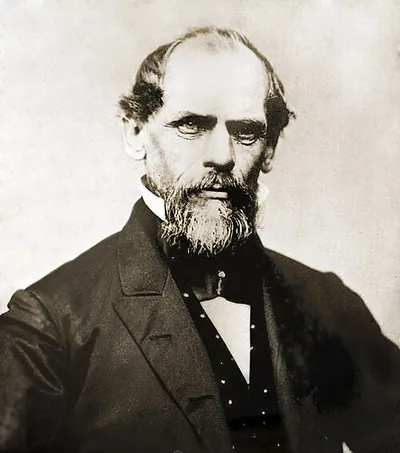 John Augustus Roebling1806–1869 · Engineering and construction
 Cyrus McCormick1809–1884 · Engineering and construction
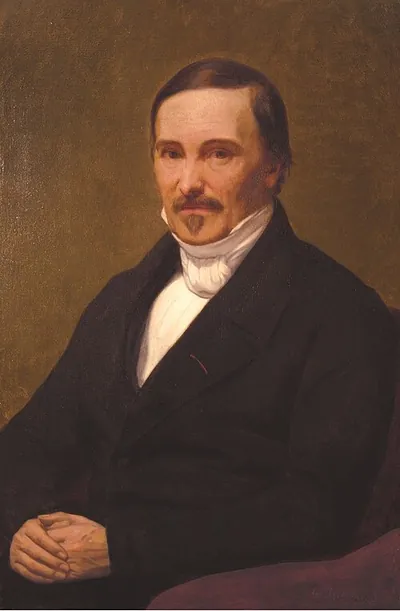 Jean-Victor Poncelet1788–1867 · Engineering and construction
