
Donald Arthur Glaser
American physicist and neurobiologist, Nobel laureate in Physics in 1960 for the bubble chamber · 1926–2013
- Born
- September 21, 1926
- Died
- February 28, 2013
- Country
- United States
- Section
- Physics
- Awards
- Nobel Prize in Physics
Biography
Donald Arthur Glaser (Cleveland, 1926 – Berkeley, 2013) was an American physicist who won the 1960 Nobel Prize in Physics for inventing the bubble chamber, a detector that made the tracks of subatomic particles visible. After the prize he left physics and turned first to molecular biology and later to neurobiology, a path that is unusual for a scientist of his standing.
He was born in Cleveland, Ohio, on September 21, 1926, to Russian Jewish immigrants. His father, William J. Glaser, was a businessman. From an early age he played the piano, the violin and the viola, and at Cleveland Heights High School he became interested in physics as a way of understanding the material world.
He graduated in physics and mathematics in 1946 from the Case School of Applied Science, now Case Western Reserve University, where he became drawn to particle physics, the study of the smallest components of matter. He played viola in the Cleveland Philharmonic and, after graduating, taught mathematics at the same institution.
For his doctorate he moved to the California Institute of Technology (Caltech), where he worked with Carl David Anderson, another Nobel laureate, studying cosmic rays, the particles that arrive from space, using cloud chambers. A cloud chamber is a vessel of supersaturated vapour in which a passing particle leaves a visible trail of droplets. Glaser preferred this work to nuclear physics because it was more accessible. At Caltech he learned to design and build his own equipment, a skill he would use for the rest of his career. He also attended molecular genetics seminars led by Max Delbrück, a third Nobel laureate, in a field he would return to years later.
He earned his PhD in 1950 with a thesis on the momentum distribution of charged cosmic ray particles. He had begun as an instructor at the University of Michigan in 1949, was promoted to professor there in 1957, and in 1959 joined the physics faculty of the University of California, Berkeley.
While teaching at Michigan he began the experiments that led to the bubble chamber. His work with cloud chambers had shown him their limits: particles passed through gas and struck metal plates that obscured what had happened, and the apparatus needed time to reset, so it could not keep pace with the particles produced by accelerators. His solution was a superheated liquid inside a glass vessel. When a charged particle passes through, it leaves a line of bubbles that can be photographed. He first tried ether and then, during a visit to the University of Chicago, hydrogen, a simpler target for studying collisions.
A popular story says the idea came to him from the bubbles in a glass of beer. Glaser rejected this in a 2006 talk, though he admitted that he used beer to fill some of his early prototypes. It is best treated as a legend.
The chamber suited high-energy accelerators well. With a group of students he travelled to Brookhaven National Laboratory to study elementary particles. The images he produced made the importance of his device clear and helped him win funding for larger chambers. Luis Alvarez, a Nobel laureate who was building a hydrogen chamber at Berkeley, recruited him, and Glaser accepted a professorship there in 1959.
The 1960 Nobel Prize recognised that the chamber allowed scientists to see what happens when beams from an accelerator strike matter, opening the way to many important discoveries. Other honours followed, including the Elliott Cresson Medal in 1961, election to the National Academy of Sciences in 1962 and election to the American Philosophical Society in 1997.
Glaser then wanted a change. Experiments were growing larger and more costly, he was spending more of his time on administration, and he expected ever more complex equipment to concentrate research in a few centres. From 1962 he turned to molecular biology, the discipline that explains the processes of life in terms of molecules. He spent a semester as a visiting professor at MIT and another in Copenhagen with the Danish molecular biologist Ole Maaloe. On entering his first biology laboratory, he remarked that Louis Pasteur would have felt quite at home there.
At the Virus Lab at Berkeley he worked with bacteriophages, bacteria and mammalian cells, and studied the development of cancer, in particular the skin disease xeroderma pigmentosum, which makes the skin extremely sensitive to ultraviolet light. Once again he automated the work. A machine he called the dumbwaiter poured agar, spread cultures, counted colonies and used a mechanical hand to pick them up.
In 1968 he set up the short-lived Berkeley Scientific Laboratory with Bill Wattenberg. In 1971 he co-founded Cetus Corporation with Moshe Alafi, Ron Cape and Peter Farley, and served as chairman of its science advisory board. The founders believed that what scientists had learned about DNA had not yet been applied to real problems. Cetus began by improving microbial strains, moved into genetic engineering and became the first biotechnology company. Chiron bought it in 1991.
Later, as molecular biology relied more and more on biochemistry, Glaser considered another change. His experience automating visual tasks drew him to human vision and to how the brain makes sense of what the eye sees. He worked on computational models of the visual system and on visual psychophysics, which studies the link between stimuli and perception, and spent a sabbatical at the Rowland Institute for Science. From 1989 he was professor of physics and neurobiology in Berkeley's graduate school.
He died in his sleep on February 28, 2013, in Berkeley, at the age of 86. His legacy has two strands. The bubble chamber changed the way particles were studied, and his path from physics to biology and neuroscience shows how one talent for designing instruments can serve very different fields.
Quotes
“Physics is a wrong tool to describe living systems.”
Main contributions
- 1971Co-founding of Cetus Corporation, the first biotechnology company, which began by improving microbial strains and moved into genetic engineering.
- Bubble chamber: a detector in which a superheated liquid leaves a trail of bubbles along the path of charged particles, which can be photographed.
- Dumbwaiter: a laboratory machine that automated tasks such as pouring agar, spreading cultures and counting cell colonies.
- Computational models of the visual system: computer simulations of how the brain processes information arriving from the eye.
Teachers and students
Trivia and anecdotes
The beer story
It is often said that the idea came from the bubbles in a glass of beer, but Glaser denied this in 2006, although he did use beer to fill some prototypes.
A musician in the lab
He played the piano, the violin and the viola, and while studying at Case he performed on viola with the Cleveland Philharmonic.
A mechanical hand
His dumbwaiter machine took photographs, dispensed chemicals and picked up colonies with a mechanical hand.
Related discoveries and inventions
- 1952Bubble chamberA detector that reveals the paths of electrically charged particles as trails of bubbles in a superheated liquid.
Their contemporaries
While Donald Arthur Glaser was alive (1926–2013)…
Alive at the same time
Discovered or invented in those years
- 1931Big BangA cosmological model describing how the universe expanded from an early state of extreme density and temperature, about 13.8 billion years ago.
- 1932NeutronA subatomic particle with no net electric charge, found in the nucleus of almost every atom alongside protons.
- 1945ComputerA programmable machine that takes in data, processes it by following stored instructions, and produces results, able to switch tasks simply by running different software.
- 1969InternetA global network of interconnected computer networks that communicate using the TCP/IP protocol suite.
- 1973Mobile phoneA handheld wireless phone that lets people make and receive calls while moving across a cellular network area.
- 1989World Wide WebA system of linked documents and resources, connected by hyperlinks and accessed over the Internet with web browsers.
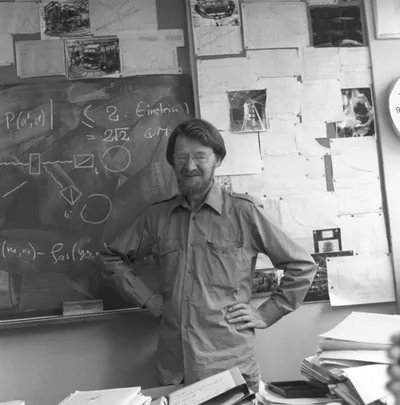 John Stewart Bell1928–1990 · Physics
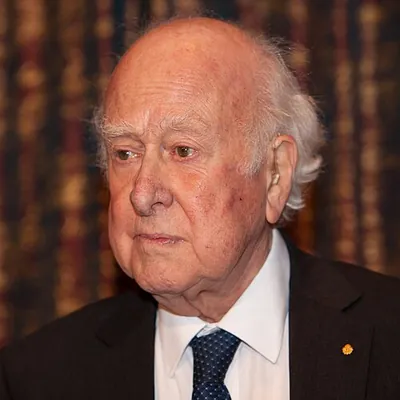 Peter Higgs1929–2024 · Physics
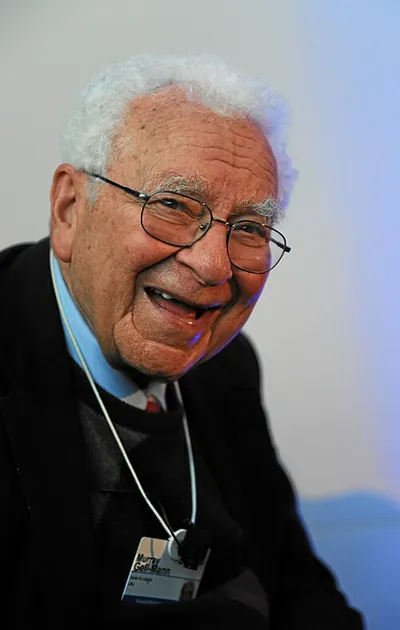 Murray Gell-Mann1929–2019 · Physics
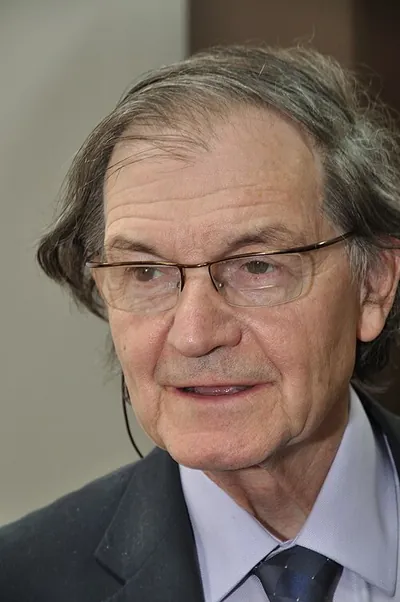 Roger Penrose1931 · Physics
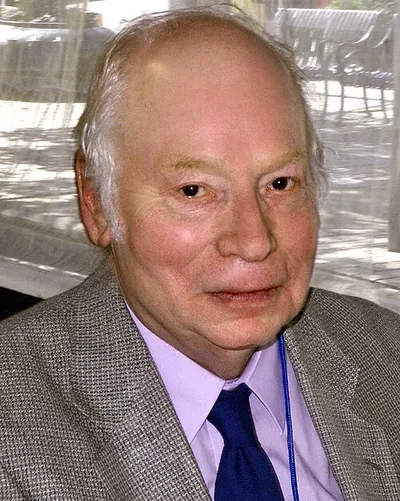 Steven Weinberg1933–2021 · Physics
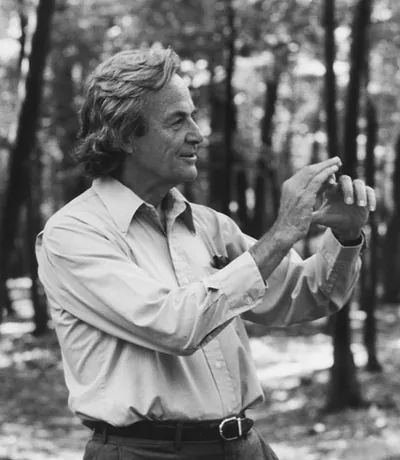 Richard Feynman1918–1988 · Physics
