
Donald William Kerst
American physicist who invented the betatron · 1911–1993
- Born
- November 1, 1911
- Died
- August 19, 1993
- Country
- United States
- Section
- Physics
Biography
Donald William Kerst (Galena, Illinois, 1911 – Madison, Wisconsin, 1993) was an American physicist who devoted his career to particle accelerators and plasma physics. He is best remembered for building the betatron, a machine that speeds up electrons using electromagnetic induction. He worked in the decades when nuclear research and wartime science were reshaping physics, and his legacy extends into plasma research and controlled fusion.
Kerst was born on November 1, 1911, in Galena, Illinois, the son of Herman Samuel Kerst and Lillian E. Wetz. He studied at the University of Wisconsin, earning a bachelor's degree in 1934 and a PhD in 1937. His thesis dealt with electrostatic generators working at air pressure and their use in studying nuclear reactions. He built and tested a 2.3 MeV generator, where MeV means million electron volts, a unit of energy common in particle physics, for experiments on scattering protons.
After graduating, he spent a year at General Electric working on X-ray tubes and machines, a job he found frustrating because the research needed energies that could not yet be produced. In 1938 he took an instructorship at the University of Illinois at Urbana-Champaign, where the physics department head, F. Wheeler Loomis, encouraged him to pursue a more powerful accelerator. That effort produced the betatron. Its principle is simple: a magnetic field that changes over time induces an electric field that pushes electrons around a circular path, speeding them up at each turn. It began operating on July 15, 1940, making Kerst the first person to accelerate electrons by electromagnetic induction, up to 2.3 MeV. In December 1941 he named the machine, combining the Greek letter beta, the symbol for the electron, with the suffix "-tron", meaning instrument.
He went on to build betatrons of growing energy: 20 MeV in 1941, 80 MeV in 1948, and 340 MeV, completed in 1950. Their success came from a deep understanding of the underlying physics and careful design of the magnets, vacuum pumps and power supplies. In 1941 he worked with Robert Serber on the first theoretical analysis of the oscillations that occur inside a betatron. The original 1940 machine was given to the Smithsonian Institution in 1960.
During the Second World War he took leave from Illinois in 1940 and 1941 to work with General Electric's engineers on the betatron. They designed 20 MeV and 100 MeV versions, and he supervised the construction of the first, which he took back to Illinois. He also designed a portable 4 MeV betatron for inspecting unexploded bombs. His background placed him among the scientists Robert Oppenheimer recruited for the Manhattan Project's Los Alamos Laboratory, which was built to design the atomic bomb. In August 1943 he became head of the laboratory's P-7 Group, responsible for the Water Boiler, a nuclear reactor meant as a laboratory instrument for testing critical mass calculations and the effects of different reflector materials. His design used enriched uranium dissolved in water, surrounded by a beryllium oxide reflector. It was the first reactor to use enriched uranium as fuel, and it consumed nearly all of the world's scarce supply at the time. It started operating in May 1944 and by the end of June had met all its design goals.
In August 1944 the laboratory reorganized to focus on an implosion-type bomb, and studying implosion on a large scale required special diagnostics. As early as November 1943 Kerst had proposed using a 20 MeV betatron producing gamma rays, a high-energy form of light, instead of X-rays. He became joint head, with Seth Neddermeyer, of the G-5 Group, which tested the betatron. Oppenheimer had the Illinois betatron shipped to Los Alamos, where it arrived in December. On January 15, 1945, the group took its first betatron pictures of an implosion.
After the war Kerst returned to Illinois. From 1953 to 1957 he was technical director of the Midwestern Universities Research Association, where he developed the spiral-sector focusing principle, which underlies many spiral ridge cyclotrons operating today, and worked on the FFAG accelerator. His team also studied beam stacking, a method of radio-frequency acceleration in fixed-field machines that led to colliding-beam accelerators. From 1957 to 1962 he worked at General Atomics' John Jay Hopkins Laboratory in La Jolla, California, on plasma physics, hoped to be a route to controlled thermonuclear energy. With Tihiro Ohkawa he invented toroidal devices that hold plasma in place with magnetic fields. They completed the work at the University of Wisconsin, where Kerst was a professor from 1962 until retiring in 1980. Their devices were the first to contain plasma without the instabilities that had troubled earlier designs, and the first to hold it for longer than the Bohm diffusion limit, an empirical bound on how quickly plasma escapes. From 1972 to 1973 he chaired the Plasma Physics Division of the American Physical Society.
Kerst married Dorothy Birkett Kerst, and they had two children, Marilyn and Stephen. After retiring they moved to Fort Myers, Florida. He died on August 19, 1993, at University Hospital and Clinics in Madison, Wisconsin, of a brain tumor. His papers are held by the University of Illinois Archives. His legacy lies in the betatron, the ancestor of a whole family of accelerators, and in his work on magnetic confinement of plasma, which remains a reference in fusion research.
Main contributions
- 1940Betatron: the first electron accelerator using electromagnetic induction, reaching 2.3 MeV.
- 1944Water Boiler: a laboratory nuclear reactor at Los Alamos, the first to use enriched uranium as fuel.
- 1945Betatron imaging of implosions: the first pictures of an implosion taken with this method.
- 1950340 MeV betatron, the most energetic machine in his series.
- 1953Spiral-sector focusing: a principle behind many spiral ridge cyclotrons.
- 1960Plasma confinement in toroidal devices with magnetic fields, developed with Tihiro Ohkawa.
Teachers and students
Trivia and anecdotes
The name of the betatron
Kerst chose the name in December 1941, combining the Greek letter beta, the symbol for the electron, with the suffix "-tron", meaning instrument.
A reactor that used most of the available uranium
The Water Boiler required nearly all of the world's enriched uranium available at the time.
Their contemporaries
While Donald William Kerst was alive (1911–1993)…
Alive at the same time
Discovered or invented in those years
- 1916Black holeA region of space where gravity is so strong that nothing, not even light, can escape once it crosses a certain boundary.
- 1925TelevisionA system that sends moving pictures and sound over distance and shows them on a receiver, the television set.
- 1925Quantum mechanicsPhysical theory describing how matter and light behave at atomic and subatomic scales, where energy is exchanged in minimal packets and results are expressed as probabilities.
- 1931Big BangA cosmological model describing how the universe expanded from an early state of extreme density and temperature, about 13.8 billion years ago.
- 1945ComputerA programmable machine that takes in data, processes it by following stored instructions, and produces results, able to switch tasks simply by running different software.
- 1969InternetA global network of interconnected computer networks that communicate using the TCP/IP protocol suite.
 Lev Landau1908–1968 · Physics
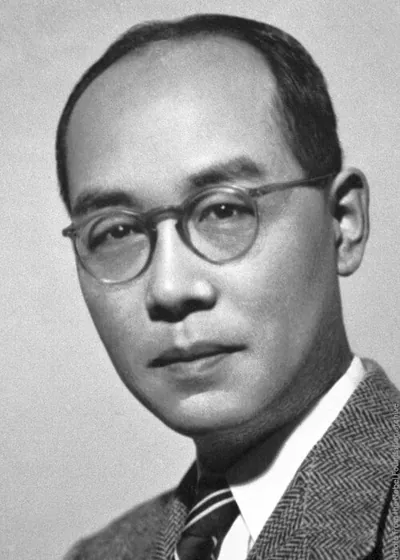 Hideki Yukawa1907–1981 · Physics
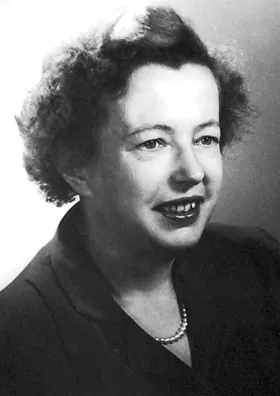 Maria Göppert Mayer1906–1972 · Physics
 Hans Bethe1906–2005 · Physics
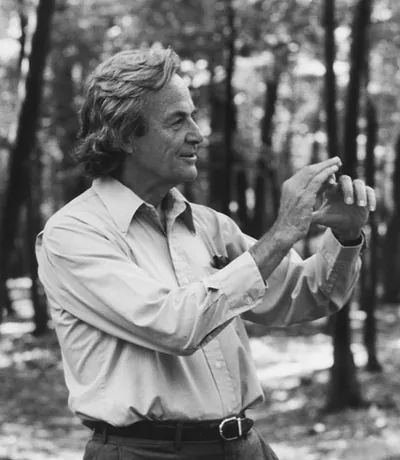 Richard Feynman1918–1988 · Physics
 J. Robert Oppenheimer1904–1967 · Physics
