
Elizabeth Lee Hazen
American microbiologist and physiologist, co-developer of nystatin, the first safe antifungal drug for humans · 1885–1975
- Born
- August 24, 1885
- Died
- June 24, 1975
- Country
- United States
- Section
- Biology
Biography
Elizabeth Lee Hazen (born August 24, 1885, in Rich, Mississippi; died June 24, 1975) was an American microbiologist and physiologist. Her name is linked to nystatin, the first safe and effective antifungal antibiotic for use in people. She developed it in the late 1940s and early 1950s together with the biochemist Rachel Fuller Brown. Their work showed that fungal infections could be treated with a drug that did not do too much harm to the human body, something that had been hard to achieve.
Hazen was born into a modest family in Mississippi. Her parents, William Edgar Hazen and Maggie Harper Hazen, died when she was four, and she and her two brothers were taken in by an aunt and uncle. She attended what was then the Mississippi Industrial Institute and College, now the Mississippi University for Women, and earned a bachelor's degree in science in 1910. While teaching biology and physics at a high school in Jackson, she continued her studies in summer courses at the universities of Tennessee and Virginia. She was then accepted into the biology department at Columbia University, where she earned a master's degree in 1917 and a doctorate in microbiology in 1927. She was among the university's first female doctoral students. During the First World War she worked as a diagnostic laboratory technician for the Army. In the 1920s she studied ricin, a plant toxin, and how it affected botulinum toxin, the poison produced by a bacterium that causes severe food poisoning.
In 1931 she joined the New York State Department of Health, working in the bacterial diagnosis laboratory in New York City. There she helped trace an anthrax outbreak, locate the sources of tularemia, and investigate food poisoning caused by badly preserved food. Over time she became interested in fungi and the diseases they cause, and she began building her own collection of cultures. In 1944, Augustus Wadsworth, the head of the division, put her in charge of research into fungi and how they interact with bacteria and other microbes. Hazen studied fungal infections common in the city, such as pneumonia and thrush, a mouth infection that makes swallowing painful. She still needed a partner who could chemically isolate the active substances microbes produced, so in 1948 she was introduced to Rachel Fuller Brown, who ran a laboratory in Albany.
Their method involved a long chain of shipments between the two cities. Hazen grew actinomycetes, soil bacteria that often slow the growth of fungi, from samples collected across the country. When a sample showed activity, it went to Albany, where Brown prepared extracts and separated out the responsible chemicals. The new samples returned to New York, where Hazen tested their toxicity against two fungi, Candida albicans and Cryptococcus neoformans, and purified the most promising ones. Hazen found a useful microbe in the soil of a friend's dairy farm and named it Streptomyces noursei after the farm's owner, William Nourse. It produced two antifungal substances. One was toxic to mice, but the other, once purified, worked against candidiasis and against a fungus that invaded the lungs and central nervous system. In 1950 the pair presented the discovery to the National Academy of Sciences. They first called it fungicidin, then renamed it nystatin in honor of the New York State Department of Public Health, their employer.
The patent took six and a half years to secure. An application was filed in late 1950, but the product's usefulness had to be proven through animal and human trials before the FDA, the American drug regulator, approved it. The drug was released by Squibb in 1954. A 1954 article then suggested that the method had been published in 1949, which would have made the patent application too late. After an inquiry, the article's author stated there was no such connection, and the U.S. Patent Office granted the patent on June 25, 1957, covering nystatin for the following 17 years. Hazen and Brown received several honors later, including the Squibb Award in Chemotherapy in 1955, a Department of Health distinguished service award when Hazen retired in 1968, and the Rhoda Benham Award of the Medical Mycological Society of the Americas. After her death in 1975 she was inducted into the National Inventors Hall of Fame in 1994.
Hazen's legacy lies in a way of working that combined field sampling with laboratory chemistry, and in a medicine that treats fungal infections in people. Nystatin is still used, especially for infections of the mouth and skin. Her partnership with Brown also shows how joint work between women scientists could produce important results at a time when few women led research.
Main contributions
- 1910Bachelor of science degree from the Mississippi University for Women, the first step in her scientific training.
- 1927Doctorate in microbiology from Columbia University, one of the first awarded to a woman there.
- 1931Joined the New York State Department of Health, where she investigated anthrax, tularemia and food poisoning outbreaks.
- 1950Presentation of nystatin to the National Academy of Sciences, the first safe and effective antifungal drug for people.
- 1954Release of nystatin by the pharmaceutical company Squibb after FDA approval.
- 1957Granting of the nystatin patent, which protected the drug and its preparation method for 17 years.
Trivia and anecdotes
A name taken from a farm
The microbe that gave rise to the antibiotic was found in the soil of a friend's dairy farm and was named after its owner, William Nourse.
A drug named after an employer
The drug was first called fungicidin, but it was renamed nystatin in honor of the New York State Department of Health that employed the researchers.
A disputed patent
A 1954 article suggested the method had been published in 1949, which could have invalidated the application. The suspicion was dropped after an inquiry, and the patent was granted in 1957.
Their contemporaries
While Elizabeth Lee Hazen was alive (1885–1975)…
Alive at the same time
Discovered or invented in those years
- 1903AirplaneA fixed-wing aircraft, heavier than air, powered by engines or rockets, that stays aloft because its wings generate lift.
- 1925TelevisionA system that sends moving pictures and sound over distance and shows them on a receiver, the television set.
- 1925Quantum mechanicsPhysical theory describing how matter and light behave at atomic and subatomic scales, where energy is exchanged in minimal packets and results are expressed as probabilities.
- 1931Big BangA cosmological model describing how the universe expanded from an early state of extreme density and temperature, about 13.8 billion years ago.
- 1945ComputerA programmable machine that takes in data, processes it by following stored instructions, and produces results, able to switch tasks simply by running different software.
- 1969InternetA global network of interconnected computer networks that communicate using the TCP/IP protocol suite.
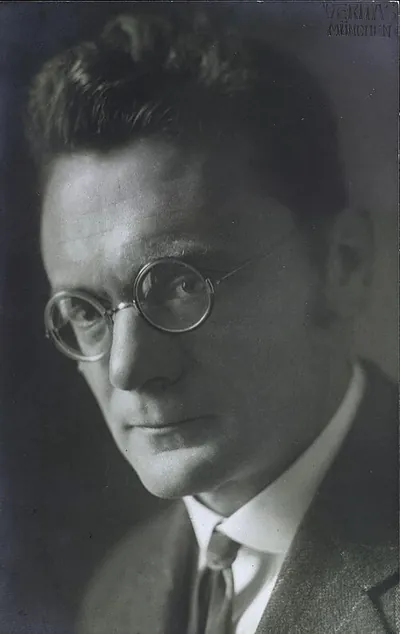 Karl von Frisch1886–1982 · Biology
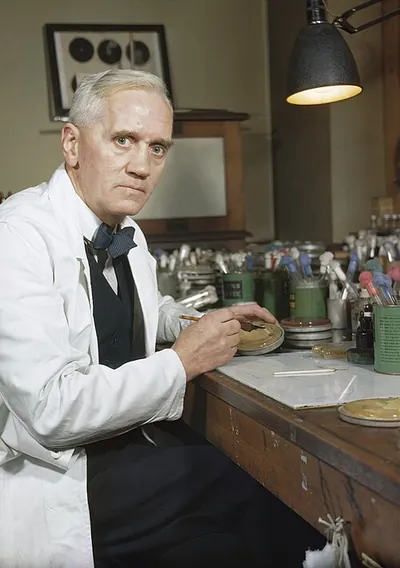 Alexander Fleming1881–1955 · Biology
 Hermann Joseph Muller1890–1967 · Biology
 J.B.S. Haldane1892–1964 · Biology
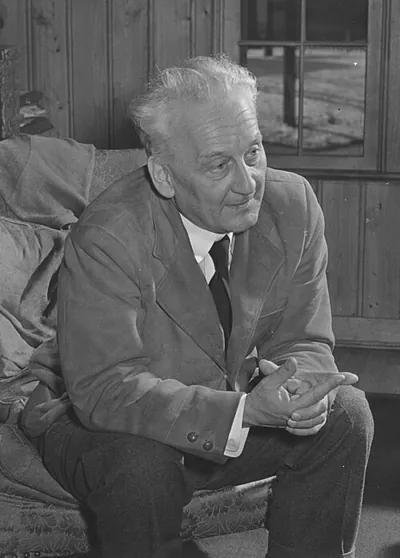 Albert Szent-Györgyi1893–1986 · Biology
 Gerty Cori1896–1957 · Biology
