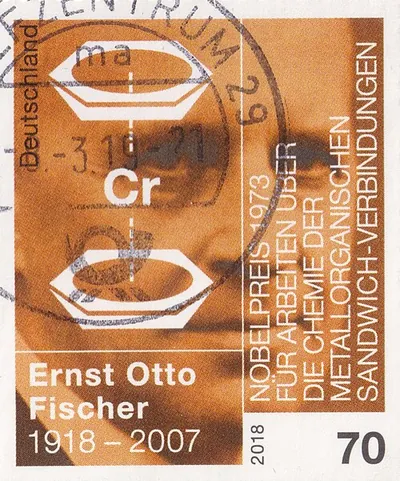
Ernst Otto Fischer
German chemist, Nobel Prize in Chemistry in 1973 for pioneering work in organometallic chemistry · 1918–2007
- Born
- November 10, 1918
- Died
- July 23, 2007
- Country
- Germany
- Section
- Chemistry
- Awards
- Nobel Prize in Chemistry
Biography
Ernst Otto Fischer (born 10 November 1918 in Solln, a district of Munich; died 23 July 2007 in Munich) was a German chemist and university professor who shared the 1973 Nobel Prize in Chemistry for his work on organometallic compounds, molecules in which a metal atom is bonded directly to carbon atoms. His research belongs to the second half of the twentieth century, when this field moved from a laboratory curiosity to a routine tool of chemical synthesis. He matters because he helped open up a whole branch of chemistry and because his sandwich-shaped structures changed how chemists understood the way metals bond to organic molecules.
Fischer was born in Solln, a district on the edge of Munich, into a family with close ties to science. His father, Karl T. Fischer, was a professor of physics at the Technical University of Munich, and his mother was Valentine Danzer. He earned his Abitur, the school-leaving certificate that gives access to university in Germany, in 1937. Before he could complete two years of compulsory military service, the Second World War broke out, and he was sent to serve in Poland, France and Russia. During a period of leave for study, towards the end of 1941, he began to study chemistry at the Technical University of Munich. After the war ended, he was released by the American forces in the autumn of 1945 and resumed his studies, graduating in 1949.
His scientific training continued under Walter Hieber, a professor of inorganic chemistry, in whose institute Fischer worked as an assistant. His doctoral thesis examined the reactions of carbon monoxide with nickel salts in the presence of dithionites and sulfoxylates, compounds that affect how carbon and nickel combine. He received his doctorate in 1952 and stayed at the same university, turning his attention to the chemistry of transition metals, the elements in the middle of the periodic table that often bind to several molecules at once.
The starting point for his best-known discoveries was ferrocene, a compound discovered shortly before, in which an iron atom is held between two rings of carbon atoms. Fischer was not convinced by the structure proposed by Pauson and Keally, and he set out to test it. Shortly afterwards he published structural data on ferrocene and described two related compounds, nickelocene and cobaltocene, in which the metal sits between two rings in the same way. At about the same time he became interested in a confusing area of chemistry that arose from reactions of chromium(III) chloride with phenylmagnesium bromide. From this work he isolated bis(benzene)chromium, a compound in which a chromium atom is sandwiched between two benzene rings. These findings led to a new class of compounds, the sandwich complexes, which had been barely known until then.
His academic career advanced steadily. He was appointed a lecturer at the Technical University of Munich in 1955, became professor in 1957 and a C4 professor, the senior rank in the German system, in 1959. In 1964 he took the chair of inorganic chemistry at the same institution. That year he was also elected a member of the mathematics and natural sciences section of the Bavarian Academy of Sciences, and in 1969 he joined the Leopoldina, one of the oldest scientific academies in Germany. In 1972 the faculty of chemistry and pharmacy of the University of Munich awarded him an honorary doctorate. He lectured in many countries on metal complexes with cyclopentadienyl, indenyl and arene rings, as well as olefins and metal carbonyls. He was Firestone Lecturer at the University of Wisconsin in 1969, visiting professor at the University of Florida in 1971, and Arthur D. Little visiting professor at the Massachusetts Institute of Technology in 1973.
In the 1960s his group discovered complexes in which a metal atom is attached to a carbon atom by a double bond, called alkylidene complexes, and others with a triple bond, called alkylidyne complexes. These are now known as Fischer carbenes and Fischer carbynes, and they serve as useful tools in building organic molecules. Over his career he published about 450 journal articles and trained many doctoral and postdoctoral students, several of whom went on to important careers. In 1973 he received the Nobel Prize in Chemistry together with Geoffrey Wilkinson for his work on these compounds.
Fischer died in Munich on 23 July 2007. At the time of his death he was the oldest living German Nobel laureate. He was succeeded in that position by Manfred Eigen, who won the Nobel Prize in Chemistry in 1967 and is nine years younger than Fischer was. His legacy lies mainly in organometallic chemistry, which today contributes to the manufacture of medicines, materials and catalysts, and in the carbenes and carbynes that bear his name.
Main contributions
- 1973Nobel Prize in Chemistry, shared with Geoffrey Wilkinson, for work on organometallic compounds.
- Challenge to and confirmation of the structure of ferrocene: an iron atom held between two carbon rings, which gave rise to sandwich-type compounds.
- Structural data on nickelocene and cobaltocene, compounds in which the metal sits between two rings.
- Isolation of bis(benzene)chromium, a compound with a chromium atom between two benzene rings.
- Discovery of Fischer carbenes and carbynes, complexes with double and triple bonds between a metal and a carbon.
Teachers and students
Trivia and anecdotes
The oldest living German Nobel laureate
At the time of his death he was the oldest living German Nobel laureate. He was succeeded in that position by Manfred Eigen, who is nine years younger than Fischer was.
A war that interrupted his studies
His university career began late because the Second World War broke out before he had finished his military service, and he was released by the Americans in the autumn of 1945.
Their contemporaries
While Ernst Otto Fischer was alive (1918–2007)…
Alive at the same time
Discovered or invented in those years
- 1925TelevisionA system that sends moving pictures and sound over distance and shows them on a receiver, the television set.
- 1925Quantum mechanicsPhysical theory describing how matter and light behave at atomic and subatomic scales, where energy is exchanged in minimal packets and results are expressed as probabilities.
- 1931Big BangA cosmological model describing how the universe expanded from an early state of extreme density and temperature, about 13.8 billion years ago.
- 1945ComputerA programmable machine that takes in data, processes it by following stored instructions, and produces results, able to switch tasks simply by running different software.
- 1969InternetA global network of interconnected computer networks that communicate using the TCP/IP protocol suite.
- 1989World Wide WebA system of linked documents and resources, connected by hyperlinks and accessed over the Internet with web browsers.
 Derek Barton1918–1998 · Chemistry
 Robert Burns Woodward1917–1979 · Chemistry
 Ilya Prigogine1917–2003 · Chemistry
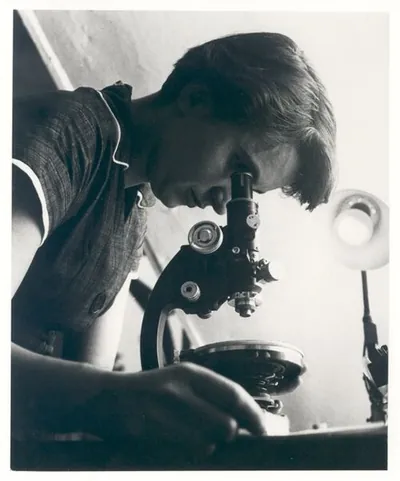 Rosalind Franklin1920–1958 · Chemistry
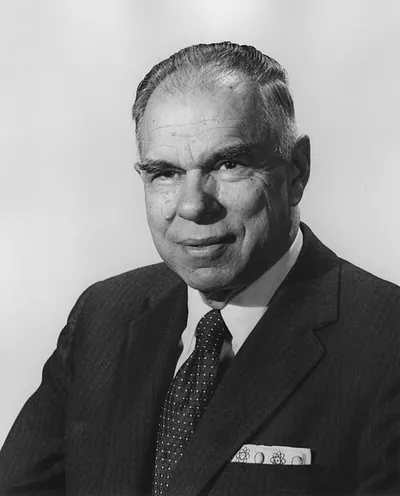 Glenn Theodore Seaborg1912–1999 · Chemistry
