Evgeny Lifshitz
Soviet physicist of Jewish origin, co-author with Landau of the Course of Theoretical Physics and of the BKL conjecture on spacetime singularities · 1915–1985
- Born
- February 21, 1915
- Died
- October 29, 1985
- Country
- Soviet Union
- Section
- Physics
Biography
Evgeny Mikhailovich Lifshitz (Kharkiv, 1915 – 1985) was a Soviet physicist whose name is attached to some of the most widely used theoretical physics textbooks of the twentieth century and to one of the major open questions in general relativity. He worked in the Soviet Union during the consolidation of modern physics, and he is remembered both for his textbooks and for his contributions to gravitation and quantum electrodynamics.
Lifshitz was born on 21 February 1915 into a Jewish family in Kharkov, then part of the Russian Empire and now in Ukraine. His father, Mikhail Ilyich Lifshitz, was a gastroenterologist and professor at the Kharkov Medical Institute. Lifshitz finished secondary school in 1929 and, after a brief spell at a chemical technical college, began studying physics and mechanics at the Kharkov Institute of Mechanical Engineering in 1931, graduating in 1933.
That same year he started doctoral work at the Ukrainian Institute of Physics and Technology under Lev Landau, one of the most influential theorists in the Soviet Union. He completed the postgraduate course and earned a Ph.D. in 1934. In 1939 he also received the higher Soviet degree of Doctor of Sciences (dóktor nauk) from Leningrad State University, a qualification that recognised a mature research career.
His work in general relativity centred on the generic curvature singularity, that is, what happens to spacetime near points where the equations of the theory break down. Together with Isaak Khalatnikov and Vladimir Belinsky he proposed the BKL conjecture, which suggests that spacetime near such singularities behaves in a chaotic, oscillating way. As of 2015, it is widely regarded as one of the most important open problems in classical gravitation.
With Landau he co-authored the Course of Theoretical Physics, a series designed to give graduate-level coverage of the whole of physics. The volumes remain in wide use and are still valued as teaching texts. Lifshitz was also only the second of 43 people ever to pass Landau's demanding "Theoretical Minimum" examination, a test Landau used to select his collaborators.
In quantum electrodynamics, the theory describing how light and matter interact through quantised energy, he calculated the Casimir force for arbitrary macroscopic arrangements of metals and dielectrics. This is a quantum attraction that acts between closely spaced surfaces even in vacuum. In 1975 a special multicritical point in phase transition studies was named the Lifshitz point in his honour.
Lifshitz died on 29 October 1985, at the age of seventy, after coronary surgery for a heart condition that had developed rapidly. His legacy lives on in the textbooks that continue to train physicists and in the open problem his conjecture left to the relativity community.
Main contributions
- 1934Earned his Ph.D. under Lev Landau after completing his postgraduate training in Kharkov.
- 1939Received the higher Soviet doctorate (Doctor of Sciences) from Leningrad State University.
- 1975Naming of the Lifshitz point, a multicritical point in phase transitions, in his honour.
- Co-authorship of the BKL conjecture, describing chaotic spacetime behaviour near generic curvature singularities.
- Co-authored with Lev Landau the Course of Theoretical Physics, a series of advanced textbooks covering all of physics.
- Calculation of the Casimir force for arbitrary macroscopic arrangements of metals and dielectrics.
Teachers and students
Trivia and anecdotes
Landau's examination
Lifshitz was the second of only 43 people to pass Landau's "Theoretical Minimum" examination.
A physicist brother
He was the brother of the physicist Ilya Lifshitz.
Their contemporaries
While Evgeny Lifshitz was alive (1915–1985)…
Alive at the same time
Discovered or invented in those years
- 1916Black holeA region of space where gravity is so strong that nothing, not even light, can escape once it crosses a certain boundary.
- 1925TelevisionA system that sends moving pictures and sound over distance and shows them on a receiver, the television set.
- 1925Quantum mechanicsPhysical theory describing how matter and light behave at atomic and subatomic scales, where energy is exchanged in minimal packets and results are expressed as probabilities.
- 1931Big BangA cosmological model describing how the universe expanded from an early state of extreme density and temperature, about 13.8 billion years ago.
- 1945ComputerA programmable machine that takes in data, processes it by following stored instructions, and produces results, able to switch tasks simply by running different software.
- 1969InternetA global network of interconnected computer networks that communicate using the TCP/IP protocol suite.
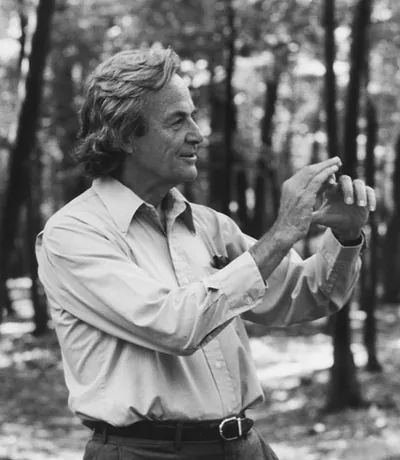 Richard Feynman1918–1988 · Physics
 Lev Landau1908–1968 · Physics
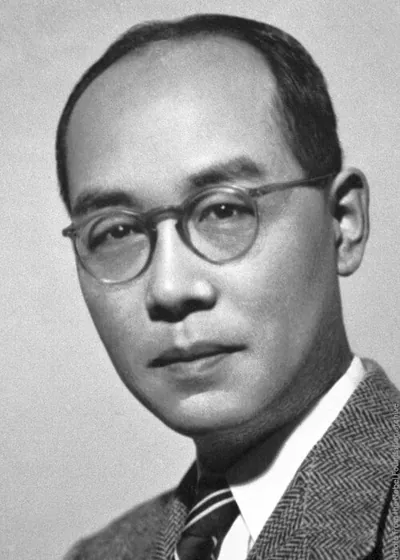 Hideki Yukawa1907–1981 · Physics
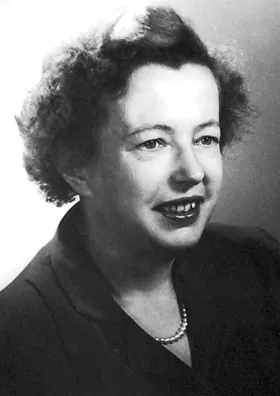 Maria Göppert Mayer1906–1972 · Physics
 Hans Bethe1906–2005 · Physics
 J. Robert Oppenheimer1904–1967 · Physics