
Frigyes Riesz
Hungarian mathematician, pioneer of functional analysis and older brother of Marcel Riesz · 1880–1956
- Born
- January 22, 1880
- Died
- February 28, 1956
- Country
- Hungary
- Section
- Mathematics
Biography
Frigyes Riesz (Győr, 1880 - Budapest, 1956) was a Hungarian mathematician who, together with his younger brother Marcel Riesz, laid the foundations of functional analysis, a branch of mathematics that studies spaces of functions and the transformations acting on them. His work later found applications in physics, and several results still bear his name.
He was born into a Jewish family in Győr, then part of Austria-Hungary. He became a university professor, and from 1911 to 1919 he held a chair at the Franz Joseph University in Kolozsvár, today Cluj-Napoca in Romania. After the First World War, the Treaty of Trianon handed that territory to the Kingdom of Romania. The university moved to Szeged in Hungary and took the name University of Szeged. Riesz stayed on there as a professor and later served as rector. He was also a member of the Hungarian Academy of Sciences and of the Polish Academy of Learning.
His best-known achievement is the spectral theory of bounded symmetric operators, set out in a form very close to the one now considered standard. An operator is, put simply, a rule that turns one function into another; spectral theory asks which special values attached to that rule allow it to be described completely. Riesz also contributed to ergodic theory, which studies the long-run average behaviour of systems that evolve over time, and to topology, the study of properties of shapes that survive stretching without tearing. He also gave an elementary proof of the mean ergodic theorem, a result that had previously required more advanced machinery.
Together with Alfréd Haar he founded the journal Acta Scientiarum Mathematicarum, which became an important outlet for mathematical research in the region. His lectures were unusual too. He entered the lecture hall with an assistant and a docent: the docent read the relevant passages from his handbook, the assistant wrote the equations on the blackboard, and Riesz stood to one side, nodding now and then. The Swiss-American mathematician Edgar Lorch spent 1934 in Szeged working with him and later wrote a reminiscence of that time, including their collaboration. The compilation of his bibliography was carried out by Pál Medgyessy.
Riesz's legacy lies chiefly in functional analysis. His work, alongside his brother's, shaped a field that still underpins much of mathematical physics and the theory of equations. His book Functional Analysis, written with Béla Sz.-Nagy and first published in 1955, remained a standard reference for decades.
Main contributions
- Spectral theory of bounded symmetric operators: describes these transformations completely through their characteristic values.
- Elementary proof of the mean ergodic theorem: shows that time averages of a system converge, using a simpler argument than those known before.
- Contributions to topology: work on the properties of spaces that are preserved under deformation.
- Founding of the journal Acta Scientiarum Mathematicarum together with Alfréd Haar.
Teachers and students
Studied under:
Taught:
Trivia and anecdotes
An unusual lecture method
Riesz gave his lectures with an assistant writing on the blackboard and a docent reading from his handbook, while he stood aside, nodding occasionally.
Their contemporaries
While Frigyes Riesz was alive (1880–1956)…
Alive at the same time
Discovered or invented in those years
- 1884CarA road vehicle with four wheels and its own engine, mainly built to carry people.
- 1903AirplaneA fixed-wing aircraft, heavier than air, powered by engines or rockets, that stays aloft because its wings generate lift.
- 1925TelevisionA system that sends moving pictures and sound over distance and shows them on a receiver, the television set.
- 1925Quantum mechanicsPhysical theory describing how matter and light behave at atomic and subatomic scales, where energy is exchanged in minimal packets and results are expressed as probabilities.
- 1931Big BangA cosmological model describing how the universe expanded from an early state of extreme density and temperature, about 13.8 billion years ago.
- 1945ComputerA programmable machine that takes in data, processes it by following stored instructions, and produces results, able to switch tasks simply by running different software.
 Emmy Noether1882–1935 · Mathematics
 G.H. Hardy1877–1947 · Mathematics
 Henri Lebesgue1875–1941 · Mathematics
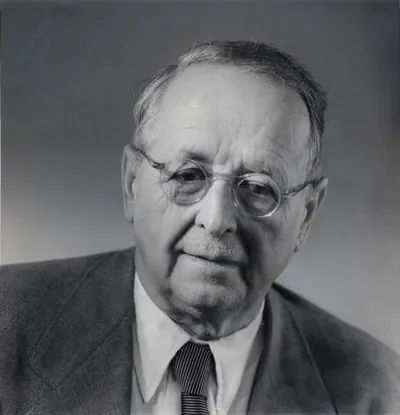 Hermann Weyl1885–1955 · Mathematics
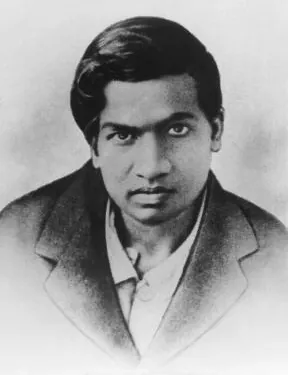 Srinivasa Ramanujan1887–1920 · Mathematics
 Bertrand Russell1872–1970 · Mathematics
