
Hugo Theorell
Swedish biochemist, Nobel Prize in Physiology or Medicine in 1955 for his work on oxidation enzymes · 1903–1982
- Born
- July 6, 1903
- Died
- August 15, 1982
- Country
- Sweden
- Section
- Chemistry
- Awards
- Nobel Prize in Physiology or Medicine
Biography
Axel Hugo Theodor Theorell (6 July 1903 – 15 August 1982) was a Swedish biochemist who received the Nobel Prize in Physiology or Medicine in 1955. He worked in the first half of the twentieth century, when biochemistry was beginning to show how cells turn food into energy. His importance lies in clarifying the role of enzymes, the proteins that speed up chemical reactions in the body, and especially the oxidation enzymes that move electrons from one substance to another.
He was born in Linköping to Thure Theorell and Armida Bill. He finished secondary school at the Katedralskolan in his home town in May 1921. That autumn he began studying medicine at the Karolinska Institute in Stockholm, graduating as a Bachelor of Medicine in 1924. He then spent three months studying bacteriology, the science of bacteria, at the Pasteur Institute in Paris under Professor Albert Calmette. In 1930 he earned his medical doctorate with a thesis on the lipids of blood plasma, the fats dissolved in the liquid part of the blood. He was soon appointed professor of physiological chemistry at the Karolinska, and from that post his attention turned to enzymes, the subject he would pursue for the rest of his working life.
In 1936 he became head of the newly founded Biochemical Department of the Nobel Medical Institute, which gave him a permanent laboratory and a stable team. He was the first researcher connected with that institute to be awarded a Nobel Prize. His studies of oxidation enzymes, a family now known as oxidoreductases, explained how these proteins operate and how they help release energy from food. One of his most notable advances concerned alcohol dehydrogenases, the enzymes that break down alcohol in the liver and other tissues. He also put forward a theory on how sodium fluoride harms cofactors, small helper molecules that some enzymes cannot work without. Universities in France, Belgium, Brazil and the United States gave him honorary degrees, and he was elected to American bodies such as the American Academy of Arts and Sciences and the United States National Academy of Sciences.
In his family life he was the father of Töres Theorell, a physician and scientist born in 1942, and the grandfather of Tobias Theorell, born in 1969. He was married to Elin Margit Elisabeth Alenius, a distinguished pianist and harpsichordist who died in 2002. Theorell died in Stockholm in 1982 and is buried beside her at Norra begravningsplatsen, the Northern Cemetery.
His legacy lives on in modern biochemistry. His work on oxidation enzymes and on the way the body processes alcohol gave later researchers a foundation for understanding human metabolism.
Main contributions
- 1930Doctoral thesis on the lipids of blood plasma, the fats carried in the blood, which earned him his medical doctorate.
- 1936Establishment and leadership of the Biochemical Department of the Nobel Medical Institute, devoted to the study of enzymes.
- 1955Nobel Prize for discovering the nature and mode of action of oxidoreductase enzymes.
- Studies of alcohol dehydrogenases, the enzymes that break down alcohol in the liver and other tissues.
- Theory on the toxic effects of sodium fluoride on the cofactors of key human enzymes.
Teachers and students
Trivia and anecdotes
A first taste of Paris
Before finishing his training, he spent three months at the Pasteur Institute in Paris learning bacteriology under Albert Calmette.
A family of talent
His son Töres Theorell also became a physician-scientist, and his wife, Elin Margit Elisabeth Alenius, was a highly regarded pianist and harpsichordist.
Their contemporaries
While Hugo Theorell was alive (1903–1982)…
Alive at the same time
Discovered or invented in those years
- 1903AirplaneA fixed-wing aircraft, heavier than air, powered by engines or rockets, that stays aloft because its wings generate lift.
- 1925TelevisionA system that sends moving pictures and sound over distance and shows them on a receiver, the television set.
- 1925Quantum mechanicsPhysical theory describing how matter and light behave at atomic and subatomic scales, where energy is exchanged in minimal packets and results are expressed as probabilities.
- 1931Big BangA cosmological model describing how the universe expanded from an early state of extreme density and temperature, about 13.8 billion years ago.
- 1945ComputerA programmable machine that takes in data, processes it by following stored instructions, and produces results, able to switch tasks simply by running different software.
- 1969InternetA global network of interconnected computer networks that communicate using the TCP/IP protocol suite.
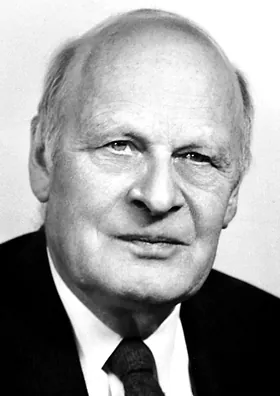 Lars Onsager1903–1976 · Chemistry
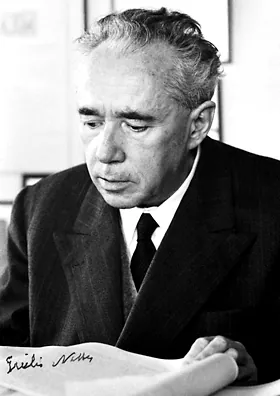 Giulio Natta1903–1979 · Chemistry
 Linus Pauling1901–1994 · Chemistry
 Willard Libby1908–1980 · Chemistry
 Cyril Norman Hinshelwood1897–1967 · Chemistry
