
James Hopwood Jeans
British physicist, astronomer and mathematician who worked on cosmology and popularised science · 1877–1946
- Born
- September 11, 1877
- Died
- September 16, 1946
- Country
- United Kingdom
- Section
- Astronomy and space
Biography
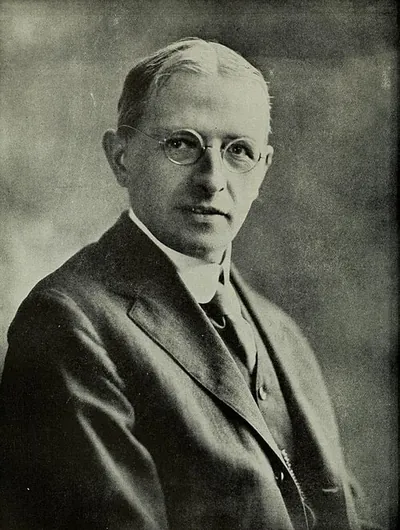
James Hopwood Jeans (Ormskirk, Lancashire, 1877 – Dorking, Surrey, 1946) was a British physicist, mathematician and astronomer whose work spanned the formation of stars and planets, radiation theory and cosmology during the first half of the twentieth century. He was also one of the most widely read science writers of his time, at a moment when relativity and quantum theory were reshaping the picture of the universe. His name survives in concepts such as the Jeans length and the Rayleigh-Jeans law.
The son of William Tulloch Jeans, a parliamentary correspondent and author, he was educated at Merchant Taylors' School and Wilson's Grammar School in Camberwell before entering Trinity College, Cambridge. He prepared for the Mathematical Tripos, the demanding examination that Cambridge used to rank its mathematicians, and finished second in 1898. His preparation followed a highly competitive approach built around solving problems quickly and accurately, a habit that shaped his working style for years.
He was elected a Fellow of Trinity in 1901 and taught at Cambridge before moving to Princeton University in 1904 as professor of applied mathematics. His first major book, The Dynamical Theory of Gases (1904), applied statistical methods to the motion of gas molecules, a way of explaining heat and pressure through the behaviour of countless tiny particles. He returned to Cambridge in 1910. From 1923 to 1944 he was associated with the Mount Wilson Observatory, operated with Caltech, where he could follow observations of stars and galaxies closely.
His work covered quantum theory, radiation and stellar evolution. Studying rotating bodies, he concluded that Laplace's idea that the Solar System formed from a single cloud of gas was mistaken. He proposed instead that the planets condensed from material torn out of the Sun by the close passage of another star. The hypothesis was taken seriously for a time but is not accepted today. In cosmology he shared with Arthur Eddington the role of founding the British school of the subject. In 1928 he put forward a steady state model in which matter was continually created across the universe. The idea lost ground after the cosmic microwave background was discovered in 1965 and read as the afterglow of the Big Bang.
Two of his results carry his name. The Jeans length is the critical radius of an interstellar cloud: a cloud smaller than this cannot overcome its own gas pressure with gravity and stays put, while a larger one collapses to form a star. His version of the relevant equation, the Jeans instability, gives the minimum mass a cloud must reach before it collapses. Together with Lord Rayleigh, he helped establish the Rayleigh-Jeans law, which links the energy radiated by a black body to its temperature, an important step on the road to quantum physics.
His private life was eventful. He married the American poet Charlotte Mitchell in 1907; she died in 1934. In 1935 he married the Austrian organist and harpsichordist Suzanne Hock, known as Susi Jeans, and the couple had three children. After retiring in 1929 he devoted much of his energy to books for general readers, including The Mysterious Universe (1930), in which he argued for an idealist view that consciousness was more fundamental than matter. Other scientists and philosophers disputed that position. He was a Fellow of the Royal Society, received the Gold Medal of the Royal Astronomical Society in 1922, and was knighted in 1928. A lunar crater, a crater on Mars and the asteroid 2763 Jeans commemorate him.
His legacy is divided between the astrophysics of star formation, where the Jeans length remains a working tool, and popular science, through which he helped bring relativity and cosmology to a wide audience. His views on the origin of the Solar System and on the steady state model have been superseded, but his clear writing and his way of tackling problems still stand as examples of the popular science of his era.
Main contributions
- 1904The Dynamical Theory of Gases: a book explaining gas behaviour through the statistical motion of its molecules.
- 1906Theoretical Mechanics: a monograph on theoretical mechanics, the branch of physics dealing with motion and its causes.
- 1908Mathematical Theory of Electricity and Magnetism: a mathematical treatise on electricity and magnetism.
- 1917Bakerian Lecture to the Royal Society, one of the society's most prestigious talks, on his theoretical physics work.
- 1928Steady state theory: the proposal that matter is continually created across the universe, later abandoned.
- 1928Jeans length: the critical radius above which an interstellar cloud collapses to form a star.
- 1930The Mysterious Universe: a popular book arguing for an idealist view of the cosmos.
- 1943Physics and Philosophy: a work comparing the views of science and philosophy on reality.
Teachers and students
Studied under:
Taught:
Trivia and anecdotes
A misattributed quotation
The mnemonic for the first fifteen digits of π, in which each word's length gives a digit, is often credited to the Hungarian mathematician George Pólya, although the source links it to Jeans.
A death mask
After his death in 1946, a death mask of his face was made; the Royal Society now holds it.
A quartet in his honour
Robert Simpson's String Quartet No. 7 was written as a tribute on the centenary of his birth, in 1977.
Related discoveries and inventions
- 1902Jeans instabilityA gravitational process in which a gas cloud contracts and can form a star when its internal gas pressure is too weak to resist its own weight.
Their contemporaries
While James Hopwood Jeans was alive (1877–1946)…
Alive at the same time
Discovered or invented in those years
- 1884CarA road vehicle with four wheels and its own engine, mainly built to carry people.
- 1903AirplaneA fixed-wing aircraft, heavier than air, powered by engines or rockets, that stays aloft because its wings generate lift.
- 1925TelevisionA system that sends moving pictures and sound over distance and shows them on a receiver, the television set.
- 1925Quantum mechanicsPhysical theory describing how matter and light behave at atomic and subatomic scales, where energy is exchanged in minimal packets and results are expressed as probabilities.
- 1931Big BangA cosmological model describing how the universe expanded from an early state of extreme density and temperature, about 13.8 billion years ago.
- 1945ComputerA programmable machine that takes in data, processes it by following stored instructions, and produces results, able to switch tasks simply by running different software.
 Henry Norris Russell1877–1957 · Astronomy and space
 Milutin Milanković1879–1958 · Astronomy and space
 Karl Schwarzschild1873–1916 · Astronomy and space
 Ejnar Hertzsprung1873–1967 · Astronomy and space
 Arthur Eddington1882–1944 · Astronomy and space
 Henrietta Swan Leavitt1868–1921 · Astronomy and space
