
John Renshaw Carson
American engineer and transmission theorist who invented single-sideband modulation · 1886–1940
- Born
- June 28, 1886
- Died
- October 31, 1940
- Country
- United States
- Section
- Technology and communications
Biography
John Renshaw Carson (1886-1940) was an American engineer and transmission theorist who worked on the first communication systems that used wires and radio. He lived during the years when long-distance telephony and radio telephony were expanding, and his importance lies in giving engineers mathematical tools to understand how signals travel and how much frequency space they occupy.
He was born in Pittsburgh, Pennsylvania, and studied at Princeton together with his twin brother Joseph. He graduated with a Bachelor of Science in 1907. That same year he began at the Massachusetts Institute of Technology (MIT), but he stayed there only from 1907 to 1908. He then returned to Princeton, where he earned his electrical engineering degree in 1909 and a master's degree in 1912.
Between 1912 and 1914 he taught electrical engineering and physics at Princeton. In 1913 he was offered a post at American Telephone & Telegraph (AT&T), and in 1914 he left the university to join the company. There he worked on early radio telephone systems and on carrier telephony, a technique that lets several conversations share the same wires by mixing each one onto a higher-frequency wave.
His best-known contribution to telephony was single-sideband modulation. When a signal is modulated in amplitude, it produces two bands of frequencies on either side of the carrier wave. In 1915 Carson proposed sending only one of these bands and suppressing the carrier. The result was a narrower bandwidth and less power needed, and the method was used on long-distance telephone circuits, including the carrier installation between Pittsburgh and Baltimore. His patent application was filed in December 1915 and granted in March 1923.
In 1922 he published a mathematical treatment of frequency modulation (FM). In it he defined instantaneous frequency, the frequency of a signal at any given moment, and set out the bandwidth rule that bears his name, a rough formula for estimating how much spectrum an FM signal needs. In the same paper he gave a negative view of narrowband FM, where the frequency swing is smaller than the audio bandwidth. That judgement later proved questionable, because Edwin Armstrong showed that FM can be advantageous when the swing is considerably wider than the audio bandwidth.
Between 1917 and 1925 he studied how filters affect amplitude modulation, using operational calculus, a mathematical method for analysing circuits. This allowed designers to predict crosstalk, the interference between calls that shared a single pair of wires. His papers appeared in the Bell System Technical Journal and culminated in his 1926 book Electrical Circuit Theory and Operational Calculus.
From 1925 to 1940 he worked for Bell Telephone Laboratories as a mathematician and electrical engineer. A notable task of that period was his mathematical analysis of the waveguide experiments George C. Southworth carried out in 1932. He received the IRE Morris N. Liebmann Memorial Award in 1924, an honorary Doctor of Science degree from the Brooklyn Polytechnic Institute in 1937, and the Elliott Cresson Medal from the Franklin Institute in 1939. He died in 1940.
His legacy is that of a theorist who turned practical telephone problems into equations. Single-sideband modulation and the FM bandwidth rule remain closely associated with his name, and his work helped communication networks grow more efficiently.
Main contributions
- 1915Single-sideband modulation: only one band of the signal is sent and the carrier is suppressed, requiring less bandwidth and power.
- 1922Carson bandwidth rule: a rough formula for estimating how much spectrum a frequency-modulated signal occupies.
- 1922Mathematical treatment of frequency modulation, including the definition of instantaneous frequency.
- 1926Electrical Circuit Theory and Operational Calculus: a book gathering his study of filters and of operational calculus applied to circuits.
- 1936Mathematical theory of high-frequency waveguides, written with S. P. Mead and S. A. Schelkunoff.
Trivia and anecdotes
Two brothers at Princeton
Carson studied at Princeton alongside his twin brother Joseph, and the two shared their university years at the same institution.
A judgement that was revised
His negative view of narrowband FM was later qualified by Edwin Armstrong, who showed that FM could be useful with a much wider frequency swing.
Archived letters
His letters from his time as an undergraduate are kept in the archives of Princeton University.
Their contemporaries
While John Renshaw Carson was alive (1886–1940)…
Alive at the same time
Discovered or invented in those years
- 1897ElectronA negatively charged subatomic particle found in every atom, and key to electricity and chemical bonding.
- 1903AirplaneA fixed-wing aircraft, heavier than air, powered by engines or rockets, that stays aloft because its wings generate lift.
- 1916Black holeA region of space where gravity is so strong that nothing, not even light, can escape once it crosses a certain boundary.
- 1925TelevisionA system that sends moving pictures and sound over distance and shows them on a receiver, the television set.
- 1925Quantum mechanicsPhysical theory describing how matter and light behave at atomic and subatomic scales, where energy is exchanged in minimal packets and results are expressed as probabilities.
- 1931Big BangA cosmological model describing how the universe expanded from an early state of extreme density and temperature, about 13.8 billion years ago.
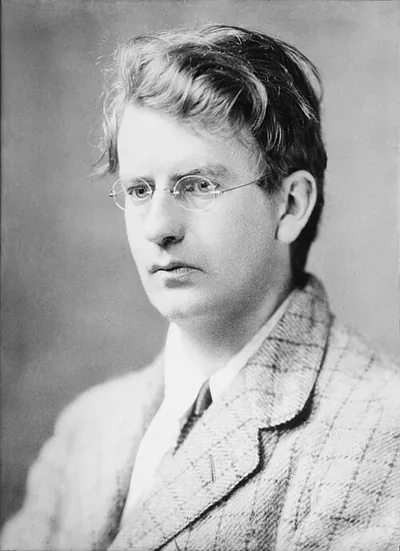 John Logie Baird1888–1946 · Technology and communications
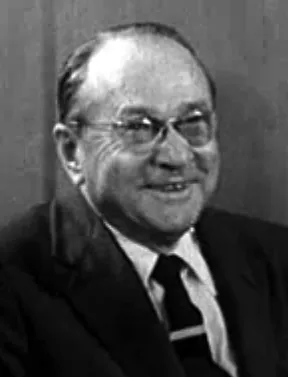 Vladimir K. Zworykin1888–1982 · Technology and communications
 Edwin Howard Armstrong1890–1954 · Technology and communications
 Vannevar Bush1890–1974 · Technology and communications
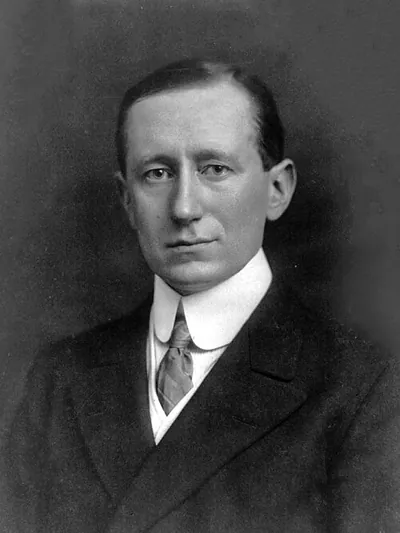 Guglielmo Marconi1874–1937 · Technology and communications
