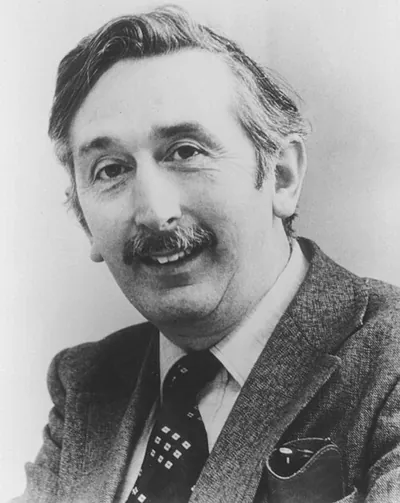
Karl Johan Åström
Swedish control theorist and engineer, a leading figure in adaptive and computer control · 1934
- Born
- August 5, 1934
- Country
- Sweden
- Section
- Engineering and construction
Biography
Karl Johan Åström (born in Östersund, Sweden, in 1934) is a Swedish control theorist and engineer and one of the central figures in his field, which studies how to make machines and processes behave as intended. His work covers control theory, computer control and adaptive control, and he helped bring demanding mathematical methods into industrial practice. His ideas underpin regulation systems that are now taken for granted, from factory controllers to the devices that keep a temperature or a machine speed steady.
Åström studied Engineering Physics and earned his doctorate in Automatic Control and Mathematics in 1960 at the Royal Institute of Technology (KTH) in Stockholm, where he also taught from 1955 to 1960. In parallel he worked on inertial guidance for the Swedish National Defence Research Institute. Inertial guidance is the technique of working out where a vehicle is and which way it points by measuring its own accelerations and turns, without relying on outside signals. That experience with sensors and real-time calculation gave him a solid base for what followed.
In 1961 he joined the IBM Nordic Laboratory to work on computerized process control, meaning the use of computers to monitor and adjust industrial processes continuously. He spent time at IBM Research in Yorktown Heights, New York (1962), and in San Jose, California (1963). After returning to Sweden he led the work on computer control of paper manufacturing machinery, a setting where theory had to function with noisy equipment and changing conditions.
In 1965 he was named chair of the newly founded Department of Automatic Control at Lund University, a post he held until 1999. He is now professor emeritus there. Since 2002 he has been distinguished visiting professor at the University of California, Santa Barbara.
His best-known theoretical contribution also dates from 1965, when he described a general framework for Markov decision processes with incomplete information. A Markov process is a model in which what happens next depends only on the present state, and in Åström's formulation the system cannot fully observe that state. The idea ultimately led to the notion of the partially observable Markov decision process, a concept widely used today in artificial intelligence and robotics. Together with Wittenmark he also studied self-tuning regulators, devices that adjust their own parameters based on the data they receive. Their 1973 paper on the subject is a standard reference in the area.
His books have served students and practitioners alike: Introduction to Stochastic Control (1970), Adaptive Control (1989) and Computer-Controlled Systems (1996), the last two written with Wittenmark; Advanced PID Control (2005), with T. Hägglund; and Feedback Systems (2008), written with R. Murray for scientists and engineers. PID control is one of the most widespread methods in industry: it adjusts an action according to the current error, its accumulation over time and how fast it is changing.
He is a member of the Royal Swedish Academy of Sciences, a Fellow of the IEEE and a foreign associate of the US National Academy of Engineering, which elected him in 1995 for his contributions to identification and to stochastic and adaptive control. He received the ASME Rufus Oldenburger Medal in 1985, the International Federation of Automatic Control Quazza Medal in 1987 and the IEEE Medal of Honor in 1993. In 1987 he was also awarded an honorary doctorate by the Institut National Polytechnique de Grenoble.
His legacy lies in bridging mathematical theory and engineering practice in control, and in training generations of researchers and engineers through his books and through the school at Lund.
Main contributions
- 1965A general framework for Markov decision processes with incomplete information, which led to the idea of the partially observable Markov decision process.
- 1970Introduction to Stochastic Control, a book on controlling systems subject to random disturbances.
- 1973Paper with Wittenmark on self-tuning regulators, which adjust their own parameters according to the data they receive.
- 1989Adaptive Control, written with Wittenmark, on systems that adjust themselves to changing conditions.
- 1996Computer-Controlled Systems, Theory and Design, written with Wittenmark, which received an IFAC textbook award for its first edition.
- 2005Advanced PID Control, written with Hägglund, on the PID controller, one of the most widely used control methods in industry.
- 2008Feedback Systems, an introduction to control written with Murray for scientists and engineers.
Teachers and students
Studied under:
Taught:
Trivia and anecdotes
A book recognized twice
Computer-Controlled Systems received an IFAC textbook award for its first edition in 1993. Feedback Systems received the same recognition in 2011.
Honours from Grenoble and the IEEE
In 1987 Grenoble awarded him an honorary doctorate. In 1993 the IEEE gave him its Medal of Honor for fundamental contributions to the theory and applications of adaptive control.
Their contemporaries
While Karl Johan Åström was alive (1934–)…
Alive at the same time
Discovered or invented in those years
- 1945ComputerA programmable machine that takes in data, processes it by following stored instructions, and produces results, able to switch tasks simply by running different software.
- 1957Artificial satelliteAn artificial satellite is a human-made object placed in orbit around a celestial body, usually Earth, to collect information, relay signals, or carry out a specific task.
- 1969InternetA global network of interconnected computer networks that communicate using the TCP/IP protocol suite.
- 1971EmailA network service that lets users send and receive digital messages through addressed mailboxes, much like postal mail but electronic.
- 1973Mobile phoneA handheld wireless phone that lets people make and receive calls while moving across a cellular network area.
- 1989World Wide WebA system of linked documents and resources, connected by hyperlinks and accessed over the Internet with web browsers.
 Rudolf E. Kálmán1930–2016 · Engineering and construction
 Fazlur Khan1929–1982 · Engineering and construction
 Godfrey Hounsfield1919–2004 · Engineering and construction
 Borys Paton1918–2020 · Engineering and construction