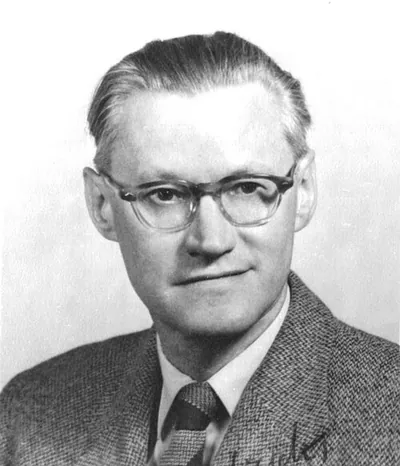
Kurt Otto Friedrichs
German-American mathematician, co-founder of the Courant Institute and specialist in applied mathematics · 1901–1982
- Born
- September 28, 1901
- Died
- December 31, 1982
- Country
- United States, Germany
- Section
- Mathematics
Biography
Kurt Otto Friedrichs (Kiel, 1901 – New Rochelle, 1982) was a German-born mathematician who became one of the central figures of applied mathematics in the twentieth century after settling in the United States. His work on partial differential equations, the equations that describe how quantities such as temperature, pressure or fluid velocity change across space and time, made him a key reference for physicists and engineers, and he helped build in New York one of the most influential research centres in his field.
Friedrichs was born in Kiel, in northern Germany, on 28 September 1901. His family moved soon afterwards to Düsseldorf, where he grew up. Before settling on mathematics he studied at several German universities and was drawn to the philosophy of Heidegger and Husserl. He eventually concluded that mathematics was his true vocation, and in the 1920s he went to Göttingen, which had a renowned mathematics institute under Richard Courant. The two men became close colleagues and friends for life.
In 1931 he became a full professor of mathematics at the Technische Hochschule in Braunschweig. A few days after Hitler became Chancellor of Germany in early 1933, he met a young Jewish student, Nellie Bruell, and fell in love with her. The antisemitic Nuremberg Laws made their relationship increasingly difficult. In 1937 both managed to emigrate separately to New York City, where they married. The couple had five children, and their marriage is described as long and very happy.
Courant had left Germany in 1933 and founded a graduate institute for mathematics at New York University. Friedrichs joined him on arriving there in 1937 and stayed for forty years. He played a decisive part in building what became the Courant Institute of Mathematical Sciences, now one of the world's leading centres for applied mathematics. His best-known contribution is his work on partial differential equations, but he also studied existence theory, numerical methods for computing solutions, differential operators in Hilbert spaces (abstract infinite-dimensional mathematical spaces), solitary waves, shock waves, combustion, relativistic flows, quantum field theory and scattering theory. He wrote many papers and several influential books, including a treatise on spectral theory of operators that is still widely cited.
With Élie Cartan he gave a geometric formulation of Newtonian gravitation, known as Newton–Cartan theory, which other authors later extended. He was elected to the US National Academy of Sciences in 1959 and received many honours. In 1977 President Jimmy Carter awarded him the National Medal of Science for applying modern mathematics to problems in physics, fluid dynamics and elasticity.
His legacy lives on in the Courant Institute, which continues to train researchers in applied mathematics, and in a student prize bearing his name at New York University.
Main contributions
- 1931Full professorship of mathematics at the Technische Hochschule in Braunschweig, his first major academic post.
- 1954Josiah Willard Gibbs lecturer of the American Mathematical Society, an honour bestowed by that society.
- 1965Perturbation of Spectra in Hilbert Space: a study of how the spectra of mathematical operators change when they are slightly modified.
- 1971Fluid Dynamics, written with Richard von Mises, on the mathematical behaviour of fluids.
- 1977National Medal of Science, awarded by President Jimmy Carter for applying modern mathematics to physics and elasticity.
- 1981Spectral Theory of Operators in Hilbert Space, a treatise on the spectral theory of operators, which studies their characteristic values.
Teachers and students
Studied under:
Taught:
Trivia and anecdotes
A prize in his name
New York University awards a student prize named after Friedrichs.
From philosophy to mathematics
Before choosing mathematics, he studied at several German universities and was drawn to the philosophy of Heidegger and Husserl.
Their contemporaries
While Kurt Otto Friedrichs was alive (1901–1982)…
Alive at the same time
Discovered or invented in those years
- 1903AirplaneA fixed-wing aircraft, heavier than air, powered by engines or rockets, that stays aloft because its wings generate lift.
- 1925TelevisionA system that sends moving pictures and sound over distance and shows them on a receiver, the television set.
- 1925Quantum mechanicsPhysical theory describing how matter and light behave at atomic and subatomic scales, where energy is exchanged in minimal packets and results are expressed as probabilities.
- 1931Big BangA cosmological model describing how the universe expanded from an early state of extreme density and temperature, about 13.8 billion years ago.
- 1945ComputerA programmable machine that takes in data, processes it by following stored instructions, and produces results, able to switch tasks simply by running different software.
- 1969InternetA global network of interconnected computer networks that communicate using the TCP/IP protocol suite.
 Andrey Kolmogorov1903–1987 · Mathematics
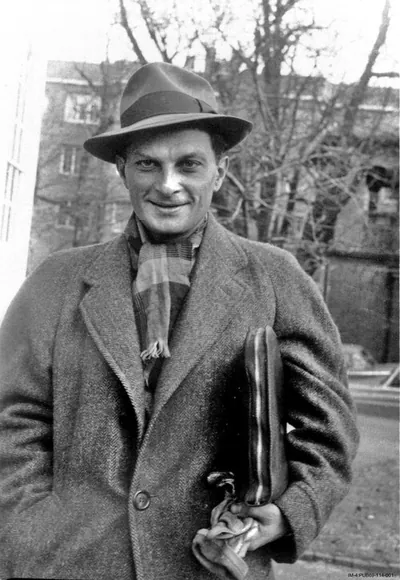 Stanisław Ulam1909–1984 · Mathematics
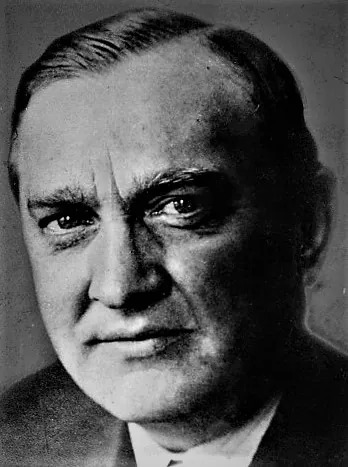 Stefan Banach1892–1945 · Mathematics
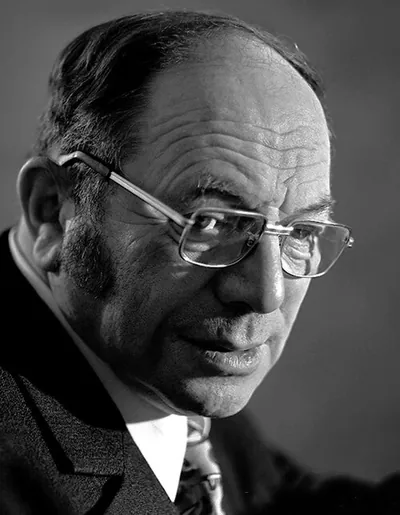 Leonid Kantorovich1912–1986 · Mathematics
 Ronald Fisher1890–1962 · Mathematics
 Paul Erdős1913–1996 · Mathematics
