
Leo Sternbach
Polish-American chemist credited with the first synthesis of benzodiazepines, the most widely used class of sedatives · 1908–2005
- Born
- May 7, 1908
- Died
- September 28, 2005
- Country
- United States, Poland
- Section
- Chemistry
Biography
Leo Sternbach (born in Opatija, 7 May 1908 – died in Chapel Hill, 28 September 2005) was a Polish-American chemist credited with the first synthesis of benzodiazepines, the most widely used family of sedatives. His work in the pharmaceutical industry, above all in the 1960s, produced drugs that changed the way anxiety and insomnia were treated.
Sternbach was born in Opatija, then part of the Austro-Hungarian Empire, into an upper middle class Jewish family. His father, Michael Abracham Sternbach, came from the Polish city of Przemyśl in Galicia and worked in a pharmacy. His mother, Piroska Cohn, came from Orosháza in Hungary. The couple met and married in Opatija. The family lived modestly, in a rented four-room flat near the pharmacy his father ran. His younger brother, Giusi, died of scarlet fever in 1926, at the age of fifteen.
His childhood was shaped by shifting borders and languages. He attended a private German school in Opatija until it closed in 1920. Because he could not speak Italian, he continued his education in Villach, Graz and Bielitz. In 1926 he moved with his family to Kraków, in Poland.
At the Jagiellonian University in Kraków he earned a master's degree in pharmacy in 1929 and a doctorate in organic chemistry in 1931. Organic chemistry is the study of molecules built around carbon, the basis of almost every medicine. He worked as a research assistant until 1936. With a scholarship from the Feliks Wiślicki Foundation in 1937, he moved on to Vienna and then Zürich. In Vienna he worked with Sigmund Fränkel and with Wolfgang Joseph Pauli Sr., and later with Leopold Ružička at the Swiss Federal Institute of Technology, where he carried on the research he had started in Kraków.
When the war began he was still in Switzerland. While in Basel in 1940 he joined Hoffmann-La Roche, the pharmaceutical company where he would stay until 2003. He married Herta Kreuzer. In 1941 he moved to Nutley, New Jersey, where the company had its American base, a move that took him out of the reach of the Nazis. Most of his career unfolded there.
His best-known work was the search for new sedatives. Benzodiazepines are molecules made of two linked rings, and small changes to their structure alter how they act on the brain. Sternbach and his team made several of them. A compound discovered in 1956 led to chlordiazepoxide, sold as Librium and approved in 1960. In 1963 an improved version, diazepam, was released as Valium, and it became hugely popular. From 1969 to 1982 it was the most prescribed drug in the United States, and in 1978, its peak year, more than 2.3 billion doses were sold. He is also credited with flurazepam, nitrazepam, flunitrazepam and clonazepam. With the Estonian chemist Moses Wolf Goldberg he developed a method for making biotin, a B vitamin, which was described as the first commercially applicable route to it.
Sternbach held 241 patents. It is said that one in every five Roche patents bore his name, and his discoveries helped turn the company into an industry giant. He did not become rich from them, but he was happy. He treated chemistry as a passion and said: "I always did just what I wanted to do." He stayed active in his career until the age of 95.
He lived in Upper Montclair, New Jersey, from 1943 to 2003, and then moved to Chapel Hill, North Carolina, where he died in 2005. In 1971 he received an honorary doctorate from the Technical University of Vienna, and in 1979 the American Chemical Society's ACS Award for Creative Invention. In February 2005 he was inducted into the National Inventors Hall of Fame. A book about his life and legacy, Good Chemistry, was published in 2004.
There is a sadder side to his story. His uncle on his father's side, Leon Sternbach, a classical philologist and professor at the Jagiellonian University, was arrested by the Gestapo in 1939 during Sonderaktion Krakau, the operation that seized dozens of Polish academics. He was sent to the Sachsenhausen concentration camp, where he was murdered in 1940.
Main contributions
- 1960Chlordiazepoxide (Librium): a benzodiazepine sold as an anti-anxiety drug, approved for use in 1960.
- 1963Diazepam (Valium): an improved version of the series that became the most prescribed drug in the United States between 1969 and 1982.
- Nitrazepam (Mogadon) and flurazepam (Dalmane): other benzodiazepines used as sleeping pills, credited to his team.
- Flunitrazepam (Rohypnol) and clonazepam (Klonopin): derivatives of the same chemical family, used as sedatives and anticonvulsants.
- A method for synthesizing biotin, developed with Moses Wolf Goldberg and described as the first commercially applicable one.
- Trimethaphan camsylate (Arfonad): a drug used to lower blood pressure in certain clinical situations.
Trivia and anecdotes
One in five patents
It is said that one in every five Hoffmann-La Roche patents carried his name, out of 241 patents of his own.
An uncle with the same surname
His paternal uncle, Leon Sternbach, was also a prominent scholar in Kraków, and died in the Sachsenhausen camp in 1940.
Their contemporaries
While Leo Sternbach was alive (1908–2005)…
Alive at the same time
Discovered or invented in those years
- 1916Black holeA region of space where gravity is so strong that nothing, not even light, can escape once it crosses a certain boundary.
- 1925TelevisionA system that sends moving pictures and sound over distance and shows them on a receiver, the television set.
- 1925Quantum mechanicsPhysical theory describing how matter and light behave at atomic and subatomic scales, where energy is exchanged in minimal packets and results are expressed as probabilities.
- 1931Big BangA cosmological model describing how the universe expanded from an early state of extreme density and temperature, about 13.8 billion years ago.
- 1945ComputerA programmable machine that takes in data, processes it by following stored instructions, and produces results, able to switch tasks simply by running different software.
- 1969InternetA global network of interconnected computer networks that communicate using the TCP/IP protocol suite.
 Willard Libby1908–1980 · Chemistry
 Dorothy Hodgkin1910–1994 · Chemistry
 Paul Flory1910–1985 · Chemistry
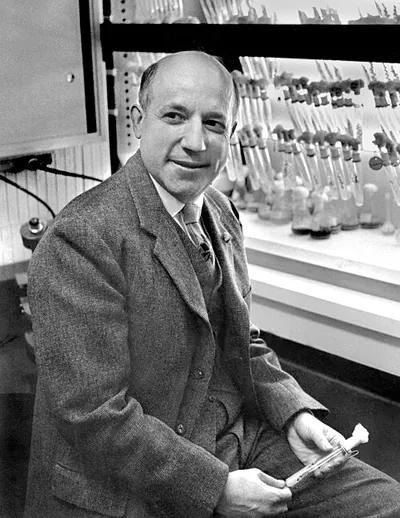 Melvin Calvin1911–1997 · Chemistry
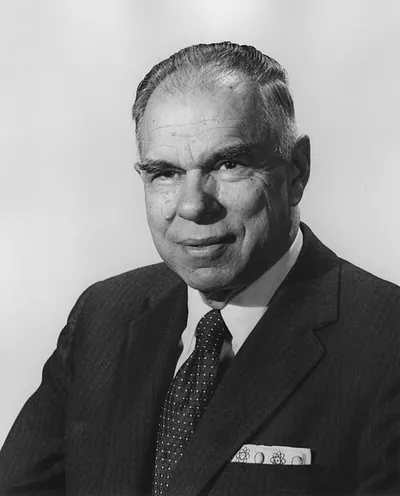 Glenn Theodore Seaborg1912–1999 · Chemistry
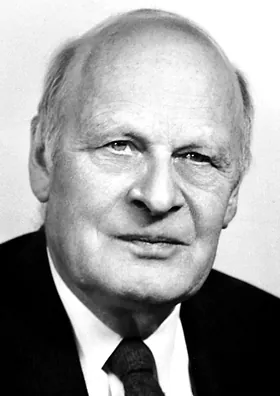 Lars Onsager1903–1976 · Chemistry