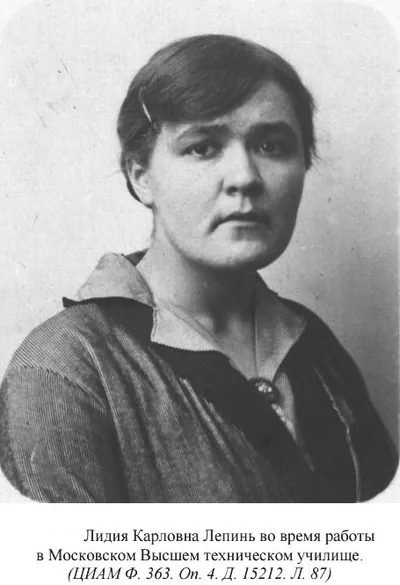
Lidija Liepiņa
Latvian physical chemist, one of the first women to earn a chemistry doctorate in the Soviet Union and a specialist in surface phenomena · 1891–1985
- Born
- April 4, 1891
- Died
- September 4, 1985
- Country
- Latvia, Soviet Union, Russian Empire
- Section
- Chemistry
- Awards
- Abel Prize
Biography
Lidija Liepiņa (1891-1985) was a Latvian physical chemist who spent most of her career in the Soviet Union. She was one of the first women to earn a doctorate in chemistry in the country. She studied what happens on the surface of solids, a field now known as surface chemistry.
She was born on 4 April 1891 in Saint Petersburg, the daughter of a Latvian father, a forestry engineer, and a Russian mother. She spent her childhood near Moscow, and in the summers her father sent her to relatives in Latvia. In 1908 she graduated with a gold medal from a private girls' gymnasium. Because Russian universities had again closed their doors to women, she had to complete an extra course and qualify as a home tutor before entering the Moscow Higher Courses for Women, where she was taught by chemists such as Nikolay Zelinsky.
For a time she wavered between chemistry and music, since she was an accomplished pianist and considered following the example of Alexander Borodin, who was both scientist and musician. In the end she chose chemistry.
During the First World War she worked in a field laboratory housed in a railway wagon on the Western Front, led by Nikolay Shilov. There the team tested gas masks and the ability of activated carbon to hold back gases, a process called adsorption (the capture of molecules on the surface of a solid). She and Shilov are credited with the first Russian gas mask, although poorer prototypes had existed before. Around 1919 she published her notes under the title «Theory of Dynamic Adsorption». She graduated in 1917 and taught at the Plekhanov Russian University of Economics and, from 1920, at the Moscow Higher Technical School, where she became its first woman professor.
Between 1922 and 1923 she made several trips to Germany to work in the laboratories of scientists such as Fritz Haber, and in 1929 she worked in Berlin with Max Bodenstein, where she met Walther Nernst. In 1932 she joined the Military Academy for Chemical Protection, where she headed the colloid chemistry department, which studies substances dispersed as tiny particles within another medium. In 1934 she became the first woman in the Soviet Union to be granted a professorship, and in 1937 she received a doctorate in sciences without defending a thesis.
During the Great Patriotic War she led the Department of General Chemistry at Moscow State University. There an industrial method was developed for producing active silica gel, used to decolourise kerosene and oils, and foaming agents for fire extinguishing were tested. Her work on corrosion, which according to one of her students aimed to protect aircraft, completes a legacy centred on the surfaces of materials and on opening Soviet science to women.
Main contributions
- 1915Helps develop, together with Nikolay Shilov, the first Russian gas mask, a filter that traps toxic gases with activated carbon.
- 1919Publication of her notes on the «Theory of Dynamic Adsorption», which describe how gases are held on solid surfaces.
- 1923Joint study of electrode potentials, that is, the electrical voltage that appears at the surface of a metal immersed in a liquid.
- 1934Receives a professorship at the Military Academy for Chemical Protection, the first ever granted to a woman in the Soviet Union.
- 1937Receives the title of Doctor of Sciences without defending a thesis, one of the country's first chemistry doctorates awarded to a woman.
- Development of an industrial method to produce active silica gel, a porous material that absorbs water vapour and supports catalysts.
Teachers and students
Trivia and anecdotes
Between the piano and the laboratory
She was a highly skilled pianist and nearly enrolled at the Moscow Conservatory. It took her several years to choose chemistry.
A puzzling order
According to her own recollection, the field laboratory was once ordered to test Aztec tobacco as an adsorbent against chlorine, and the request was read as a German provocation.
Their contemporaries
While Lidija Liepiņa was alive (1891–1985)…
Alive at the same time
Discovered or invented in those years
- 1903AirplaneA fixed-wing aircraft, heavier than air, powered by engines or rockets, that stays aloft because its wings generate lift.
- 1925TelevisionA system that sends moving pictures and sound over distance and shows them on a receiver, the television set.
- 1925Quantum mechanicsPhysical theory describing how matter and light behave at atomic and subatomic scales, where energy is exchanged in minimal packets and results are expressed as probabilities.
- 1931Big BangA cosmological model describing how the universe expanded from an early state of extreme density and temperature, about 13.8 billion years ago.
- 1945ComputerA programmable machine that takes in data, processes it by following stored instructions, and produces results, able to switch tasks simply by running different software.
- 1969InternetA global network of interconnected computer networks that communicate using the TCP/IP protocol suite.
 Jaroslav Heyrovský1890–1967 · Chemistry
 Harold Urey1893–1981 · Chemistry
 Wallace Carothers1896–1937 · Chemistry
 Cyril Norman Hinshelwood1897–1967 · Chemistry
 Peter Debye1884–1966 · Chemistry
 Linus Pauling1901–1994 · Chemistry
