
Mary Cartwright
British mathematician, one of the pioneers of the study of dynamical systems that later became known as chaos theory · 1900–1998
- Born
- December 17, 1900
- Died
- April 3, 1998
- Country
- United Kingdom, United Kingdom of Great Britain and Ireland
- Section
- Mathematics
Biography
Mary Cartwright (Aynho, England, 1900 – Cambridge, 1998) was a British mathematician who studied equations in which tiny changes in starting conditions can produce very different outcomes. She worked in the first half of the twentieth century, when women had very limited access to universities and scientific societies, and her career helped open the way for those who followed. She is remembered today as one of the pioneers of what would later be called chaos theory.
She was born on 17 December 1900 in Aynho, Northamptonshire, where her father, William Digby Cartwright, was the local vicar. Through her grandmother, Jane Holbech, she was descended from the poet John Donne, and she grew up with four siblings. Her schooling took her through several institutions before she completed her education at Godolphin School in Salisbury between 1916 and 1919. As a schoolgirl she was drawn to history, but she disliked the teaching method of the time, which relied on memorising long lists of events, and she chose mathematics instead. Her interest in the past never left her, and she later wrote biographies of mathematicians.
In October 1919 she entered St Hugh's College, Oxford, to study mathematics. She was one of only a handful of women studying the subject there, and in 1923 she graduated with a first-class degree, a distinction few women had achieved in that field before. For the next four years she taught mathematics at girls' schools in Worcester and Buckinghamshire. In 1928 she returned to Oxford to work for a doctorate under G. H. Hardy. Because Hardy spent the 1928–1929 academic year at Princeton, E. C. Titchmarsh took over much of her supervision. Her thesis, on the zeros of certain integral functions, was examined by John Edensor Littlewood, whom she first met during her oral examination. She completed the doctorate in 1930.
That year she was awarded a Yarrow Research Fellowship and moved to Girton College, Cambridge. While attending Littlewood's lectures she solved one of the open problems he had posed, and the two became close friends and collaborators for many years. Her best-known result is Cartwright's theorem, which places a limit on how large a function of a complex variable can become inside a disc when it takes the same value only a limited number of times. To prove it she used a method introduced by Lars Ahlfors for conformal mappings, transformations that preserve angles, which was a fresh approach at the time. During her years in Cambridge she also attended the mathematical lectures of Ludwig Wittgenstein. Over her career she published more than ninety papers on series, functions and their extreme values.
Her work took a decisive turn in 1938. The Radio Research Board, part of the Department of Scientific and Industrial Research, needed a mathematician to study certain differential equations that arose from modelling radio and radar systems, and asked the London Mathematical Society for help. Cartwright took up the challenge, but the dynamics behind the equations were unfamiliar to her, so she turned to Littlewood for that part of the problem. Together they studied the Van der Pol oscillator, a system whose behaviour becomes irregular and extremely sensitive to its starting state. The intricate structure they uncovered surprised them both, and it is now seen as a classic example of the butterfly effect. They did not reach an answer in time for the war effort, but they helped engineers see practical ways to compensate for the erratic electrical noise that was disturbing their equipment. The collaboration went on to shape the modern theory of dynamical systems.
In 1945 she simplified Hermite's proof that pi is irrational, meaning it cannot be written as a fraction of two whole numbers. Her version was published in an appendix to Harold Jeffreys' book Scientific Inference. In 1947 she was elected a Fellow of the Royal Society. She was not the first woman to be elected, but she was the first mathematician among them. She became Mistress of Girton in 1948 and held a Reader post in the Theory of Functions at Cambridge from 1959 until 1968. In 1961 she became the first woman to preside over the London Mathematical Society, and in 1968 she received its De Morgan Medal, its highest honour. In 1969 she was made a Dame by the British crown.
Cartwright retired in 1968 but continued to lecture at universities in the United States and to publish research for many years. She died in Cambridge on 3 April 1998, at the age of 97. Her legacy rests on her theorem, her long partnership with Littlewood on nonlinear equations, and the example she set as a woman who reached the highest ranks of British mathematics at a time when few did. Her studies of the Van der Pol oscillator and of unpredictable behaviour in systems remain part of the starting point of chaos theory.
Main contributions
- 1930Cartwright's theorem: sets a bound on how large a function can become inside a disc when it repeats its values a limited number of times.
- 1945A simplified version of the proof that pi is irrational, published in an appendix to Harold Jeffreys' book.
- 1950Studies with Littlewood of the Van der Pol oscillator, a system with irregular behaviour that is highly sensitive to starting conditions, now a classic example of the butterfly effect.
- 1956Integral Functions, a book collecting her work on this class of functions.
- 1961First woman to serve as president of the London Mathematical Society.
- 1968De Morgan Medal, the highest award of the London Mathematical Society, the first awarded to a woman.
Teachers and students
Studied under:
Taught:
Trivia and anecdotes
A subject set aside
Cartwright turned away from history because she disliked memorising lists of events, although she never lost her interest in the past.
Lectures by Wittgenstein
During her time in Cambridge she attended mathematics lectures given by the philosopher Ludwig Wittgenstein.
A poet in the family
Through her grandmother she descended from the poet John Donne.
Their contemporaries
While Mary Cartwright was alive (1900–1998)…
Alive at the same time
Discovered or invented in those years
- 1903AirplaneA fixed-wing aircraft, heavier than air, powered by engines or rockets, that stays aloft because its wings generate lift.
- 1925TelevisionA system that sends moving pictures and sound over distance and shows them on a receiver, the television set.
- 1925Quantum mechanicsPhysical theory describing how matter and light behave at atomic and subatomic scales, where energy is exchanged in minimal packets and results are expressed as probabilities.
- 1931Big BangA cosmological model describing how the universe expanded from an early state of extreme density and temperature, about 13.8 billion years ago.
- 1945ComputerA programmable machine that takes in data, processes it by following stored instructions, and produces results, able to switch tasks simply by running different software.
- 1969InternetA global network of interconnected computer networks that communicate using the TCP/IP protocol suite.
 Andrey Kolmogorov1903–1987 · Mathematics
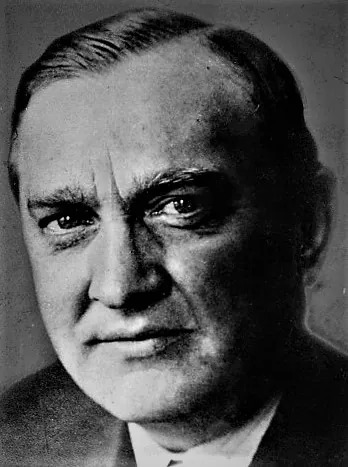 Stefan Banach1892–1945 · Mathematics
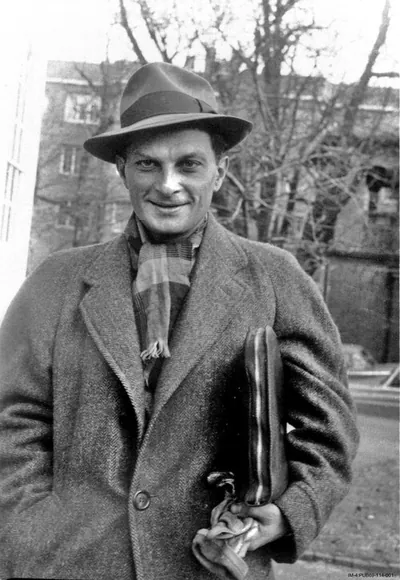 Stanisław Ulam1909–1984 · Mathematics
 Ronald Fisher1890–1962 · Mathematics
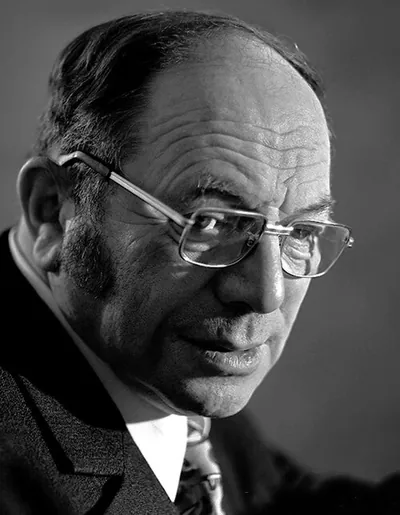 Leonid Kantorovich1912–1986 · Mathematics
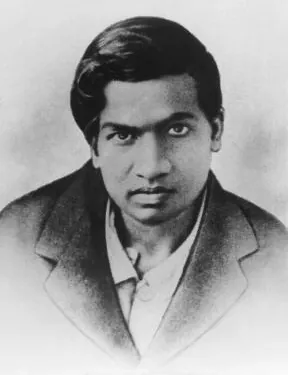 Srinivasa Ramanujan1887–1920 · Mathematics
