
Pierre Duhem
French physicist and philosopher of science, pioneer of medieval science history and author of the Duhem-Quine thesis · 1861–1916
- Born
- June 10, 1861
- Died
- September 14, 1916
- Country
- France
- Section
- Physics
Biography
Pierre Duhem (Paris, 1861 - Cabrespine, 1916) was a theoretical physicist, historian and philosopher of science who worked during the French Third Republic. He is remembered for championing thermodynamics as the foundation of physics, for his pioneering study of medieval science and for a philosophical claim still debated today: that no single experiment can by itself refute a hypothesis.
He was born in Paris on 10 June 1861 to a textile sales representative of Flemish descent and a mother from Languedoc. The family was devoutly Catholic and politically conservative, views hardened by the Paris Commune of 1871, which they saw as the anarchy that follows from rejecting religion. At the Collège Stanislas his interest in physics was encouraged by his teacher Jules Moutier, a theoretical physicist who wrote influential textbooks on thermodynamics. In 1882 he entered the École normale supérieure first in his cohort, earning licentiates in mathematics and physics in 1884 and the agrégation in physical sciences in 1885.
His doctoral thesis, on the use of the thermodynamic potential in electrochemical cells, attacked the principle of maximum work proposed by Marcellin Berthelot. The jury rejected it, and his scientific disputes with Berthelot, a powerful anti-clerical republican while Duhem was a royalist Catholic, seem to have held back his career. He finally received his doctorate in 1888 with a thesis on magnetization dynamics. He wanted a post in Paris and never got one. He taught at Lille (1887-1893), briefly at Rennes (1893-1894) and then at Bordeaux for the rest of his career.
In theoretical physics he is best known today for chemical thermodynamics, including the Gibbs-Duhem and Duhem-Margules equations. He drew on the early work of Josiah Willard Gibbs and helped make it known to French scientists. Duhem was also a supporter of energetics, the programme of deriving all physical phenomena, including mechanics, electromagnetism and chemistry, from the principles of thermodynamics. He tried this in his Traité de l'énergétique (1911), but could not reduce electromagnetism to those principles. Like Ernst Mach, he doubted that atoms were physically real, so he rejected the statistical mechanics of Maxwell, Boltzmann and Gibbs, which explained thermodynamics through the behaviour of enormous numbers of particles. He also opposed Einstein's relativity, attacking it sharply in 1914 and 1915.
His historical work began with a technical question: the origins of statics, the branch of mechanics that studies bodies in equilibrium. While pursuing it he found medieval thinkers such as Jean Buridan, Nicole Oresme and Roger Bacon, whose sophistication surprised him. Duhem argued that they had anticipated many discoveries credited to Galileo and that modern mechanics grew, through barely perceptible improvements, from doctrines taught in medieval schools. Against the Enlightenment view that the Middle Ages were sterile, he held that the Church had helped foster Western science. His monumental ten-volume The System of the World traces cosmological ideas from Plato to Copernicus. In it he revived the phrase saving the phenomena, used since antiquity for theories that describe observations without explaining their underlying causes.
In the philosophy of science he is known above all for The Aim and Structure of Physical Theory (1906). There he argued that a hypothesis cannot be tested in isolation, because every experiment checks a whole web of theoretical assumptions. It follows that no crucial experiment can settle a dispute between two theories on its own. Later developed by Willard Van Orman Quine, this idea is now called the Duhem-Quine thesis. He also challenged the claim that Newton had deduced his law of gravitation from Kepler's laws, since the mutual perturbations between planets made the two incompatible.
His faith, in his own view, was not a guide to physics. In an appendix titled Physics of a Believer he maintained that religious judgements and physical principles belong to different domains and cannot contradict each other. His contemporary Abel Rey criticised his Catholicism as an influence on his ideas, and Duhem rejected this: he insisted his work should be judged on its merits and was not a form of Catholic science.
In 1900 he received an honorary doctorate from the Jagiellonian University in Kraków and was elected a corresponding member of the French Academy of Sciences that same year. Near the end of his life he was proposed for the history of science chair at the Collège de France, but he declined, insisting that he was a theoretical physicist. He died suddenly in 1916, aged 55, after an attack of angina at a family house in Cabrespine, near Carcassonne. His legacy lives on chiefly in the philosophy of science and in the study of medieval science, a field he helped to pioneer.
Main contributions
- 1895Les théories de la chaleur: an account of the theories of heat of his time, the foundation of his thermodynamic work.
- 1902Les origines de la statique (1903) and L'évolution de la mécanique (1902): historical studies of the origins of statics and mechanics.
- 1906La théorie physique, son objet et sa structure: a key work in the philosophy of science on testing hypotheses.
- 1908Sozein ta phainomena: an essay on the notion of physical theory from Plato to Galileo.
- 1911Traité de l'énergétique: an attempt to explain all of physics from thermodynamics.
- 1913Le Système du Monde: ten volumes on the history of cosmological doctrines from Plato to Copernicus, published up to 1959.
Teachers and students
Trivia and anecdotes
A rejected thesis
His first doctoral thesis, which criticised Berthelot's principle of maximum work, was rejected by the jury, and it is often said to have shaped his later academic difficulties.
A refused chair
He turned down a candidacy for the Collège de France because, as he wrote to his daughter, he would only go to Paris to teach theoretical physics.
Their contemporaries
While Pierre Duhem was alive (1861–1916)…
Alive at the same time
Discovered or invented in those years
- 1869Periodic tableAn arrangement of the chemical elements into rows (periods) and columns (groups), ordered by atomic number, that reveals recurring chemical behaviour and lets scientists predict properties.
- 1869Deoxyribonucleic acidA double-stranded molecule that carries the genetic instructions of nearly all living things and many viruses.
- 1876TelephoneA device that carries the human voice over distance by turning sound into electrical signals and back into sound at the other end of the line.
- 1884CarA road vehicle with four wheels and its own engine, mainly built to carry people.
- 1897ElectronA negatively charged subatomic particle found in every atom, and key to electricity and chemical bonding.
- 1903AirplaneA fixed-wing aircraft, heavier than air, powered by engines or rockets, that stays aloft because its wings generate lift.
 Pierre Curie1859–1906 · Physics
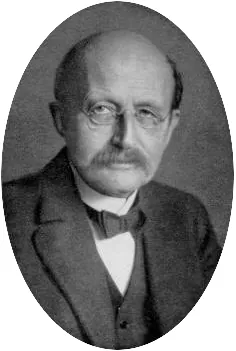 Max Planck1858–1947 · Physics
 Joseph John Thomson1856–1940 · Physics
 Robert Andrews Millikan1868–1953 · Physics
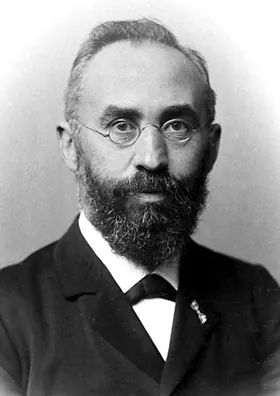 Hendrik Lorentz1853–1928 · Physics
 Heike Kamerlingh Onnes1853–1926 · Physics
