
Rainer Weiss
German-American physicist who helped detect gravitational waves · 1932–2025
- Born
- September 29, 1932
- Died
- August 25, 2025
- Country
- United States
- Section
- Physics
- Awards
- Nobel Prize in Physics
Biography
Rainer Weiss (Berlin, September 29, 1932 – Cambridge, Massachusetts, August 25, 2025) was a German-American physicist whose work opened a new way of observing the universe. He is best known for his role in the detection of gravitational waves, the ripples in spacetime predicted by Albert Einstein, and he shared the 2017 Nobel Prize in Physics with Kip Thorne and Barry Barish. He worked at a time when cosmology was moving from theory to measurement, and his legacy lives on in the observatories that now listen to the cosmos with lasers.
He was born in Berlin to a Jewish physician, neurologist and psychoanalyst who was also an active communist, and to a Christian actress. When the Nazis came to power, his father was forced to leave Germany. The family first settled in Prague, but after the 1938 Munich Agreement and the German occupation of Czechoslovakia they had to flee again. Thanks to the philanthropic Stix family of St. Louis, who helped them obtain visas, they reached the United States. Weiss grew up in New York City, where he attended Columbia Grammar School.
He enrolled at MIT but left at the start of his junior year, partly because of a romantic relationship and partly because he was torn between engineering and physics. Jerrold Zacharias, an influential MIT physicist, stepped in. Weiss worked for a while as a technician in Zacharias's laboratory and returned to finish his bachelor's degree in 1955. Zacharias later supervised his doctoral thesis, completed in 1962. Their bond went beyond the laboratory, and a shared love of music, especially Beethoven's Spring Sonata, helped cement it.
After teaching at Tufts University from 1960 to 1962, he was a postdoctoral researcher at Princeton from 1962 to 1964. In 1964 he joined the MIT faculty and set up a research group devoted to cosmology and gravitation within the Research Laboratory of Electronics. Because the instruments he needed did not exist, he equipped the lab with its own machine and electronics shops, and he expected his students to build and design their own apparatus.
By 1966 his position at MIT was in doubt, since his group had produced few publications. On the advice of Bernard Burke, head of the astrophysics division in the physics department, Weiss revised his standards for what counted as publishable work. That allowed him to earn tenure. The same year Joseph Weber claimed to have devised a way to detect gravitational waves. When Weiss's students asked him about it, he could not explain it, because it seemed to clash with his understanding of general relativity.
Einstein's general relativity predicts that accelerating masses send waves through spacetime, tiny distortions that stretch and squeeze distances. In 1967 Weiss devised a thought experiment to convey the idea simply: measure how long light takes to travel between free masses in space. This required clocks so precise that they were practically impossible. Around 1968, as Weber's claims went unconfirmed, Weiss began to suspect that Weber was wrong. He revisited his idea, replaced the clocks with laser interferometry, and concluded that this method could in principle detect waves more sensitively than Weber's resonant bars. In interferometry a beam of light is split into two, sent down two perpendicular arms, and recombined, so that tiny differences in path length show up as changes in the pattern.
In 1973 the US military cut funding for science not considered directly relevant to its mission, and Weiss had to change direction. He wrote a proposal to the National Science Foundation describing a new way to measure gravitational waves. It took many years before his interferometers were sensitive enough to detect anything, and during that period several of his graduate students had difficult thesis defences because they had no positive results to report.
His earlier work concerned the cosmic microwave background, the faint glow that fills the universe and dates from its early history. In 1973 he made pioneering measurements of its spectrum using a weather balloon, showing that it had the thermal shape expected from the remnant of the Big Bang. He later co-founded NASA's Cosmic Background Explorer, COBE, which mapped that radiation in detail, and served as its science advisor. In his view, both projects linked the challenges of building instruments with physics important to understanding the universe.
He proposed the LIGO concept to Kip Thorne in 1972, but Thorne took three years to be persuaded it could work. After prototypes were studied at MIT, Caltech, Garching and Glasgow, and after Weiss estimated what a full-scale interferometer would require, MIT and Caltech signed an agreement in 1984 to design and build LIGO, with joint leadership by Ronald Drever, Weiss and Thorne. The detector needs arms several kilometres long, because the changes it must measure are extraordinarily small.
The signal was observed in September 2015, and in February 2016 Weiss was one of four scientists who presented the announcement at the press conference. He received many honours: the Gruber Cosmology Prize in 2006 with John Mather and the COBE team, the APS Einstein Prize in 2007 with Ronald Drever, and in 2016 and 2017 several awards, including the Breakthrough, Kavli and Shaw prizes, the Princess of Asturias Award and the Nobel Prize. For the Nobel he received half of the prize money, while Thorne and Barish each received a quarter.
He married Rebecca Young in 1959 and remained married to her until his death; they had two children. He had his first child while still a graduate student, a period he later described as the best time of his life. He died at a hospital in Cambridge, Massachusetts, on August 25, 2025, at the age of 92.
Kip Thorne described him as, by a large margin, the most influential person the field has seen. His legacy is the laser interferometry technique that now allows LIGO and other detectors to register gravitational waves. It also lies in the way he combined rigorous measurement with the construction of the instruments needed to make it.
Main contributions
- 1967Thought experiment on gravitational waves. Using light travelling between free masses, he set out a simple way of understanding how such waves could be detected.
- 1972The LIGO concept. He proposed to Kip Thorne a gravitational wave detector based on laser interferometry, the basis of the current observatory.
- 1973Measurements of the cosmic microwave background. Using a weather balloon, he showed that its spectrum has the thermal shape expected from the remnant of the Big Bang.
- 2015First direct observation of gravitational waves, made in September 2015 and announced in 2016 by LIGO and Virgo.
- The COBE satellite. Co-founder and science advisor of this NASA satellite, which mapped the background radiation in detail.
Teachers and students
Studied under:
Taught:
Trivia and anecdotes
A romance and a departure
He left MIT at the start of his third year, partly because of a relationship with a music student from Chicago. Zacharias intervened so that he would return to his studies.
An unequal split of the Nobel
According to the Nobel Prize website, Weiss received half of the prize money, while Thorne and Barish each received a quarter.
Their contemporaries
While Rainer Weiss was alive (1932–2025)…
Alive at the same time
Discovered or invented in those years
- 1932NeutronA subatomic particle with no net electric charge, found in the nucleus of almost every atom alongside protons.
- 1945ComputerA programmable machine that takes in data, processes it by following stored instructions, and produces results, able to switch tasks simply by running different software.
- 1969InternetA global network of interconnected computer networks that communicate using the TCP/IP protocol suite.
- 1971EmailA network service that lets users send and receive digital messages through addressed mailboxes, much like postal mail but electronic.
- 1973Mobile phoneA handheld wireless phone that lets people make and receive calls while moving across a cellular network area.
- 1989World Wide WebA system of linked documents and resources, connected by hyperlinks and accessed over the Internet with web browsers.
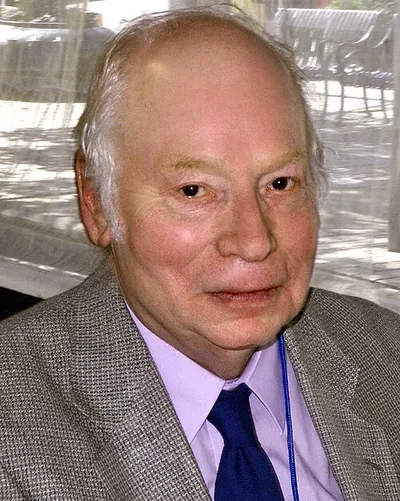 Steven Weinberg1933–2021 · Physics
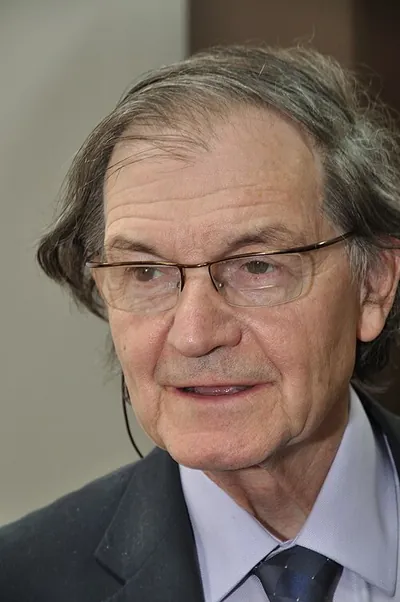 Roger Penrose1931 · Physics
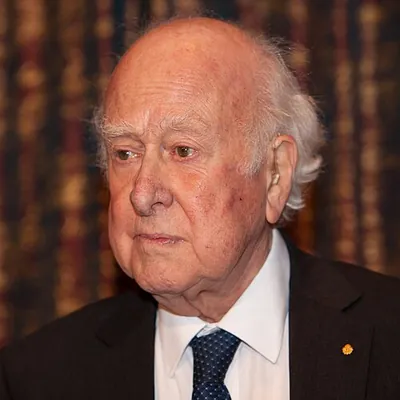 Peter Higgs1929–2024 · Physics
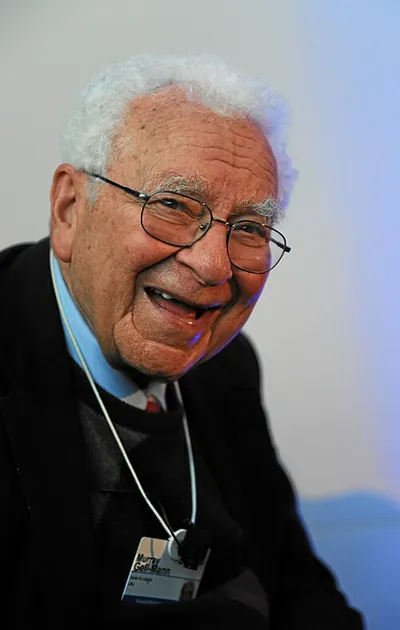 Murray Gell-Mann1929–2019 · Physics
 John Stewart Bell1928–1990 · Physics
 Stephen Hawking1942–2018 · Physics
