
Raymond Dart
Australian anatomist and anthropologist, one of the pioneers in searching for human origins in Africa · 1893–1988
- Born
- February 4, 1893
- Died
- November 22, 1988
- Country
- Australia
- Section
- Biology
Biography
Raymond Arthur Dart (Brisbane, 1893 – Johannesburg, 1988) was an Australian anatomist and anthropologist who, alongside Louis Leakey and Robert Broom, was among the pioneers of the search for human origins in Africa, at a time when most scientists placed them in Europe or Asia. His name is above all tied to the Taung Child, the fossil that gave its name to Australopithecus africanus.
He was born in Toowong, a suburb of Brisbane, the fifth of nine children of a farmer and tradesman. His birth came during a flood that filled the family home. He won a scholarship to Ipswich Grammar School. He had hoped to become a medical missionary in China and wanted to study medicine in Sydney, but his father persuaded him to accept a place at the newly founded University of Queensland, where he studied geology and zoology and graduated in 1913. He later studied medicine in Sydney and qualified in 1917.
In the final year of the First World War he served as a captain and medic in the Australian Army in England and France. After the war he worked in London under Grafton Elliot Smith, a fellow Australian anatomist and anthropologist who became his mentor and whose ideas shaped much of his early work. In 1922, reluctantly and at the encouragement of Elliot Smith and Arthur Keith, he took up a professorship in the new anatomy department at the University of the Witwatersrand in Johannesburg.
The Taung skull came to light in 1924, although Dart did not find it himself, a point he later acknowledged in his memoirs. Professor Robert Burns Young sent him crates of fossils from a limeworks near the town of Taung. Dart recognised at once that one skull belonged to an early human relative, since its brain size was too large for a baboon or chimpanzee. His student Josephine Salmons played a decisive part by drawing his attention to the significance of other remains from the site. In 1925 he published the species in Nature as Australopithecus africanus, the 'southern ape from Africa', arguing that early human relatives had lived in Africa.
The reception was sceptical. Dart was an outsider to the scientific establishment, and the fossil had come from Africa rather than Europe or Asia, where human origins were assumed to lie. Arthur Keith, who first judged the specimen more ape than human ancestor, conceded in 1947 that Dart had been right and he had been wrong. Dart's closest ally was Robert Broom, who twelve years later found an adult specimen of the same species at Sterkfontein cave, which finally led to his claim being accepted. Robert Ardrey also brought Dart's ideas to a wide audience, notably in African Genesis, published in 1961. Some of his theories, such as the 'killer ape' idea, were later refuted, while others still have support.
Although he is best remembered for Australopithecus, Dart spent much of his career on comparative anatomy and physical anthropology. Like many scientists of his day, he believed that sorting people by physical traits would help explain human evolution, and he used such classifications to justify a racial hierarchy. In 1936 he led an expedition to the Kalahari to measure and photograph San people, and he collected around seventy plaster face masks made by moulding directly onto living faces. In 1937 he published two articles based on this material and described the San as 'living fossils', a term now recognised as offensive and dehumanising. In the 1930s he also proposed a dual evolutionary origin for the neocortex, the outer layer of the brain linked to higher functions, based on his study of reptile brains.
In his personal life, he married Dora Tyree, a medical student from Virginia, in 1921 at Woods Hole, Massachusetts; they divorced in 1934. In 1936 he married Marjorie Frew, head librarian at Witwatersrand, and they had two children, Diana and Galen. From 1966, at the age of 73, he divided his time between South Africa and the Institutes for the Achievement of Human Potential, founded by Glenn Doman to treat brain-injured children. He worked there for nearly two decades, with methods that drew considerable controversy. His son Galen had suffered motor damage at birth.
Dart's legacy is twofold. In 1956 Phillip Tobias founded the Institute for the Study of Man in Africa at Witwatersrand in his honour, and a memorial lecture in his name has been held there since 1964. His 1959 memoir, Adventures with the Missing Link, remains a key account of his discoveries. From the 1990s, historians such as Saul Dubow, Catherine Burns and Yvette Abrahams criticised his part in scientific racism, and other writers have questioned how human remains were handled or argued that his racial typology helped underpin apartheid policies.
Main contributions
- 1924Identification of the Taung Child as a hominin, an early human relative with a brain intermediate between apes and people.
- 1925Description of Australopithecus africanus, based on the first fossil of this species, in Nature, arguing that early hominins lived in Africa.
- 1953The 'predatory transition' hypothesis, which gave hunting a central role in human evolution and was largely rejected later.
- A proposal for a dual evolutionary origin of the neocortex, based on his study of reptile brain structure in the 1930s.
Trivia and anecdotes
A mistaken age
The Taung Child was first thought to be about six, because it had its first permanent molar, which usually appears around that age in children. Its features, however, resembled those of a three-year-old chimpanzee.
Consulted in court
Archival research by Kuljan (2016) shows that Dart was consulted in court at least twice to determine a person's racial classification. On one occasion, the person was charged with illegal possession of alcohol.
Related discoveries and inventions
- 1924Taung ChildA fossilised skull of a young Australopithecus africanus, about three years old, found in South Africa in 1924 and described in 1925, which helped lay the foundations of human palaeontology.
Their contemporaries
While Raymond Dart was alive (1893–1988)…
Alive at the same time
Discovered or invented in those years
- 1903AirplaneA fixed-wing aircraft, heavier than air, powered by engines or rockets, that stays aloft because its wings generate lift.
- 1925TelevisionA system that sends moving pictures and sound over distance and shows them on a receiver, the television set.
- 1925Quantum mechanicsPhysical theory describing how matter and light behave at atomic and subatomic scales, where energy is exchanged in minimal packets and results are expressed as probabilities.
- 1931Big BangA cosmological model describing how the universe expanded from an early state of extreme density and temperature, about 13.8 billion years ago.
- 1945ComputerA programmable machine that takes in data, processes it by following stored instructions, and produces results, able to switch tasks simply by running different software.
- 1969InternetA global network of interconnected computer networks that communicate using the TCP/IP protocol suite.
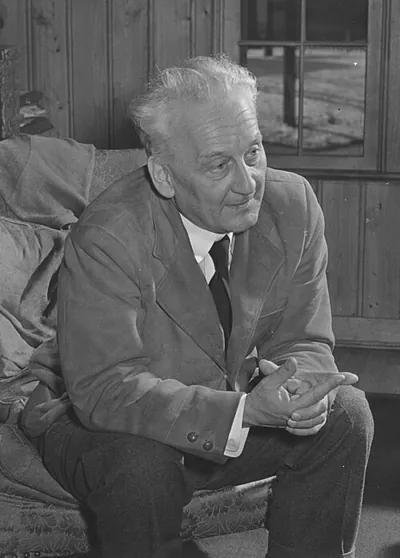 Albert Szent-Györgyi1893–1986 · Biology
 J.B.S. Haldane1892–1964 · Biology
 Gerty Cori1896–1957 · Biology
 Hermann Joseph Muller1890–1967 · Biology
 Hans Krebs1900–1981 · Biology
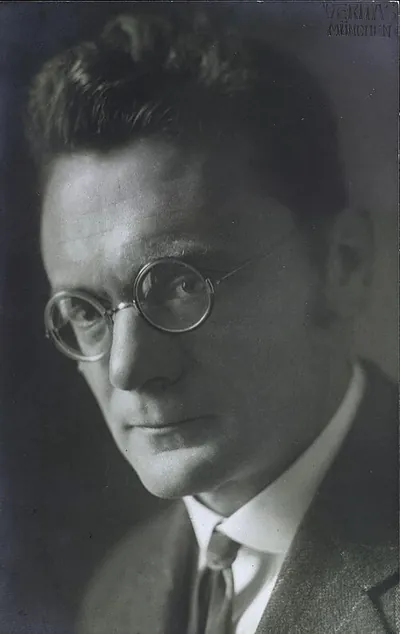 Karl von Frisch1886–1982 · Biology
