Roger Payne
American biologist and environmentalist who discovered humpback whale song · 1935–2023
- Born
- January 29, 1935
- Died
- June 10, 2023
- Country
- United States
- Section
- Biology
Biography
Roger Searle Payne (Manhattan, 1935 – South Woodstock, Vermont, 2023) was an American biologist and environmentalist best known for discovering, in 1967, that male humpback whales produce complex, structured songs. His work changed how the public saw whales and became a key part of the worldwide campaign to end commercial whaling.
Payne was born on 29 January 1935 in Manhattan, New York City. His mother taught music and his father was an electrical engineer. He finished secondary school at Horace Mann School in 1952, then earned a bachelor's degree at Harvard University and a doctorate at Cornell University. His early research looked at echolocation in bats, the way they find objects by listening to the echoes of their own calls, and at how their prey, moths, try to avoid them. He also studied how owls locate sounds in space.
Wanting work more directly connected to conservation, Payne turned his attention to whales. His breakthrough came in 1967 during a research trip to Bermuda. He was working alongside Scott McVay, a naval engineer who was recording underwater sounds in the hope of detecting Russian submarines. Listening back to the recordings, the two men realised that male humpback whales were producing elaborate sound sequences during the breeding season. Payne described these songs as exuberant, unbroken rivers of sound built from long, repeated themes, lasting up to half an hour and performed by a whole group of males at once. From one breeding season to the next the song shifted slightly, with new phrases added and others dropped. Payne concluded that the whales were singing to one another, an idea that was new at the time.
In 1970 his recordings were released as an LP called Songs of the Humpback Whale. It remains the best-selling nature sound record ever made. Its popularity gave real momentum to the Save the Whales movement, which sought an end to commercial whaling at a time when the hunt had pushed many species dangerously close to extinction. The International Whaling Commission finally banned commercial whaling in 1986. Afterwards Payne led many expeditions across the world's oceans to study whale migrations, cultures and vocalisations. He was also the first to propose that fin whales and blue whales can communicate with sound across entire oceans, a idea later confirmed.
Payne worked on many creative and educational projects. In January 1979 National Geographic magazine included a flexible-disc sound sheet of whale recordings, made by Frank Watlington with commentary by Payne. The issue printed ten and a half million copies, the largest single pressing of any record at that point. In 1987 he worked with the musician Paul Winter to combine whale song with human music. He also wrote books and took part in television documentaries and the IMAX film Whales: An Unforgettable Journey.
In 1971 he founded Ocean Alliance, a non-profit conservation organisation based in Gloucester, Massachusetts. He was an assistant professor of biology at Rockefeller University and, at the same time, a research zoologist at the Institute for Research in Animal Behavior, run jointly by Rockefeller University and the Wildlife Conservation Society. When that institute was succeeded by the society's field biology centre in 1972, he stayed on as a research zoologist and scientific director of its whale programme until 1983. From 2020 he was principal adviser to Project CETI, an interdisciplinary initiative that uses machine learning to study whale communication. In his last years he also supported the planned move of the captive orca Lolita from the Miami Seaquarium to a sanctuary in the Salish Sea.
From 1960 to 1985 he was married to the researcher Katharine Payne, who studied the vocalisations of elephants and humpback whales. The couple had four children. In 1991 he married the actress and environmentalist Lisa Harrow. He died at his home in South Woodstock, Vermont, on 10 June 2023, aged 88, from squamous-cell carcinoma. Five days earlier he had published an essay in Time calling for a new conservation movement. His legacy lies in showing that whales communicate through complex song, and in helping the wider public care about protecting them.
Main contributions
- 1967Discovery of humpback whale song: males produce complex, repeated sound sequences during the breeding season.
- 1970Songs of the Humpback Whale: a record of his recordings that boosted the campaign to end commercial whaling.
- 1971Founding of Ocean Alliance, an organisation devoted to whale and ocean conservation.
- 1977Humpback whale recordings included on the Voyager Golden Record, carried aboard the Voyager spacecraft that left the Solar System.
- Proposal that fin and blue whales communicate with sound across whole oceans, later confirmed.
Trivia and anecdotes
A record in a magazine
In 1979, National Geographic printed a flexible sound sheet of whale recordings, with a run of ten and a half million copies.
Whale sounds in pop music
Kate Bush used a fragment of Payne's recordings as the intro to her 1978 album The Kick Inside.
Their contemporaries
While Roger Payne was alive (1935–2023)…
Alive at the same time
Discovered or invented in those years
- 1945ComputerA programmable machine that takes in data, processes it by following stored instructions, and produces results, able to switch tasks simply by running different software.
- 1957Artificial satelliteAn artificial satellite is a human-made object placed in orbit around a celestial body, usually Earth, to collect information, relay signals, or carry out a specific task.
- 1969InternetA global network of interconnected computer networks that communicate using the TCP/IP protocol suite.
- 1971EmailA network service that lets users send and receive digital messages through addressed mailboxes, much like postal mail but electronic.
- 1973Mobile phoneA handheld wireless phone that lets people make and receive calls while moving across a cellular network area.
- 1989World Wide WebA system of linked documents and resources, connected by hyperlinks and accessed over the Internet with web browsers.
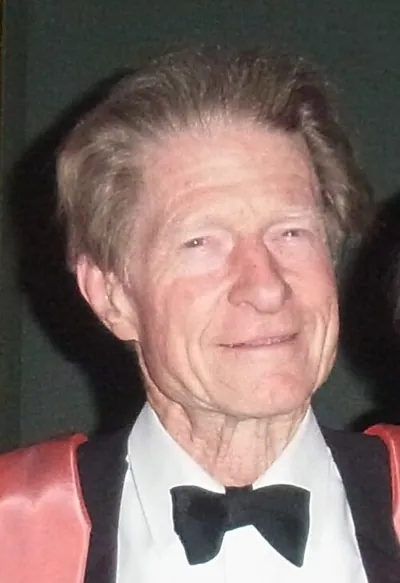 John Gurdon1933–2025 · Biology
 Lynn Margulis1938–2011 · Biology
 Ada Yonath1939–2026 · Biology
 Edward O. Wilson1929–2021 · Biology
 Stephen Jay Gould1941–2002 · Biology
 James Watson1928–2025 · Biology