
Shoichi Sakata
Japanese physicist and theorist of subatomic particles, creator of the Sakata model · 1911–1970
- Born
- January 18, 1911
- Died
- October 16, 1970
- Country
- Japan, Empire of Japan
- Section
- Physics
Biography
Shoichi Sakata (Tokyo, 1911 - Nagoya, 1970) was a Japanese physicist who worked on particle physics in the first half of the twentieth century, when the study of the atomic nucleus and the forces holding it together was expanding rapidly. His name is linked to three major ideas: the two-meson theory, the Sakata model, an early precursor of the quark model, and the neutrino mixing matrix that bears the initials of Maki, Nakagawa and Sakata. Well known among specialists, he is less familiar outside Japan, a gap his scientific community has tried to close.
Sakata was born in Tokyo on 18 January 1911, into a family with a tradition of public service. He was the eldest of six children. His godfather was the politician Katsura Tarō, several times Prime Minister of Japan, whom one of Sakata's relatives had served as secretary. As a schoolboy in Hyōgo Prefecture he was taught by the physicist Bunsaku Arakatsu and heard a lecture by Jun Ishiwara, one of the most influential figures in Japanese physics at the time. He also became close to Katō Tadashi, who later translated Friedrich Engels's unfinished Dialectics of Nature into Japanese. Sakata later said that this work and Lenin's Materialism and Empirio-criticism shaped his thinking, and his Marxist convictions stayed with him for life.
In 1930 he entered Kyoto Imperial University. In his second year he attended lectures by Yoshio Nishina on quantum mechanics, the theory describing how matter behaves on the atomic scale. Those lectures brought him into contact with Hideki Yukawa and Shin'ichirō Tomonaga, the first two Japanese Nobel laureates. After graduating he worked at the Institute of Physical and Chemical Research (RIKEN) alongside Tomonaga and Nishina, and in 1934 he moved to Osaka Imperial University to work with Yukawa. Yukawa had published his first paper on the meson theory in 1935; meson is the name for particles that carry the nuclear force. Together they developed the theory and postulated a possible neutral carrier of that force. In 1939 Sakata followed Yukawa to Kyoto Imperial University as a lecturer.
In 1942 he and Inoue proposed the two-meson theory. The starting point was an experimental puzzle: a charged particle found in cosmic rays had been taken for Yukawa's meson, but it did not behave like one. Sakata and Inoue resolved the puzzle by proposing that it was a different particle, produced when the meson decays, and they also introduced a neutrino distinct from the one seen in beta decay. We now recognise these as the muon and its neutrino, members of the second lepton generation. The English version of their paper was delayed until 1946, and the experimental observation of pion decay into a muon came a year later. That same year, 1942, Sakata became a professor at Nagoya Imperial University, where he remained until his death. After the war he reorganised his research group on democratic principles, at a time when several Japanese scientists campaigned for the peaceful use of nuclear energy.
In 1954 he spent several months at the Niels Bohr Institute, at the invitation of Bohr and Christian Møller. There he presented the work of young Japanese particle physicists, especially an empirical rule found by Nakano and Nishijima, later called the NNG rule. It describes which combinations of strongly interacting particles are allowed. Back in Nagoya, his group sought the physical explanation, and in 1956 Sakata proposed his model. In it, all strongly interacting particles were built from three basic particles: the proton, the neutron and the lambda. Although these basic particles had whole-number charges, they showed properties similar to the up, down and strange quarks that Gell-Mann and Zweig would propose in 1964 with fractional charges. In 1959 the model was found to have a U(3) symmetry, a mathematical framework that Gell-Mann later used on his road to the eightfold way.
The Sakata model was superseded by the quark model, but it guided it. In 1960, together with Maki, Nakagawa and Ohnuki, he extended the model to include leptons, producing the so-called Nagoya model. In 1962 Maki, Nakagawa and Sakata proposed that neutrinos could mix, which meant they could change type while travelling. This idea, now called the MNS matrix, was confirmed decades later by neutrino oscillation experiments, which earned the 2015 Nobel Prize in Physics. The Nagoya model also inspired the 1973 CKM matrix of Kobayashi and Maskawa, whose authors shared the 2008 Nobel Prize. Several of Sakata's students and collaborators, including Nambu, Maskawa and Kobayashi, trained or worked under his influence.
Sakata earned recognition in Japan, including the Asahi Prize in 1948 and the Imperial Prize of the Japan Academy in 1950. Yet the 1969 Nobel Prize in Physics went only to Gell-Mann, and many in the field regretted the omission. Sakata fell ill in the late 1960s. In September 1970 Yukawa wrote to the Nobel committee member Ivar Waller to explain that Sakata's health had worsened since the nomination had been prepared. Sakata died on 16 October 1970. He was posthumously honoured with the Order of the Sacred Treasure, and his legacy remains part of the history of particle physics, where his model, his neutrino matrix and his role in training a generation of Japanese physicists hold an important place.
Main contributions
- 1942Two-meson theory, proposed with Inoue, which explained particles found in cosmic rays as products of a meson's decay.
- 1956Sakata model, which builds strongly interacting particles from three basic particles, a precursor of the quark model.
- 1959Discovery of the U(3) symmetry within the Sakata model, a mathematical framework later used in the eightfold way.
- 1960Nagoya model, an extension of the Sakata model that includes leptons.
- 1962Maki-Nakagawa-Sakata neutrino mixing matrix, describing how neutrinos can change type.
Teachers and students
Studied under:
Taught:
Trivia and anecdotes
A political godfather
His godfather was Katsura Tarō, a Prime Minister of Japan, whom one of Sakata's relatives had served as secretary.
The Nobel that never came
After the 1969 Nobel went only to Gell-Mann, Yukawa wrote in 1970 explaining that Sakata's illness had worsened since the nomination.
Their contemporaries
While Shoichi Sakata was alive (1911–1970)…
Alive at the same time
Discovered or invented in those years
- 1916Black holeA region of space where gravity is so strong that nothing, not even light, can escape once it crosses a certain boundary.
- 1925TelevisionA system that sends moving pictures and sound over distance and shows them on a receiver, the television set.
- 1925Quantum mechanicsPhysical theory describing how matter and light behave at atomic and subatomic scales, where energy is exchanged in minimal packets and results are expressed as probabilities.
- 1931Big BangA cosmological model describing how the universe expanded from an early state of extreme density and temperature, about 13.8 billion years ago.
- 1945ComputerA programmable machine that takes in data, processes it by following stored instructions, and produces results, able to switch tasks simply by running different software.
- 1969InternetA global network of interconnected computer networks that communicate using the TCP/IP protocol suite.
 Lev Landau1908–1968 · Physics
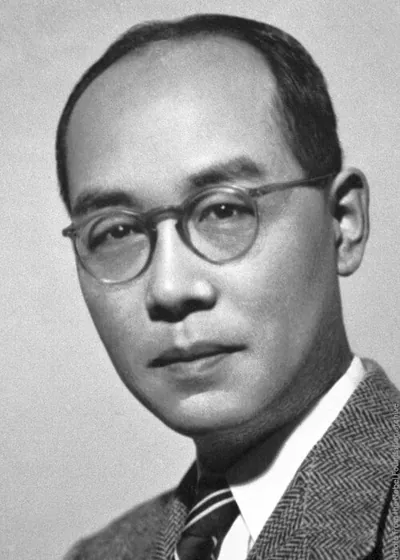 Hideki Yukawa1907–1981 · Physics
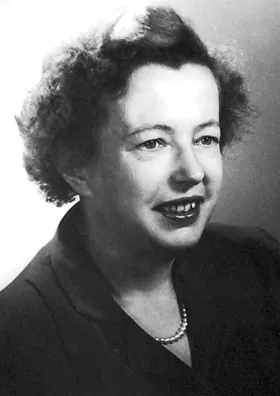 Maria Göppert Mayer1906–1972 · Physics
 Hans Bethe1906–2005 · Physics
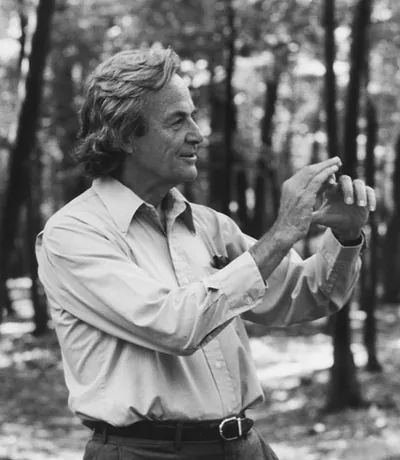 Richard Feynman1918–1988 · Physics
 J. Robert Oppenheimer1904–1967 · Physics
