
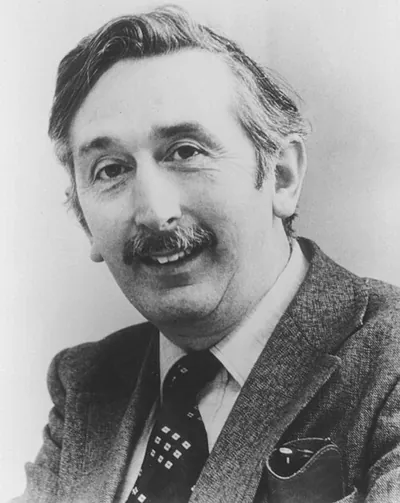
William F. Baker
American structural engineer who designed the structure of the Burj Khalifa · 1953
- Born
- October 9, 1953
- Country
- United States
- Section
- Engineering and construction
Biography
William Frazier Baker is an American structural engineer, best known for designing the structure of the Burj Khalifa in Dubai, the tallest human-made structure in the world. His career, spent almost entirely at the firm Skidmore, Owings & Merrill (SOM), spans the last decades of the twentieth century and the first of the twenty-first, a period in which skyscrapers grew taller than ever before. His significance lies in turning the challenge of holding up ever taller towers into a design problem that he solved with his own methods.
He was born on 9 October 1953 in Fulton, Missouri. He trained in civil engineering at the University of Missouri, where he earned his bachelor's degree in 1975. After a brief spell at the oil company ExxonMobil, he completed a master's degree at the University of Illinois in 1980. The following year he joined the Chicago office of SOM, one of the largest architecture and engineering firms in the United States, and he became a partner there in 1996.
From his early years at the firm he worked on a wide range of projects. On one side were skyscrapers such as the AT&T Corporate Center in Chicago (1989) and the Trump International Hotel and Tower in the same city (2008). On the other were long-span roofs, which cover large spaces without intermediate supports, such as the north building expansion at McCormick Place (1986) and the Korean Air Lines Operations Center in Seoul (1995). He also worked with artists including Jamie Carpenter, Jaume Plensa and James Turrell, on pieces where structure and art were designed together.
The high point of his career came with the Burj Khalifa, completed in Dubai in 2009. To reach record heights, Baker developed what is called the buttressed core: a hexagonal central core of reinforced concrete, strengthened by three buttresses that, seen from above, form a Y. This arrangement lets the building resist the push of wind both sideways and in twisting, and it carries loads smoothly from the spire down to the foundations, without having to shift columns at intermediate levels. In other words, the building's form and its structure were conceived as one thing.
His work has earned many honours. He was elected a member of the National Academy of Engineering in 2011 and an International Fellow of the Royal Academy of Engineering in 2014. In 2010 he received the Gold Medal of the Institution of Structural Engineers, its highest award, and in 2009 he became the first American to win the Fritz Leonhardt Prize for achievement in structural engineering. He is also an honorary professor at the University of Cambridge and often gives lectures on structural engineering in the United States and abroad.
His legacy lies in the way he treated very tall buildings as a whole, in which every element works with the others. The Burj Khalifa shows how engineering can answer problems of weight, wind and stability that seemed hard to solve at that scale. His work now serves as an example of how structure, far from being a hidden element, can define the identity of a building.
Main contributions
- 1986North Building Expansion of McCormick Place in Chicago: a long-span roof, meaning a ceiling that covers a wide space without intermediate supports.
- 1989AT&T Corporate Center in Chicago: one of the many skyscrapers he worked on from the Chicago office.
- 1995Korean Air Lines Operations Center in Seoul: another long-span roof, reflecting his specialty in wide roofs.
- 2009Burj Khalifa in Dubai: the tallest building in the world, held up by a hexagonal core reinforced by three Y-shaped buttresses, known as the buttressed core.
Trivia and anecdotes
A Y-shaped floor plan
The buttressed core of the Burj Khalifa looks like the letter Y in plan. This shape lets the three buttresses support one another and resist the tower's twisting.
First American to receive the Fritz Leonhardt Prize
In July 2009 he became the first American engineer to receive the Fritz Leonhardt Prize for achievement in structural engineering.
Honorary doctorates
He has received honorary doctorates from the University of Stuttgart (2011), Heriot-Watt University (2012), the Illinois Institute of Technology (2015) and the University of Missouri (2017), his alma mater.
Their contemporaries
While William F. Baker was alive (1953–)…
Alive at the same time
Discovered or invented in those years
- 1957Artificial satelliteAn artificial satellite is a human-made object placed in orbit around a celestial body, usually Earth, to collect information, relay signals, or carry out a specific task.
- 1969InternetA global network of interconnected computer networks that communicate using the TCP/IP protocol suite.
- 1971EmailA network service that lets users send and receive digital messages through addressed mailboxes, much like postal mail but electronic.
- 1973Mobile phoneA handheld wireless phone that lets people make and receive calls while moving across a cellular network area.
- 1989World Wide WebA system of linked documents and resources, connected by hyperlinks and accessed over the Internet with web browsers.
- 1990Web browserA program that lets people access the web by fetching a page's files from a server and displaying them on screen as an interactive page.
 Santiago Calatrava1951 · Engineering and construction
 Rudolf E. Kálmán1930–2016 · Engineering and construction
 Fazlur Khan1929–1982 · Engineering and construction
 Godfrey Hounsfield1919–2004 · Engineering and construction
