Yuri Babaev
Soviet physicist and nuclear weapons designer, one of the creators of the Tsar Bomba · 1928–1986
- Born
- May 21, 1928
- Died
- October 6, 1986
- Country
- Soviet Union
- Section
- Physics
- Awards
- Abel Prize
Biography
Yuri Nikolayevich Babayev (Moscow, 1928 – 1986) was a Soviet physicist who spent most of his career in the Soviet nuclear weapons program. He is known as one of the designers of the Tsar Bomba, the largest nuclear weapon ever detonated, and his career shows how deeply science and the arms race of the Cold War were intertwined.
Born in Moscow in 1928, Babayev was a child during the Second World War. His family was evacuated from the Eastern Front, first to Chelyabinsk and then to Leninabad, today Khujand. Despite the hardships, he did well at school. He graduated with honours from the physics faculty of Moscow State University in 1950.
That same year he joined the Soviet weapons effort as one of its youngest scientists, serving as a senior laboratory assistant in the group led by Andrei Sakharov. The team worked at Arzamas-16, also called KB-11, today the All-Russian Scientific Research Institute of Experimental Physics (VNIIEF), in Sarov. There he took part in developing the Soviet Union's first thermonuclear weapon, the RDS-6, detonated in 1953. That year he received the Stalin Prize for his role, the first of several state honours tied to his work.
In 1955, together with the physicist Yuri Trutnev, he proposed a new two-stage thermonuclear design with much better performance, which was developed in theory and completed in 1958. A thermonuclear bomb combines fusion, where light atomic nuclei join, with fission, where heavy atoms split. In a two-stage design, energy from the first stage sets off the second, greatly increasing the yield. Babayev often attended tests of the weapons he helped build.
He earned his doctorate in nuclear engineering in 1960 and became a doctor of technical sciences in 1962. In 1964 he was made head of his department and deputy director of VNIIEF. His work also covered low-yield nuclear charges for civilian uses, such as creating reservoirs, and lasers pumped by nuclear energy. He was interested in how radiation affects people and the environment. As chair of the Academic Council at KB-11, he guided the training of many scientists.
In November 1968 he was elected to the Soviet Academy of Sciences. He died in Moscow in 1986 and was buried at Kuntsevo Cemetery. His legacy lies chiefly in Soviet thermonuclear weapons design and in the generation of scientists he trained at Sarov.
Main contributions
- 1953Development of the RDS-6, the Soviet Union's first thermonuclear bomb, detonated that year.
- 1958Two-stage thermonuclear design with Yuri Trutnev, proposed in 1955 and completed in 1958, a basis for powerful thermonuclear weapons.
- 1961Contribution to the design of the Tsar Bomba, the largest nuclear weapon ever detonated.
- Development of low-yield nuclear charges for civilian purposes, such as creating reservoirs, and of nuclear-pumped lasers.
Trivia and anecdotes
A posthumous honour
In 2000, fourteen years after his death, he was awarded the State Prize of the Russian Federation posthumously.
Their contemporaries
While Yuri Babaev was alive (1928–1986)…
Alive at the same time
Discovered or invented in those years
- 1931Big BangA cosmological model describing how the universe expanded from an early state of extreme density and temperature, about 13.8 billion years ago.
- 1932NeutronA subatomic particle with no net electric charge, found in the nucleus of almost every atom alongside protons.
- 1945ComputerA programmable machine that takes in data, processes it by following stored instructions, and produces results, able to switch tasks simply by running different software.
- 1969InternetA global network of interconnected computer networks that communicate using the TCP/IP protocol suite.
- 1971EmailA network service that lets users send and receive digital messages through addressed mailboxes, much like postal mail but electronic.
- 1973Mobile phoneA handheld wireless phone that lets people make and receive calls while moving across a cellular network area.
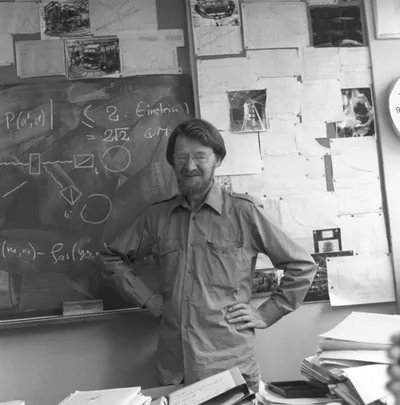 John Stewart Bell1928–1990 · Physics
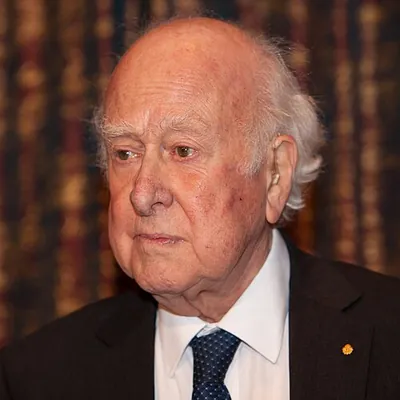 Peter Higgs1929–2024 · Physics
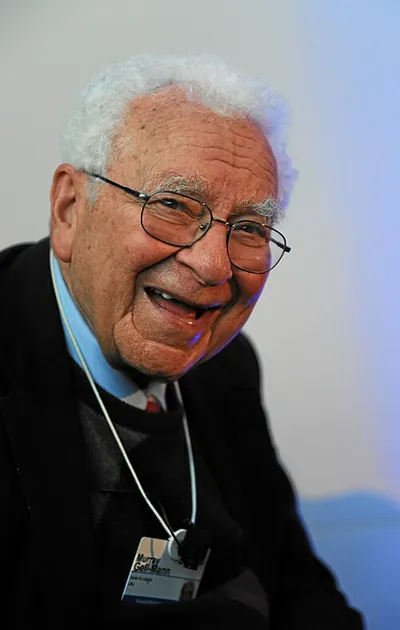 Murray Gell-Mann1929–2019 · Physics
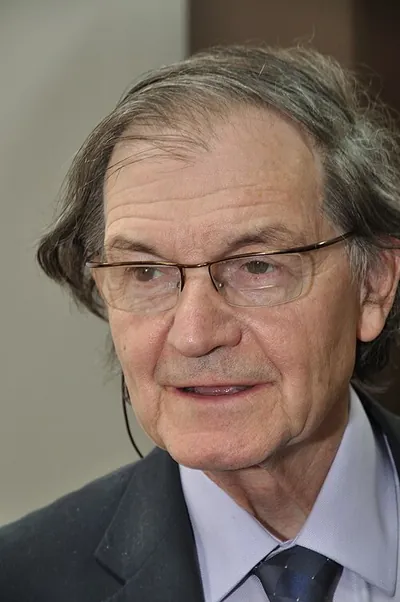 Roger Penrose1931 · Physics
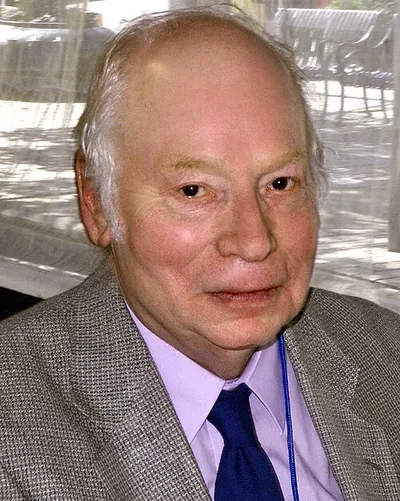 Steven Weinberg1933–2021 · Physics
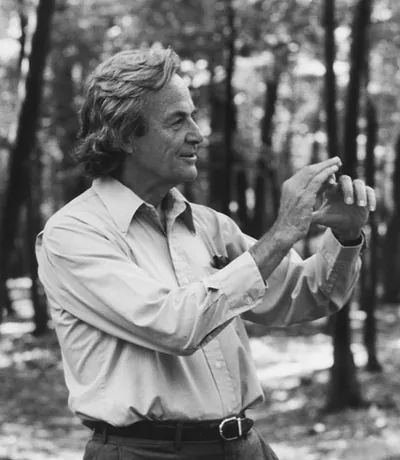 Richard Feynman1918–1988 · Physics