
Agnes Arber
British plant morphologist and historian of botany, also a philosopher of biology · 1879–1960
- Born
- February 23, 1879
- Died
- March 22, 1960
- Country
- United Kingdom
- Section
- Biology
Biography
Agnes Robertson Arber (London, 1879 - Cambridge, 1960) was a British plant morphologist, which means she studied the form and structure of plants, and she also worked on the history and philosophy of biology. She spent the last fifty-one years of her life in Cambridge. In 1946 she became the first woman botanist elected a Fellow of the Royal Society, Britain's oldest scientific academy, and the third woman overall to receive that honour. Her work matters because she combined careful laboratory study with an unusually thoughtful account of how a scientist looks at what she studies.
She was born in Primrose Hill, north London, the first child of Henry Robert Robertson, a Scottish-born artist with a keen interest in botany, and of Agnes Lucy Turner. Her father gave her drawing lessons as a small child, a skill that later allowed her to illustrate her own publications. At the age of eight she started at the North London Collegiate School, founded by Frances Buss, one of the leading campaigners for girls' education. There, under the science teacher Edith Aitken, she developed a fascination with plants. At thirteen she read George Edward Massee's short book Plant Life, and at about the same time she came to love the writings of Goethe, a passion that stayed with her all her life. While still at school she found an 1578 edition of Lyte's Herbal, an English version of work by the botanist Rembert Dodoens, which sparked her interest in early printed herbals.
Through the school's science club she met Ethel Sargant, a specialist in the anatomy of plant embryos, who invited her to work in her private laboratory. Sargant would become her mentor and colleague for many years. In 1897 Arber entered University College London, where she gained her BSc in 1899, and then moved to Newnham College, Cambridge, where she took further courses under teachers including Albert Seward, Francis Darwin and Frederick Blackman. One of the most influential figures was William Bateson, who helped bring the work of Gregor Mendel on inheritance back into view.
Between 1902 and 1903 she worked for Sargant as a research assistant on the structure of seedlings, and in 1903 she published her first paper, on the anatomy of a cycad of the genus Macrozamia. She then turned to gymnosperms, a group that includes pines and other seed plants without flowers, both living and fossil. She earned her doctorate in 1905 and was awarded a research fellowship by Newnham College in 1912.
In 1909 she married Edward Alexander Newell Arber, a palaeobotanist who had once taught her and was nine years older. The couple settled in Cambridge and shared many interests. They had one daughter, Muriel, whose birth year is given as 1912 in some sources and 1913 in others. Her husband died in 1918 after a long period of ill health, and Agnes never remarried.
Her first book, Herbals, their origin and evolution (1912), traces how printed herbals changed between 1470 and 1670, and links the emergence of botany as a discipline to the way plants were described, classified and identified. It was revised in 1938 and again in 1986 and remains a standard work on the subject. Her second book, Water Plants (1920), compared aquatic plants by their structural differences and was the first general study of them. She drew about a third of its illustrations herself. In 1925 she published The Monocotyledons, completing a manual that Sargant had begun on this group, which includes lilies and grasses. In it she set out her methods and the principles behind them, distinguishing between pure and applied morphology.
After the Balfour Laboratory closed in 1927, she set up a small laboratory in a back room of her house, because the head of the botany department, Albert Seward, said the school had no space for her. In 1934 she published The Gramineae, a study of cereals, bamboo and grasses that opens with their relationship to human history. Between 1930 and 1942 she also examined the structure of flowers. By the 1940s she had largely stopped bench research and turned to philosophy. The Natural Philosophy of Plant Form (1950) and The Mind and the Eye (1954) examine the nature of biological research and the way a specialist observes her subject.
Her legacy lies in joining exact botanical work with reflection on the scientist's craft. In 1946 she oversaw the publication of Goethe's botanical writings, and in 1948 she received the Linnean Medal, becoming the first woman to win it. She died in Cambridge in 1960 and was buried in the churchyard of St Andrew's, Girton.
Main contributions
- 1912Herbals, their origin and evolution: a history of printed herbals from 1470 to 1670 and of how botany emerged as a discipline.
- 1920Water Plants: the first general study of aquatic flowering plants, compared by their structural differences.
- 1925The Monocotyledons: a morphological manual on monocots, a group that includes lilies and grasses.
- 1934The Gramineae: a study of the life cycles of cereals, bamboo and grasses, and their links to human history.
- 1950The Natural Philosophy of Plant Form: a philosophical reflection on the form of plants.
- 1954The Mind and the Eye: a study of the nature of biological research and the biologist's point of view.
Teachers and students
Trivia and anecdotes
A herbal at school
According to her biography, she came across an 1578 edition of Lyte's Herbal while still at school, a find that led her to the history of printed herbals.
A denied presidency
In 1921 the botany section of the British Association for the Advancement of Science denied her the presidency. She withdrew her candidacy and resigned as the association's secretary, in an episode widely read as hostility towards a woman from Cambridge.
Illustrator of her own books
Inheriting her father's love of drawing, she made about a third of the illustrations for Water Plants herself.
Their contemporaries
While Agnes Arber was alive (1879–1960)…
Alive at the same time
Discovered or invented in those years
- 1884CarA road vehicle with four wheels and its own engine, mainly built to carry people.
- 1903AirplaneA fixed-wing aircraft, heavier than air, powered by engines or rockets, that stays aloft because its wings generate lift.
- 1925TelevisionA system that sends moving pictures and sound over distance and shows them on a receiver, the television set.
- 1925Quantum mechanicsPhysical theory describing how matter and light behave at atomic and subatomic scales, where energy is exchanged in minimal packets and results are expressed as probabilities.
- 1931Big BangA cosmological model describing how the universe expanded from an early state of extreme density and temperature, about 13.8 billion years ago.
- 1945ComputerA programmable machine that takes in data, processes it by following stored instructions, and produces results, able to switch tasks simply by running different software.
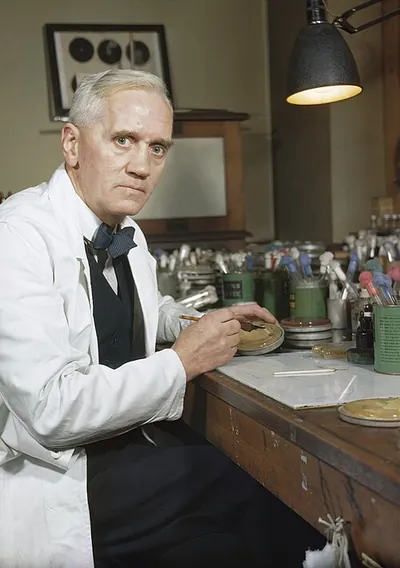 Alexander Fleming1881–1955 · Biology
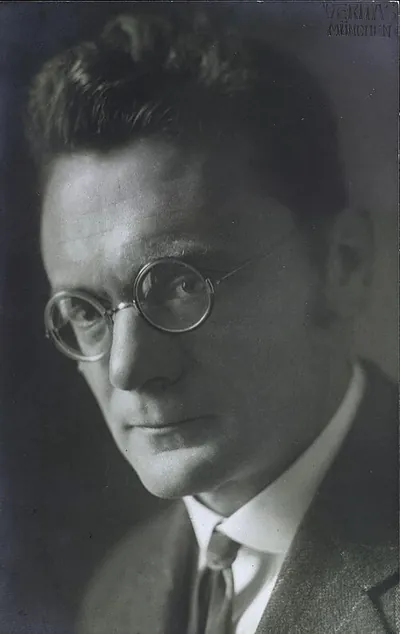 Karl von Frisch1886–1982 · Biology
 Hans Spemann1869–1941 · Biology
 Hermann Joseph Muller1890–1967 · Biology
 Thomas Hunt Morgan1866–1945 · Biology
 J.B.S. Haldane1892–1964 · Biology
