
Harriet Margaret Louisa Bolus
South African botanist and taxonomist, specialist in succulent aizoaceae plants · 1877–1970
- Born
- July 31, 1877
- Died
- April 5, 1970
- Country
- South Africa
- Section
- Biology
Biography
Harriet Margaret Louisa Bolus, known as Louisa, was a South African botanist who spent much of her life studying and classifying the plants of the Cape region. Working between the late nineteenth and the late twentieth century, she is best remembered for naming 1,494 species, more land plant species than any other female scientist.
She was born in Burgersdorp, in the Cape Province, on 31 July 1877, to British-born parents. Her grandfather, William Kensit, was a serious amateur botanist who collected specimens in South Africa, and that environment shaped her early interests. She attended the Collegiate Girls' High School in Port Elizabeth, earned a teaching credential in 1899 and was awarded a degree in literature and philosophy in 1902 by the University of the Cape of Good Hope, later part of the University of South Africa.
While still a student she worked as an assistant to Harry Bolus, her great-aunt's husband, in the herbarium he had founded. In 1903 she was appointed curator of the Bolus Herbarium, a post she held until 1955. For about ten years before Harry Bolus died in 1911, she also acted as his secretary and companion. Her research focused on the aizoaceae family, especially the genus Mesembryanthemum, whose members are fleshy succulents from dry regions. Describing a species means comparing specimens, noting their features and giving them a Latin name that other scientists accept, and this was the core of her daily work.
Her first book, Elementary Lessons in Systematic Botany, appeared in 1919. Notes on Mesembryanthemum and Some Allied Genera and A Book of South African Flowers followed, both in 1928. She contributed to many botanical journals, edited the Annals of the Bolus Herbarium and hired the botanical artist Louise Guthrie for the herbarium staff.
In 1913 she became a founding member of the council of the Botanical Society of South Africa, and she was a fellow of the Royal Society of South Africa and the Linnean Society of London. She is regarded as a pioneer of nature study classes at the Kirstenbosch National Botanical Garden. In 1912 she married Frank Bolus, son of Harry Bolus, and she was widowed in 1945. She died in Cape Town on 5 April 1970.
Her legacy is twofold: a herbarium that remains a reference, and a large body of described species that makes her the scientific author of more land plant species than any other woman. Several plants bear her name, including the genus Kensitia, now considered a synonym of Erepsia.
Main contributions
- 1903Appointed curator of the Bolus Herbarium, a post she held until 1955.
- 1919Elementary Lessons in Systematic Botany, her first book, a manual of systematic botany.
- 1928Notes on Mesembryanthemum and Some Allied Genera, a study of Mesembryanthemum and related genera.
- 1928A Book of South African Flowers, a popular work on the flowers of South Africa.
- Naming of 1,494 land plant species over the course of her career.
Teachers and students
Trivia and anecdotes
A family herbarium
She worked in her father-in-law's herbarium while still a student and ended up running it for more than half a century.
Plants named after her
The genus Kensitia was created in her honour, though it is now treated as a synonym of Erepsia. The genus Bolusanthus also bears her name.
An honorary doctorate
In 1936 Stellenbosch University awarded her an honorary doctorate in science.
Their contemporaries
While Harriet Margaret Louisa Bolus was alive (1877–1970)…
Alive at the same time
Discovered or invented in those years
- 1884CarA road vehicle with four wheels and its own engine, mainly built to carry people.
- 1903AirplaneA fixed-wing aircraft, heavier than air, powered by engines or rockets, that stays aloft because its wings generate lift.
- 1925TelevisionA system that sends moving pictures and sound over distance and shows them on a receiver, the television set.
- 1931Big BangA cosmological model describing how the universe expanded from an early state of extreme density and temperature, about 13.8 billion years ago.
- 1945ComputerA programmable machine that takes in data, processes it by following stored instructions, and produces results, able to switch tasks simply by running different software.
- 1969InternetA global network of interconnected computer networks that communicate using the TCP/IP protocol suite.
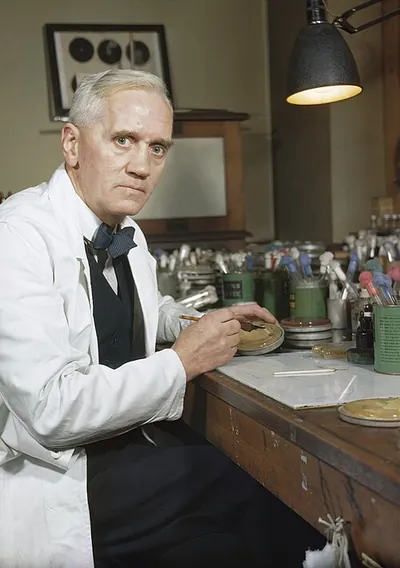 Alexander Fleming1881–1955 · Biology
 Hans Spemann1869–1941 · Biology
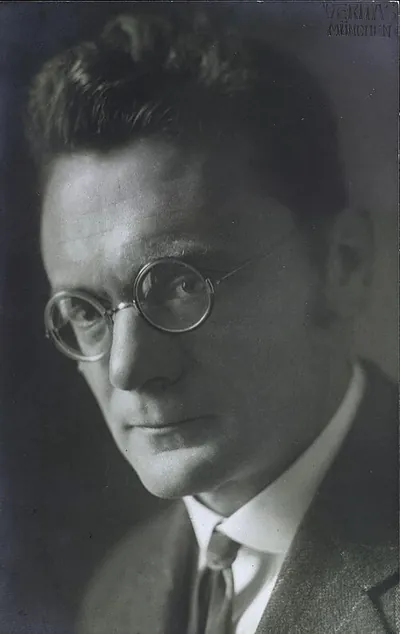 Karl von Frisch1886–1982 · Biology
 Thomas Hunt Morgan1866–1945 · Biology
 Hermann Joseph Muller1890–1967 · Biology
 J.B.S. Haldane1892–1964 · Biology
