
Harvey Fletcher
American physicist, known as the father of stereophonic sound and a pioneer of audiology · 1884–1981
- Born
- September 11, 1884
- Died
- July 23, 1981
- Country
- United States
- Section
- Technology and communications
Biography
Harvey Fletcher (born in Provo, Utah, in 1884; died in 1981) was an American physicist who spent much of his career studying sound, speech and hearing. He is known as the father of stereophonic sound, and his work laid foundations for modern audiology and for the way recorded sound is reproduced today. He worked in an era when radio, sound film and telephony were expanding quickly, and his research helped explain how the voice is heard and carried across a line.
Fletcher grew up in Provo and finished high school at Brigham Young High School in 1904. He then studied at Brigham Young University, graduating in 1907. He went on to the University of Chicago, where he earned a PhD in 1911, the first physics student there to do so summa cum laude. His advisor was Robert Millikan, and the two worked on methods for measuring the electric charge of the electron.
That partnership later became one of the most debated episodes of his life. The oil drop experiment, which measured the electron's charge and earned Millikan the 1923 Nobel Prize in Physics, is usually credited to Millikan alone. According to the available accounts, Fletcher contributed detailed work to the apparatus, drawing on his experience with projection lanterns, and in return Millikan took the main credit while Fletcher's dissertation included a related result under his own name. Fletcher kept this arrangement private until he died.
After his doctorate he returned to BYU and headed its physics department from 1911 to 1916. He then joined Western Electric as a researcher and, in 1929, helped found the Acoustical Society of America, whose first president he became. In 1933 he moved to the engineering research department of Bell Telephone Laboratories, where he stayed until 1949. There he became absorbed in acoustics, the study of how sound waves travel and how the ear perceives them.
His best-known work concerns speech perception. He showed that the features of speech are spread across a wide range of frequencies, and he devised the articulation index, a rough measure of how good a voice channel is. He also developed the equal-loudness contours, often called Fletcher–Munson curves, which map how loud different pitches seem to the ear, along with the idea of the critical band, the range within which the ear blends nearby sounds.
At Bell Labs he oversaw research into electrical sound recording. Between 1931 and 1932, working with conductor Leopold Stokowski, the team made the first stereophonic recordings, the first live stereo transmission and a first vinyl disc. He also built the 2-A audiometer, which measures hearing ability, an early electronic hearing aid and an artificial larynx.
Fletcher returned to BYU in 1952 as research director and served as the first dean of its new college of physics and engineering sciences until 1958. He was president of the American Physical Society and received honours such as the Louis E. Levy Medal from the Franklin Institute in 1924. He was an honorary fellow of the Acoustical Society of America from 1949 and a member of the National Academy of Sciences.
He was a devout member of The Church of Jesus Christ of Latter-day Saints. He died in 1981 after a stroke.
His legacy lives on in acoustics, audiology and sound technology. BYU named its engineering laboratory building after him, and in 2016 he received a posthumous technical Grammy for his stereophonic sound work.
Main contributions
- 1929Founding of the Acoustical Society of America, a scientific society devoted to the study of sound, which he helped set up.
- 1931First stereophonic recordings, made with Leopold Stokowski, which let sound be placed across a left-to-right space.
- 1932First live stereo sound transmission and the making of an early vinyl record within the same research programme.
- The 2-A audiometer, an instrument that measures a person's hearing ability precisely.
- Equal-loudness contours, which describe how the ear perceives the loudness of sounds at different frequencies.
- The articulation index, a rough measure of how well a channel carries speech.
Teachers and students
Trivia and anecdotes
A secret agreement
According to the sources, Fletcher gave up the spotlight on the oil drop experiment to Millikan in exchange for credit in his dissertation, and kept this quiet until he died.
An honour from the acoustics society
He was made an honorary fellow of the Acoustical Society of America in 1949, the second person to receive the honour after Thomas Edison, who had been given it twenty years earlier.
Their contemporaries
While Harvey Fletcher was alive (1884–1981)…
Alive at the same time
Discovered or invented in those years
- 1884CarA road vehicle with four wheels and its own engine, mainly built to carry people.
- 1903AirplaneA fixed-wing aircraft, heavier than air, powered by engines or rockets, that stays aloft because its wings generate lift.
- 1925TelevisionA system that sends moving pictures and sound over distance and shows them on a receiver, the television set.
- 1931Big BangA cosmological model describing how the universe expanded from an early state of extreme density and temperature, about 13.8 billion years ago.
- 1945ComputerA programmable machine that takes in data, processes it by following stored instructions, and produces results, able to switch tasks simply by running different software.
- 1969InternetA global network of interconnected computer networks that communicate using the TCP/IP protocol suite.
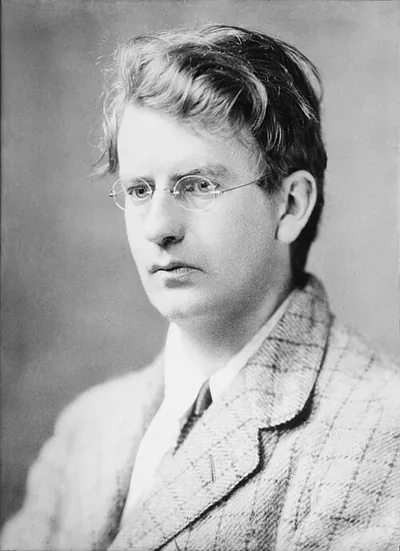 John Logie Baird1888–1946 · Technology and communications
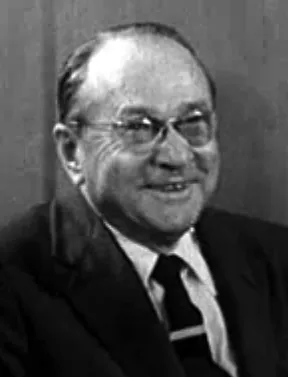 Vladimir K. Zworykin1888–1982 · Technology and communications
 Edwin Howard Armstrong1890–1954 · Technology and communications
 Vannevar Bush1890–1974 · Technology and communications
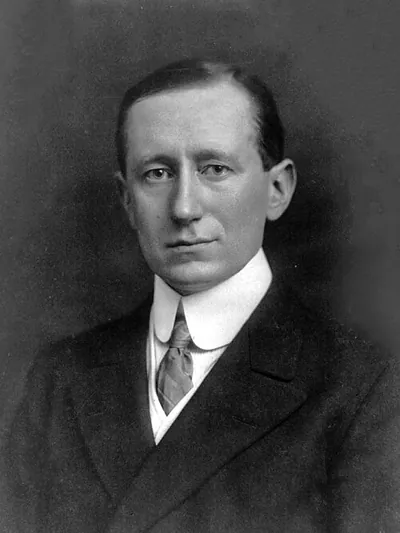 Guglielmo Marconi1874–1937 · Technology and communications
