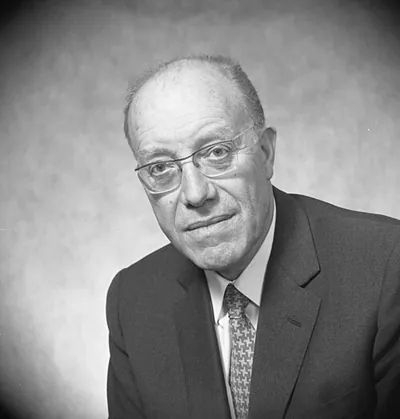
Heinz Maier-Leibnitz
German physicist, pioneer of nuclear spectroscopy and promoter of the research reactors at Garching and the Laue-Langevin Institute · 1911–2000
- Born
- March 28, 1911
- Died
- December 16, 2000
- Country
- Germany
- Section
- Physics
Biography
Heinz Maier-Leibnitz (Esslingen am Neckar, 1911 - Allensbach, 2000) was a German physicist whose career spanned the mid-twentieth century. He is remembered for combining basic research in nuclear physics with the construction of large scientific facilities, and for helping West Germany acquire research reactors.
He studied physics at the universities of Stuttgart and Göttingen, where he took his doctorate in 1935 under James Franck, a Nobel laureate, and Georg Joos. Franck had left Germany in 1933, so Joos became the central figure in his supervision. During his early work he discovered metastable negative helium ions, atoms carrying an extra electron that remain in an excited state for a brief time. This knowledge later found uses in particle accelerators.
Shortly after his doctorate he became an assistant to Walther Bothe, director of the Institute of Physics at the Kaiser Wilhelm Institute for Medical Research in Heidelberg. Bothe had come to know him on a recruiting visit to Göttingen, where Robert Wichard Pohl and Georg Joos had praised his intelligence and creativity. In Heidelberg he worked alongside Wolfgang Gentner, who became his mentor and a close friend. His research covered nuclear spectroscopy, which studies the energy of radiation emitted by atomic nuclei; coincidence measurements, which register electrons and gamma rays arriving together to identify a given process; radioactive tracers, atoms that can be followed through a sample or a living body; and the conservation of energy in Compton scattering, where a photon transfers part of its energy to an electron.
The war interrupted this work. Early on he served in German air defence and then as a meteorologist at air bases in France. In 1942 he returned to Bothe, who had taken part in the German nuclear energy project, known as the Uranium Club, since 1939. After the war the institute suffered from wartime damage and Allied occupation policies. Maier-Leibnitz left for North America in spring 1947 and rejoined Bothe's team in 1948 when his contract ended. He also began studying positron annihilation in solids, a technique that reveals how electrons bound in atoms are distributed in momentum.
In 1952 he succeeded Walther Meissner in the chair of technical physics at the Munich Technical University. There he built a school of nuclear solid-state physics that carries his name. Under his guidance the physics teaching at the University of Munich was reorganised, and a Physics Department was formed in 1965. One of his early appointments was Nikolaus Riehl, who had been taken to the Soviet Union in 1945 to work on the Soviet atomic bomb and returned to Germany in 1955. Riehl was an expert in uranium purification and helped create new research facilities.
His most visible achievement was the Munich Research Reactor, the first nuclear reactor built in Germany. Constructed at Garching between 1956 and 1957, it was nicknamed the Atomei, or atomic egg, after its shape. Rather than focusing on reactor physics alone, it was mainly used as a source of neutrons, uncharged particles that probe matter, and became a flexible tool for many scientific fields. The large Garching research campus grew around it. A second reactor, FRM II, reached its first criticality, the point at which a self-sustaining chain reaction begins, four years after his death.
Maier-Leibnitz served in the working groups of the German Atomic Energy Commission, chaired by Werner Heisenberg. He was especially active in the reactor group, which was regarded as the most influential. He also chaired a special committee that designed the German nuclear programme, making him one of its key figures. His instrumental expertise, particularly in neutron optics, led him to see early that the neutron flux at the Munich reactor was too low for some experiments. With Louis Néel he pushed for a Franco-German high-flux neutron source, which led to the founding of the Laue-Langevin Institute in Grenoble in 1967, named after Max von Laue and Paul Langevin.
In April 1957 he signed the Göttingen Manifesto, in which eighteen leading German nuclear scientists asked their government to commit to not producing nuclear weapons. His public service continued with the presidency of the International Union of Pure and Applied Physics from 1972 to 1975 and the presidency of the German Research Foundation from 1974 to 1979. After twenty-seven years at the Munich Technical University he became emeritus in 1979. As a hobby he enjoyed cooking and wrote a cookbook.
His legacy lives on in the Garching reactor, the Laue-Langevin Institute, the school of nuclear physics he led, and the Heinz Maier-Leibnitz Prize, awarded each year since 1979 to young German researchers.
Main contributions
- 1935Discovery of metastable negative helium ions, atoms that stay briefly in an excited state before losing their extra electron.
- 1957Start-up of the Munich Research Reactor, the first nuclear reactor built in Germany, mainly used as a neutron source.
- 1957Signing of the Göttingen Manifesto, in which German scientists asked that no nuclear weapons be produced.
- 1967Founding of the Laue-Langevin Institute in Grenoble, a centre built around a high-flux neutron source.
Teachers and students
Trivia and anecdotes
The atomic egg
The Garching reactor was nicknamed the Atomei, or atomic egg, because of its distinctive shape.
A cookbook
As a hobby, Maier-Leibnitz enjoyed cooking and went on to publish a cookbook.
Their contemporaries
While Heinz Maier-Leibnitz was alive (1911–2000)…
Alive at the same time
Discovered or invented in those years
- 1916Black holeA region of space where gravity is so strong that nothing, not even light, can escape once it crosses a certain boundary.
- 1925TelevisionA system that sends moving pictures and sound over distance and shows them on a receiver, the television set.
- 1925Quantum mechanicsPhysical theory describing how matter and light behave at atomic and subatomic scales, where energy is exchanged in minimal packets and results are expressed as probabilities.
- 1931Big BangA cosmological model describing how the universe expanded from an early state of extreme density and temperature, about 13.8 billion years ago.
- 1945ComputerA programmable machine that takes in data, processes it by following stored instructions, and produces results, able to switch tasks simply by running different software.
- 1969InternetA global network of interconnected computer networks that communicate using the TCP/IP protocol suite.
 Lev Landau1908–1968 · Physics
 Hideki Yukawa1907–1981 · Physics
 Maria Göppert Mayer1906–1972 · Physics
 Hans Bethe1906–2005 · Physics
 Richard Feynman1918–1988 · Physics
 J. Robert Oppenheimer1904–1967 · Physics
