Michael Fisher
British physicist, chemist and mathematician, a leading figure in statistical physics and critical phenomena · 1931–2021
- Born
- September 3, 1931
- Died
- November 26, 2021
- Country
- United Kingdom
- Section
- Physics
Biography
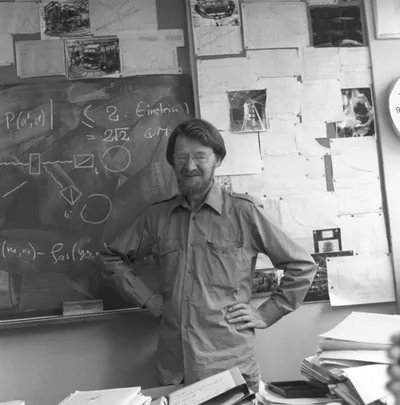
Michael Ellis Fisher (born in Fyzabad, Trinidad and Tobago, 3 September 1931; died 26 November 2021) was a physicist, chemist and mathematician whose work reshaped statistical physics, the branch of science that explains how the behaviour of vast numbers of particles adds up to the properties of matter. He is best remembered for his theory of phase transitions and critical phenomena, and his ideas reached chemists as well as physicists.
Fisher took his first degree at King's College London in 1951 and stayed on to complete a PhD in physics in 1957. His doctoral research dealt with analogue computing, a way of solving mathematical problems with physical models, and he carried it out under Donald MacCrimmon MacKay. He joined the college staff as a lecturer the following year and became a full professor in 1965.
In 1966 he moved to Cornell University in the United States, where he held posts in chemistry, physics and mathematics and chaired the chemistry department from 1975 to 1978. He became a Fellow of the Royal Society in 1971. In 1973 he and Jack Kiefer became the first two Cornell faculty members named Horace White Professors. He also served as secretary of the university senate. Although he spent decades working in America, he kept his British citizenship, which is why in 1983 he was elected as a foreign associate of the US National Academy of Sciences in the chemistry section.
His central subject is what happens when a substance changes state, such as water boiling or a magnet losing its magnetism when heated. Near the critical point, the difference between the two states fades and fluctuations appear at every scale. Fisher helped show that these behaviours obey scaling laws and can be described by numbers called critical exponents, which may be shared by very different systems.
His work connected chemists and physicists who had been studying related problems in separate vocabularies. The Wolf Prize committee credited him with bringing them together and giving them a common language. He shared the 1980 prize with Kenneth G. Wilson and Leo Kadanoff. Wilson and Kadanoff developed the renormalization group, a method for studying a system at different scales, and Fisher applied it to many of the problems that defined the field.
He lived in Ithaca, New York, and later in Maryland, with his wife Sorrel; they had four children. Two of them, Daniel S. Fisher and Matthew P. A. Fisher, also became theoretical physicists.
From 1987 he was based at the Institute for Physical Science and Technology at the University of Maryland. His other honours include the Boltzmann Medal of the International Union of Pure and Applied Physics in 1983, the Lars Onsager Prize of the American Physical Society in 1995, and the BBVA Foundation Frontiers of Knowledge Award in Basic Sciences in 2009.
His legacy lies in the methods physicists still use to describe complex systems near their critical points, and in the generations of researchers who worked within the framework he helped build.
Main contributions
- Theory of critical phenomena: explains how a substance's properties change as it approaches its critical point, where its two phases stop being distinct.
- Scaling laws: mathematical relations describing how a system behaves near its critical point when the scale of observation changes.
- Critical exponents: numbers that characterise a system's behaviour at the critical point and that can be shared by very different systems.
- Finite size effects: study of how results change when the system analysed is small rather than infinitely large.
- Application of the renormalization group to many phase transition problems, a technique that analyses a system across different scales.
Teachers and students
Studied under:
Taught:
Trivia and anecdotes
From analogue computing to statistical physics
His doctoral thesis dealt with analogue computing, a field far removed from the critical phenomena for which he later became famous.
A praise in committee language
The Wolf Prize committee wrote that he was still at the height of his powers and creativity when he received the award in 1980.
A family of physicists
Two of his four children followed him into theoretical physics, one at Stanford and the other at the University of California, Santa Barbara.
Their contemporaries
While Michael Fisher was alive (1931–2021)…
Alive at the same time
Discovered or invented in those years
- 1931Big BangA cosmological model describing how the universe expanded from an early state of extreme density and temperature, about 13.8 billion years ago.
- 1932NeutronA subatomic particle with no net electric charge, found in the nucleus of almost every atom alongside protons.
- 1945ComputerA programmable machine that takes in data, processes it by following stored instructions, and produces results, able to switch tasks simply by running different software.
- 1969InternetA global network of interconnected computer networks that communicate using the TCP/IP protocol suite.
- 1973Mobile phoneA handheld wireless phone that lets people make and receive calls while moving across a cellular network area.
- 1989World Wide WebA system of linked documents and resources, connected by hyperlinks and accessed over the Internet with web browsers.
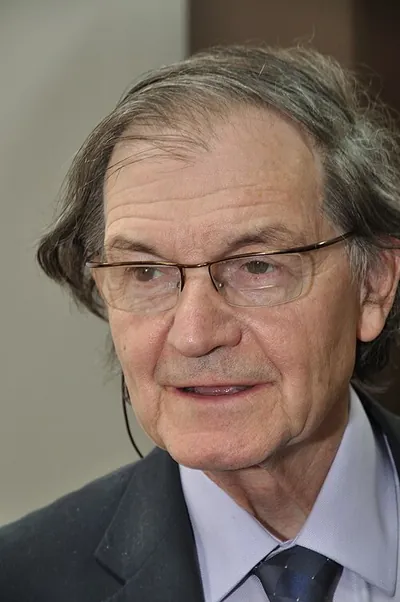 Roger Penrose1931 · Physics
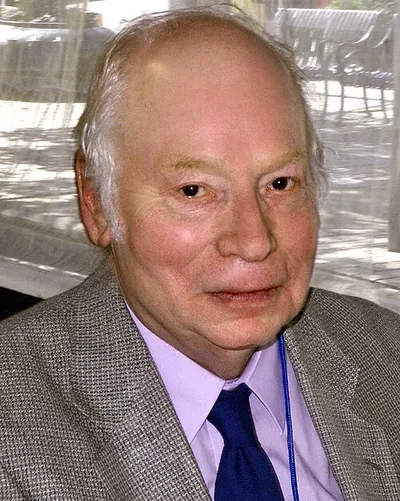 Steven Weinberg1933–2021 · Physics
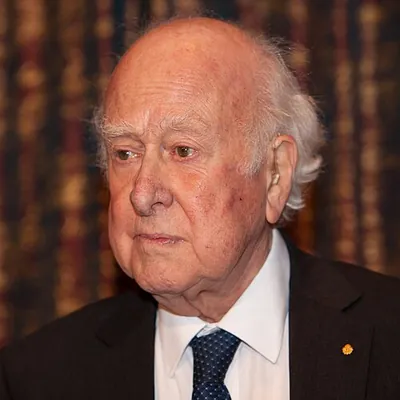 Peter Higgs1929–2024 · Physics
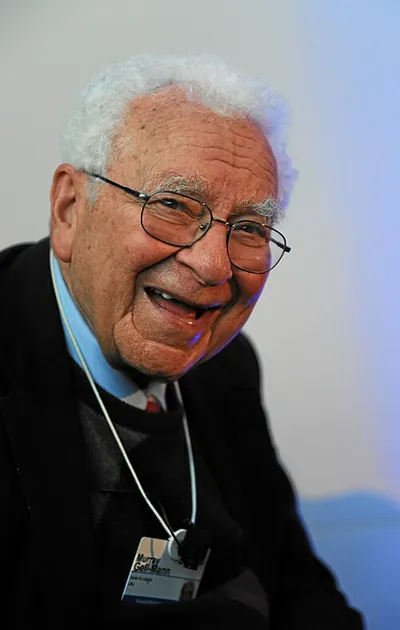 Murray Gell-Mann1929–2019 · Physics
 John Stewart Bell1928–1990 · Physics
 Stephen Hawking1942–2018 · Physics