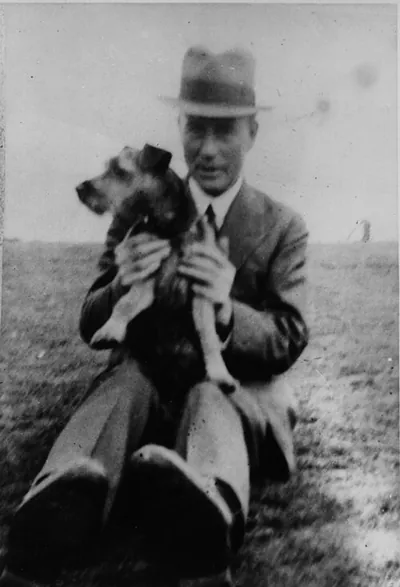
Frederick Griffith
British army medical officer and bacteriologist who discovered bacterial transformation · 1877–1941
- Born
- 1877
- Died
- April 17, 1941
- Country
- United Kingdom, United Kingdom of Great Britain and Ireland
- Section
- Biology
Biography
Frederick Griffith was a British medical officer and bacteriologist whose experiments in the 1920s revealed that bacteria could permanently change their form by taking in something from dead cells of another type. He did not know what that something was, but his work is now regarded as one of the first demonstrations that hereditary material can pass from one cell to another. He lived through two world wars and worked in modest conditions, which shaped both his methods and his reputation.
Griffith was born in late 1877 in Prescot, then in Lancashire and now part of Merseyside. He studied at the University of Liverpool and then worked at the Liverpool Royal Infirmary, at a laboratory linked to the university, and for the Royal Commission on Tuberculosis. These posts gave him hands-on training in diagnosing infectious diseases and in growing bacteria in the laboratory, a discipline that was still young in Britain.
In 1910 the British government hired him for the laboratory of the local government board, which was later absorbed into the Ministry of Health. Funding for research was scarce, especially during the First World War, and the equipment was basic. Griffith and his colleague William M. Scott made the most of what they had. They received samples of pneumococci from patients across the country, sorted them by type, and looked for patterns in how pneumonia spread. They also used mice to study how the disease developed in the body.
The pneumococcus, the bacterium Streptococcus pneumoniae, exists in two main forms. The smooth form, called S, is wrapped in a capsule, a sticky layer of sugar molecules that shields it from the immune system. The rough form, called R, lacks this capsule and rarely causes serious disease. Griffith found that mice injected with live S bacteria died of pneumonia within days, while mice given S bacteria killed by heat survived. When he mixed heat-killed S bacteria with live R bacteria, however, the mice sickened and died. Bacteria recovered from their blood were of the smooth type, and they kept that form across later generations. Griffith concluded that something from the dead smooth bacteria had altered the rough ones. He called it the transforming principle, without knowing whether it was a protein or a nucleic acid. He was cautious and published only results he considered secure. Oswald Avery, the leading American pneumococcus researcher, first suggested that Griffith's experiments had been contaminated, although other laboratories soon confirmed the findings.
Griffith also worked on other infections. In 1931 he co-authored a study of acute tonsillitis, and in 1934 he reported a detailed classification of Streptococcus pyogenes, the bacterium behind strep throat and several more serious conditions. He published relatively little, and his work was known mainly through careful, well-documented papers.
Griffith died on 17 April 1941 in London, during a German air raid in the Second World War, together with his friend and colleague William M. Scott. Accounts differ on the details. One memorial lecture places the death on the night of the raid, while another places it at his home in February of that year. His obituary in The Lancet mentioned his discovery briefly, but the British Medical Journal's obituary did not.
Griffith's legacy came to fruition in 1944, when Avery, Colin MacLeod and Maclyn McCarty showed that the transforming principle was DNA, deoxyribonucleic acid. This overturned the view that proteins in chromosomes carried heredity. Ten years later, in 1953, Watson and Crick's model of the DNA double helix explained how such a simple-looking molecule could carry the instructions for building proteins. Griffith did not live to see that answer, but his experiment opened the question.
Main contributions
- 1928Transforming principle: a harmless rough bacterium acquires a capsule and the smooth type's traits after exposure to material from killed smooth bacteria.
- 1931Study of acute tonsillitis, its complications and the bacteria involved.
- 1934Detailed serological classification of Streptococcus pyogenes, the streptococcus behind strep throat and other serious infections.
- 1944Identification of the transforming principle as DNA, made by Avery, MacLeod and McCarty building on Griffith's work.
Trivia and anecdotes
A lab on a shoestring
A frequently quoted remark from the period says Griffith and Scott could achieve more with a kerosene tin and a primus stove than many could with a palace.
A distinguished nephew
His nephew John Stanley Griffith received the Faraday Medal of the Royal Society, one of Britain's highest scientific honours.
Conflicting accounts of his death
Sources disagree on whether he died in the laboratory during the raid or at home weeks earlier, so the details should be treated with caution.
Their contemporaries
While Frederick Griffith was alive (1877–1941)…
Alive at the same time
Discovered or invented in those years
- 1884CarA road vehicle with four wheels and its own engine, mainly built to carry people.
- 1897ElectronA negatively charged subatomic particle found in every atom, and key to electricity and chemical bonding.
- 1903AirplaneA fixed-wing aircraft, heavier than air, powered by engines or rockets, that stays aloft because its wings generate lift.
- 1925TelevisionA system that sends moving pictures and sound over distance and shows them on a receiver, the television set.
- 1925Quantum mechanicsPhysical theory describing how matter and light behave at atomic and subatomic scales, where energy is exchanged in minimal packets and results are expressed as probabilities.
- 1931Big BangA cosmological model describing how the universe expanded from an early state of extreme density and temperature, about 13.8 billion years ago.
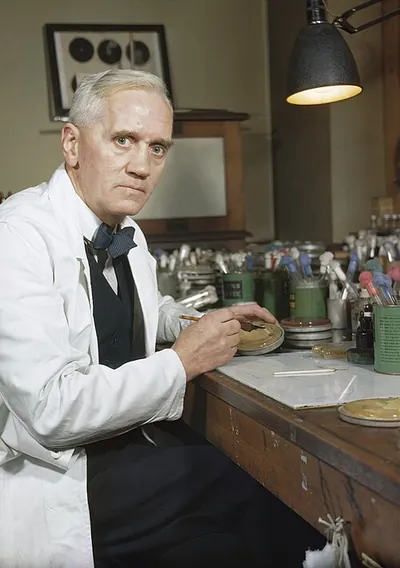 Alexander Fleming1881–1955 · Biology
 Hans Spemann1869–1941 · Biology
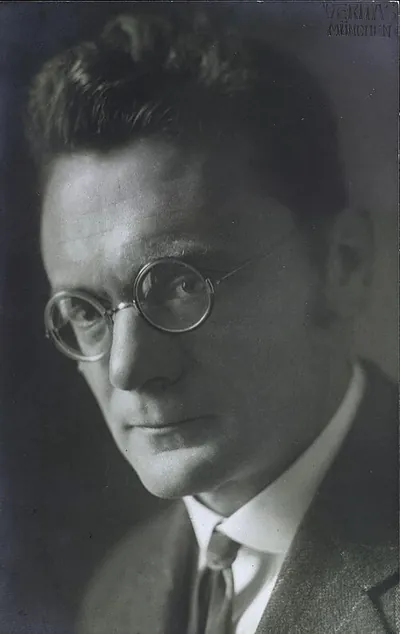 Karl von Frisch1886–1982 · Biology
 Thomas Hunt Morgan1866–1945 · Biology
 Hermann Joseph Muller1890–1967 · Biology
 J.B.S. Haldane1892–1964 · Biology
