
Oswald Avery
Canadian physician and medical researcher, a pioneer of molecular biology who showed that DNA carries heredity · 1877–1955
- Born
- October 21, 1877
- Died
- February 2, 1955
- Country
- Canada, United States
- Section
- Biology
Biography
Oswald Theodore Avery (Halifax, 1877 – 1955) was a Canadian-born physician and medical researcher who spent most of his career at the Rockefeller Institute in New York. He is remembered for a 1944 study showing that DNA, rather than proteins as many scientists assumed, is the material from which genes and chromosomes are built. He is considered one of the first molecular biologists, a scientist who studies life at the level of molecules.
Avery was born on October 21, 1877, in Halifax, Nova Scotia, to Joseph Francis Avery, a Baptist minister, and Elizabeth Crowdy, a couple who had emigrated from Britain a few years earlier. When he was about ten the family moved to the Lower East Side of Manhattan, where the young Oswald grew deeply involved in church life and learned the cornet. He became skilled enough to play with the National Academy of Music under Walter Damrosch in a performance of Dvořák's Symphony No. 5, From the New World. He studied at Colgate University, graduating in 1900 with a degree in the humanities, and then entered the medical school of Columbia University, from which he received his medical degree in 1904.
After a few years in general practice, which frustrated him because he could not cure many chronic illnesses, he joined the Hoagland Laboratory in 1907 as an associate director under Benjamin White. There he studied the bacteria found in yogurt and other fermented milk products, and later tuberculosis. His careful clinical work caught the attention of Rufus Cole at the Rockefeller Institute, who came to see him in person after Avery had turned down two written offers. He joined the institute in 1913 and remained there for the rest of his working life.
At Rockefeller he concentrated on pneumonia. Working with Cole and Alphonse Dochez, he helped develop an effective serum against a strain of pneumococcus, the bacterium that causes the disease, made from the blood of infected horses. His studies of the different types of pneumococcus, and of soluble substances found in the blood and urine of patients, led him to suspect that the complex sugars in the bacterial capsule played a role in how the immune system recognised an organism. This line of work prepared the ground for the question that made him famous.
The starting point was Frederick Griffith's 1928 observation that harmless pneumococci could acquire the ability to cause disease when mixed with heat-killed dangerous ones. Griffith described a mysterious 'transforming principle' able to change one kind of bacterium into another, but he could not say what it was. Avery, together with Colin MacLeod and Maclyn McCarty, set out to find it. They moved the experiments from mice to test tubes, broke open the cells with detergent and then stripped the extract of its parts one by one. An enzyme removed the sugar coat, and enzymes that digest proteins removed the proteins, yet the extract still transformed the bacteria. Removing the RNA did not stop the effect either. When only nearly pure DNA remained and they treated it with an enzyme that breaks down DNA, the transforming ability vanished. In 1944 they concluded that DNA was the transforming principle. The finding was not accepted at once, since many biologists still believed proteins carried heredity. Only during the 1950s, with work such as the Hershey and Chase experiment of 1952, did the role of DNA become firmly established.
Avery was nominated for the Nobel Prize for decades but never received it. The Swedish chemist Arne Tiselius later said he was the most deserving scientist never to win the award. He died in 1955. In 1976 a lunar crater was named after him. His lasting legacy is the demonstration that heredity resides in a specific chemical molecule, a discovery that opened the way to modern molecular genetics.
Main contributions
- 1915A classification of pneumococcus types and their link to lobar pneumonia, in which he suggested that some healthy people could carry the bacterium.
- 1923Studies of specific soluble substances in the blood and urine of pneumonia patients, which allowed the type of pneumococcus to be identified without waiting for a culture.
- 1944Demonstration that DNA is the transforming principle, that is, the molecule that carries genetic information.
Trivia and anecdotes
A young musician
As a boy Avery learned the cornet from a German musician at his church, and later played in a performance of Dvořák's Symphony No. 5.
Nicknames in the lab
While teaching student nurses at Hoagland Laboratory, he earned the nicknames 'The Professor' and 'Fess'.
A Nobel that never came
He was nominated for the Nobel Prize through the 1930s, 1940s and 1950s but never won it, a snub the Swedish chemist Arne Tiselius later called unfair.
Their contemporaries
While Oswald Avery was alive (1877–1955)…
Alive at the same time
Discovered or invented in those years
- 1884CarA road vehicle with four wheels and its own engine, mainly built to carry people.
- 1903AirplaneA fixed-wing aircraft, heavier than air, powered by engines or rockets, that stays aloft because its wings generate lift.
- 1925TelevisionA system that sends moving pictures and sound over distance and shows them on a receiver, the television set.
- 1925Quantum mechanicsPhysical theory describing how matter and light behave at atomic and subatomic scales, where energy is exchanged in minimal packets and results are expressed as probabilities.
- 1931Big BangA cosmological model describing how the universe expanded from an early state of extreme density and temperature, about 13.8 billion years ago.
- 1945ComputerA programmable machine that takes in data, processes it by following stored instructions, and produces results, able to switch tasks simply by running different software.
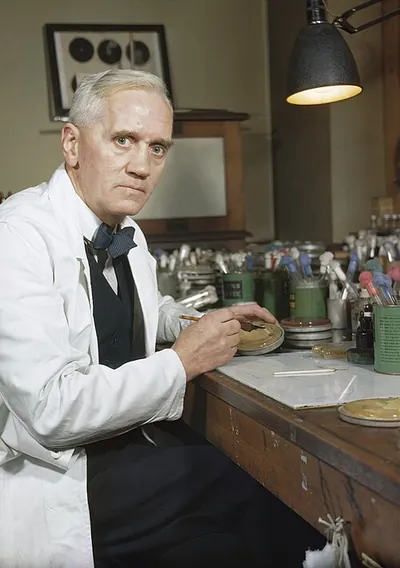 Alexander Fleming1881–1955 · Biology
 Hans Spemann1869–1941 · Biology
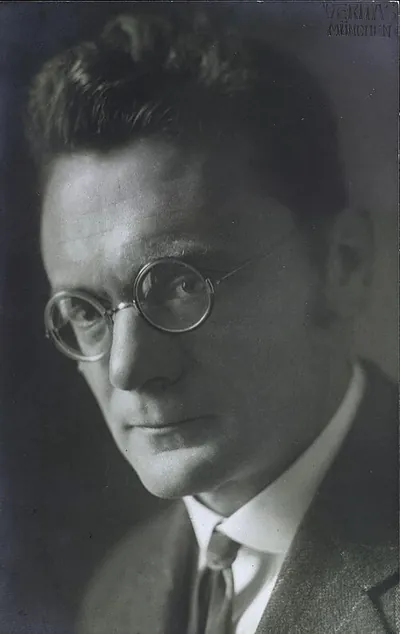 Karl von Frisch1886–1982 · Biology
 Thomas Hunt Morgan1866–1945 · Biology
 Hermann Joseph Muller1890–1967 · Biology
 J.B.S. Haldane1892–1964 · Biology
